Kora - Emil Kovács - Érd
| Dimensions | 995 × 373 × 190 mm |
|---|---|
| Name of musical instrument | |
| Type of musical instrument | |
| Typical place of occurrence | |
| Date of manufature of instrument | |
| Place of manufacture | |
| Made by | |
| Restored by | |
| Scale | |
| Number of strings | |
| How to play musical instrument | |
| Continent | |
| Country |
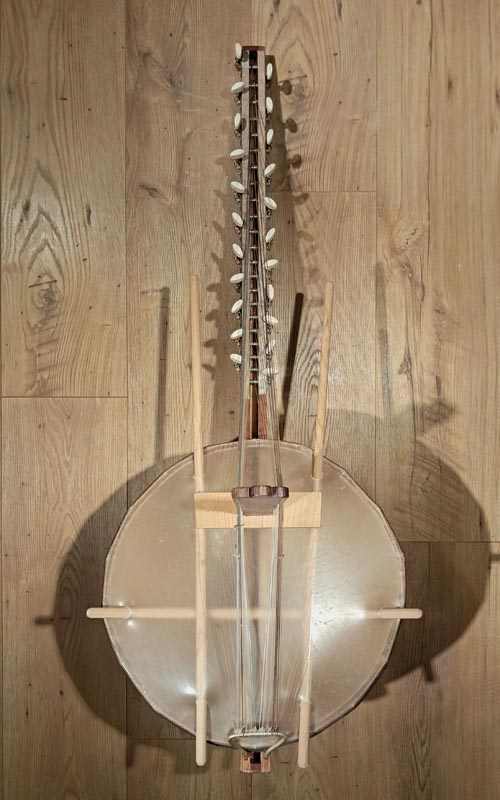
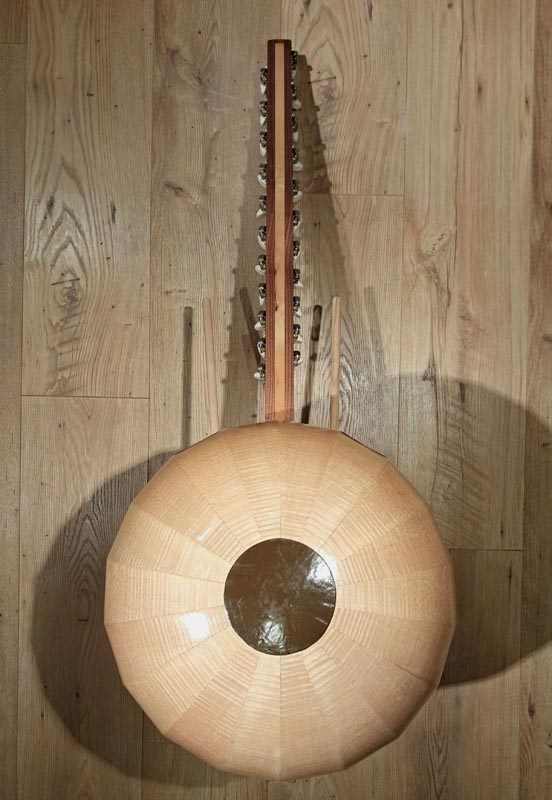
The kora is a West African plucked instrument similar in construction to the harp. The kora probably originated in Guinea-Bissau, Gambia and Senegal. It may have existed as early as the 15th century. Today it is known throughout West Africa.
In shape it resembles a lute or a spiked lute. It has a large soundboard made of half-cut goat-skin, covered like a drum, above which are stretched strings, 21 in all, not side by side but above each other, in a plane perpendicular to the top, on a toothed string-base. The neck of the instrument does not function here as a fingerboard, but only fixes the other end of the strings. The instrument is plucked in the same way as a harp, but in the opposite position. The strings, which can be made of antelope leather or, more recently, nylon, are diatonically tunable.
Early players are usually mandinka travelling musicians, found in Mali, Guinea, Senegal and Gambia.
The instrument features in the title of the Senegalese national anthem.
Emil Kovács
Born in 1948 in Budapest.
In 1966 he was taught by masters Bohák, Kürtös and Lehoczky at the Minőségi Hangszer K.T.Sz.
From 1968 to 1970 he worked as an apprentice.
In 1972 he retired from the army.
In 1972 Minőségi Hangszer K.T.SZ Musical Instrument K.T.SZ. changed its name and partly its profile.
He was offered a job at the Művészi Kézműves Vállalat, (there was also instrument production) “…new broom sweeps clean !” and was asked to take part in the training of apprentices.
At Művészi Kézműves Vállalat he was involved in training apprentices and preparing a curriculum for the apprenticeship school and a syllabus for the practical training.
In 1975, he wrote the textbook “Pengetős Szakmai Ismeretek”.
In 1976 he passed his master’s examination.
From 1978 he worked in the restauration workshops of the College of Music.
In 1982 he worked at the Lunacharsk Instrument Factory in Leningrad for a short period of professional training, at which time he began to work on historical instruments as a restorer.
From 1988 until its dissolution, he was a member of the National Association of Hungarian Artists. In 1992 the instrument repair workshops of the College of Music were closed down.
He then founded his own workshop. From then on, he designed and made all the details of his handicrafts independently.
Since 1978, he has made more than 200 new instruments. Most of them are Renaissance and Baroque bowed or plucked instruments, but he has also made folk instruments and modern bowed instruments, instruments of mandolin family, guitars and harps.
Since 1995, he has also been making acoustic jazz guitars with carved bodies exclusively for custom orders. His instruments are used in the USA, Japan, France, Italy, Germany, Switzerland, Austria and Israel.
In 2017 he was awarded a Gold String Master Award.
From 2020 he lives and works in Érd. 50% of his current work is as a restorer.

Reviews
There are no reviews yet.