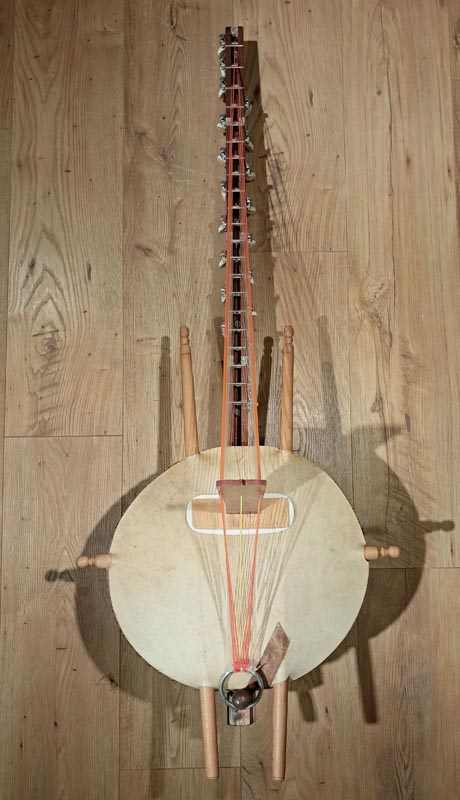
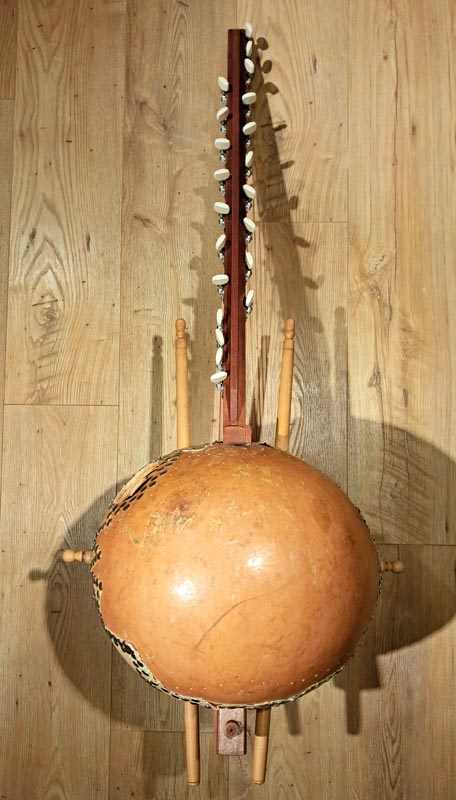
Kora 1.
| Dimensions | 1158 × 455 × 375 mm |
|---|---|
| Name of musical instrument | |
| Type of musical instrument | |
| Typical place of occurrence | |
| Date of manufature of instrument | |
| Place of manufacture | |
| Made by | |
| Restored by | |
| Scale | |
| Number of strings | |
| How to play musical instrument | |
| Continent | |
| Country |
The kora is a West African plucked instrument similar in construction to the harp. The kora probably originated in Guinea-Bissau, Gambia and Senegal. It may have existed as early as the 15th century. Today it is known throughout West Africa.
In shape it resembles a lute or a spiked lute. It has a large soundboard made of half-cut goat-skin, covered like a drum, above which are stretched strings, 21 in all, not side by side but above each other, in a plane perpendicular to the top, on a toothed string-base. The neck of the instrument does not function here as a fingerboard, but only fixes the other end of the strings. The instrument is plucked in the same way as a harp, but in the opposite position. The strings, which can be made of antelope leather or, more recently, nylon, are diatonically tunable.
Early players are usually mandinka travelling musicians, found in Mali, Guinea, Senegal and Gambia.
The instrument features in the title of the Senegalese national anthem.
no data

Reviews
There are no reviews yet.