Guitar - Contraguitar
| Dimensions | 1035 × 369 × 90 mm |
|---|---|
| Name of musical instrument | |
| Type of musical instrument | |
| Typical place of occurrence | |
| Date of manufature of instrument | |
| Place of manufacture | |
| Made by | |
| Restored by | |
| Scale | |
| Number of strings | |
| How to play musical instrument | |
| Continent | |
| Country |
Contraguitar
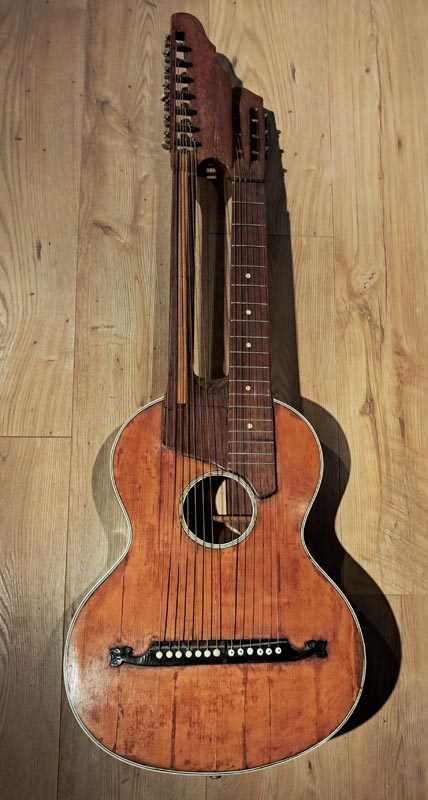
The contraguitar or Schrammel guitar is a special type of acoustic guitar with extended strings in the bass range. Its main area of distribution is the Alpine region. It is used both in Viennese music (Schrammel music, named after the brothers Johann and Josef Schrammel) and in Alpine folk music.
Construction
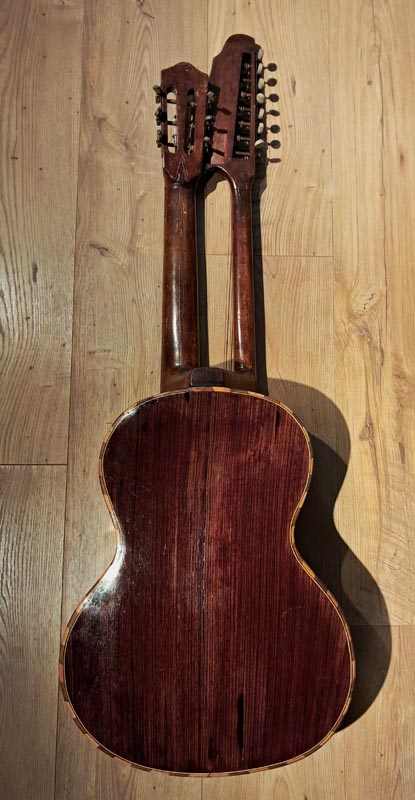
In addition to the normal guitar neck with six strings and fingerboard, the contraguitar usually has a second neck over which three to eleven bass strings are stretched freely (drone or contrabass strings). Typical here is the design with seven or nine contra-strings, i.e. a total of 13 or 15 strings. The bass strings are not fretted, but plucked open individually as on a harp guitar. The neck of the bass strings therefore does not need a fingerboard. The bass strings also vibrate passively as resonance strings and thus provide a fuller sound. This distinguishes the contraguitar from other double-neck guitars, which have fretted fingerboards on both necks.
In many cases, the double neck is equipped with a common neck foot, which is often screwed through the neck foot on the body with a screw and not firmly glued in as on a classical guitar, for example. This allows the string action, i.e. the distance from the fingerboard to the string, to be adjusted.
There are also known designs with a second headstock and bar support (Hermann Hauser, Otwin). There are instruments with the same length (63-68 cm) as well as those with an ascending (63-93 cm) bass scale. The standard scale length of the playing strings is 64 cm (e.g. Reisinger and Wesely), with newer instruments also 65 cm. The bodies of historical contraguitars are usually quite flat (8 cm) and overly wide compared to six-string guitars.
It is not uncommon for German makers (e.g. Raab from Munich) to produce guitars with a shape of arms. However, it is almost never found among Viennese instrument makers.
A large proportion of the contra and Schrammel guitars were originally designed for steel strings. However, the high tensile load – especially on old instruments – often leads to serious damage to the instrument’s statics.
Types and tunings
The contraguitar has two different tunings for the drone stringing:
The German version with an even number of strings, usually twelve, is tuned diatonically downwards from the lowest playing string like the German bass lute, i.e. ‘F-G-A-B-C-D | E-A-d-g-h-e’ on the twelve-string contrabass guitar. Most twelve-string contraguitars were made in the Vogtland region until the 1960s and thus continued the playing tradition of the German bass lutes, which slowly died out from 1930 onwards, for a certain period of time.
The so-called Schrammel guitar, which was developed in Vienna around the middle of the 19th century, can be recognised by its odd number of strings (13, 15 or 17, but sometimes different). The bass strings are usually tuned chromatically from E flat downwards, i.e. A-Hb-H-C-Db-D-Eb |E-A-d-g-h-e’ on the 13-string contrabass guitar. The Viennese instrument maker Johann Gottfried Scherzer is regarded as the developer of this instrument, who continued and significantly improved the experiments of his former teacher Johann Georg Stauffer from 1848. The best-known makers of Schrammel guitars are probably Ludwig Reisinger (born on 15 July 1863, Vienna) with his workshop in Westbahnstrasse and his successor Josef Wesely (born on 9 April 1904, Vienna). The workshop was taken over by Richard Witzmann (born 2 June 1953, Tyrol), who still runs it today.
Viennese Schrammel guitars have an ascending bass scale. The swirled headstock on the bass side is typical of the Viennese Schrammel guitar. A frequently found construction element is a rod (made of metal very rarely made of wood) inserted into the body, , which compensates for the string tension and improves the free vibration of the body. The Viennese guitar maker Franz Xaver Güttler (1857-1924), who opened his workshop in Vienna in 1899, was known for building powerful-sounding Schrammel guitars.
no data

Reviews
There are no reviews yet.