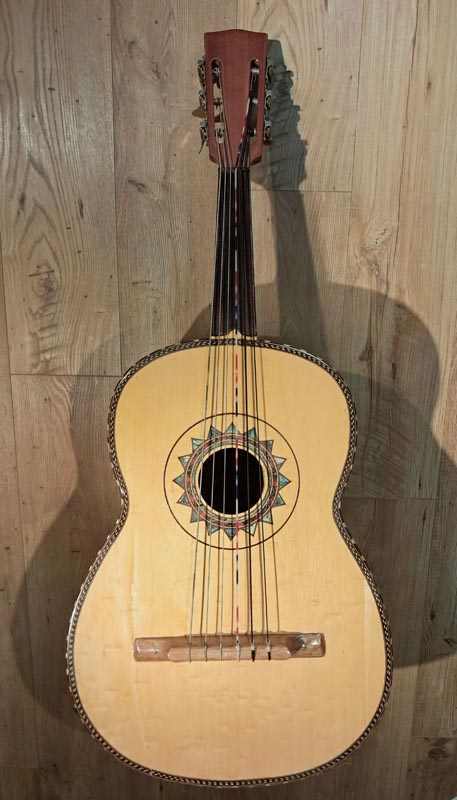
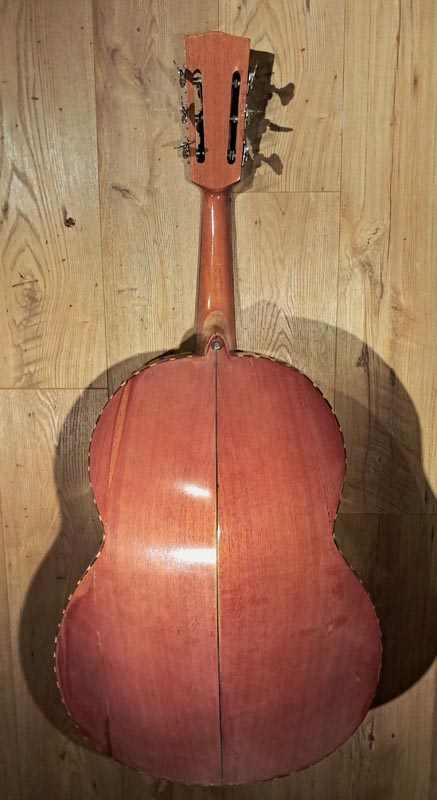
Guitarrón – Mexican
| Dimensions | 1130 × 473 × 247 mm |
|---|---|
| Name of musical instrument | |
| Type of musical instrument | |
| Typical place of occurrence | |
| Date of manufature of instrument | |
| Place of manufacture | |
| Made by | |
| Restored by | |
| Scale | |
| Number of strings | |
| How to play musical instrument | |
| Former owner | Géza Orczi (musician/instrument maker) |
| Continent | |
| Country |
The guitarrón mexicano (Spanish for “big Mexican guitar”, the suffix -ón being a Spanish augmentative) or Mexican guitarrón is a very large, deep-bodied Mexican six-string acoustic bass guitar played traditionally in Mariachi groups. Although similar to the guitar, it is not a derivative of that instrument, but was independently developed from the sixteenth-century Spanish bajo de uña (“fingernail[-plucked] bass”). Because its great size gives it volume, it does not require electric amplification for performances in small venues. The guitarrón is fretless with heavy gauge strings, most commonly nylon for the high three and wound metal for the low three. The guitarrón is usually played by doubling notes at the octave, a practice facilitated by the standard guitarrón tuning A1 D2 G2 C3 E3 A2. Unlike a guitar, the pitch of the guitarrón strings does not always rise as strings move directionally downward from the lowest-pitched string (A2, which is the 6th string from the lowest-pitched string, is a perfect 5th below its adjacent string E3).
The guitarrón was the inspiration behind Ernie Ball’s development of the first modern acoustic bass guitar, released on the market in 1972.
Use
Traditional uses
The guitarrón is used in Mexican Mariachi groups, which usually consist of at least two violins, two trumpets, one Spanish guitar, a vihuela (a high-pitched, five-string guitar-type instrument), and the guitarrón. A strap is usually used to keep the instrument up and playable. The guitarrón is the principal rhythm instrument in the mariachi group, and it serves as the bass instrument, playing deep pitches. The rhythmic propulsion of the basslines played on it help to keep the other instruments together. It is unusual for a group to have more than one guitarrón player.
Guitarrón players need good left-hand strength to stop (press down the strings onto the fingerboard) the heavy strings of the instrument and a strong right hand, specifically the index, middle finger, and thumb, to pluck the thick, heavy strings (usually a metal and a nylon string). The right hand is typically used to pluck two strings at a time, to play the bassline in octaves, even though it is notated as a single note bass part. Since the strings are so thick, the player has to keep on or a bit ahead of the beat, rather than behind the beat. The instrument is used to play basslines that “walk” through the chord progression with rising and falling arpeggio figures and scales. The instrument plays more ornamented lines to embellish cadences and key, meter, or tempo changes.
Non-traditional uses
Mexican composer Julián Carrillo adapted the guitarrón for microtonal music by adding frets to enable it to play eighths of a tone. He scored for this instrument, under the name octavina, in several compositions, most notably the Preludio a Colón (1922).
The guitarrón is played by Roy Estrada on the 1966 Mothers of Invention album Freak Out!.
Randy Meisner of the Eagles also plays the guitarrón on the track “New Kid in Town” from the album Hotel California (1976; in the credits the name of the instrument is anglicized to “guitarone”).
One American player using the guitarrón in a non-traditional context is Aaron Goldsmith, formerly of the New York-based multicultural acoustic ensemble Luminescent Orchestrii; he uses a modified guitarrón with an elongated neck that allows him to play melodically.
Played by Simon Edwards, the guitarrón was a defining element of the 1980s British folk-pop band Fairground Attraction. In addition, Edwards plays the guitarrón on the Talk Talk album Spirit of Eden (labelled “Mexican bass” in liner notes.)
Design
The back of the guitarrón is made of two pieces of wood that are set at an angle making the back shaped like a shallow letter V. This design feature increases the depth and overall size of the instrument. The arched shape helps the instrument to project a strong, deep tone. The sides and back are made from Mexican cedar and the top is made from tacote, a wood that is both lightweight and strong. Tuning machines with worm gears serve to increase or decrease the tension on the strings, which is how the instrument is tuned.
Géza Orczi
Géza Orczi (Nagykáta, September 29, 1955 – April 8, 2021) Hungarian musician, percussionist and plucked-string instrumentalist, master instrument maker and restorer, founding member of Gandharvák, the group that created the Uplifting Classical genre, and Artisjus Award-winning performer.
Career
He began studying plucked string instruments at the age of nine. He was part of the pol-beat movement of the 1970s and 1980s. Later, his interests expanded to include percussion and wind instruments, as well as instrument making. In 1987, he passed the ORI exam in percussion and plucked string instruments, and in 1988, he also qualified as a bandleader. As a dancer, he became acquainted with the dance culture and folk music of the Balkan peoples, fields in which he has been continuously active. He was a permanent member and collaborator of ensembles and dance groups that play Balkan music and preserve traditions. He has participated in numerous productions as an accompanist for dance and theater performances. He is the recipient of several gold and platinum records.
His main instruments include the tapan, ud, saz, bouzouki, dzura, tambura, tamburica, and kaval.
As a master instrument maker and restorer, he specialized in traditional folk instruments.
Orchestral Activities
Orchestral Memberships
Kálmán Balogh, Besh o droM, Carmina Danubiana, Dilbere, Falkafolk, Gandharvák, Kolo, Kremenica, Makám, Rila, Szabotage, Sebő, Sirtos, Udrub, Vágtázó Csodaszarvas, Zora, Zsarátnok
Collaborations, Guest Appearances
Brathanki, Etnofon Music Association, Kaláka, Kálmánia, Korai öröm, Maskarades, Mydros, Pyrgos, Rece-Fice, Söndörgő, Vándor Vokál, Vizin
Performances
Plays
A Midsummer Night’s Dream (Besh o DroM, Szeged National Theater), Romeo and Juliet (Szabotage, Bárka Theater), The Lazy Tempefői (Sebő Band, Kőszeg Castle Theater), Dancing Hungarians, Pannon Fresco
Film music
Mátyás, the Prince Who Never Was (Sebő Band)
Festival Appearances
Mallorca World Folkdance 1997, 1999 – Grand Prize (Rila Ensemble), Womex, Sziget, Sopot, Volt, Kaláka, Misztrál, Magyarsziget, Philharmonic Tour with the Zsarátnok and Sebő Ensembles
Accompaniment for dance groups
Martenica, Tabán, Opanke, Jantra, Zdravec
Awards and recognitions
2004 “Honorary Bulgarian” certificate
2005 Artisjus Award (for promoting contemporary music)
2006 Bartók Commemorative Certificate
Discography
Balkandzsijszka Racsenica / Balkan Folk Music (as Géza Orczi) (Hungaroton, 1989)
Vándor Vokál: Polyphonic Folk Songs of Eastern Europe (Etnofon, 1995), The Moon Has Risen (Periferics, 2000), I Planted Roses (Belgium, Wildboar Music, 2002)
Zsarátnok: The Balkan Legends (New Tone Records, 1994)
Kálmán Balogh & The Gipsy Cimbalom Band: Gypsy Jazz (Rounder Select, 1999)
Rila: Bolgárkert (Fonó Budai Zeneház, 1999)
BesH o droM: Macsó Hímzés (Fonó, 2000) – gold record
Sebő Ensemble: Rejtelmek (Gryllus, 2001)
Makám: Anzix (FolkEuropa, 2003)
BesH o DroM: Don’t Point at Me (Asphalt Tango Records, 2003)
Ferenc Sebő: László Nagy (2004)
Ferenc Sebő: Attila József (2005)
Vágtázó Csodaszarvas: Pure Spring (2006) gold record
Vágtázó Csodaszarvas: Endless Asia! (Fonó Records, 2008) Gold Record
Carmina Danubiana: At the Foot of Buda Castle – The Hunyadis in Folklore (Csörsz Rumen István, 2008)
SzaboTage (Géza Orczi – Zoltán Szabó): Fairies and Witches (István Csörsz Rumen, 2009)
Vágtázó Csodaszarvas: Star Riding (2011) Early Joy Recycled 1998
Gandharvák: Uplifting Classical 1. (Gandharva Sound, 2012)
Ferenc Sebő: Weöres 100 (Gryllus, Hungarian Radio, 2013)
Gandharvák: Uplifting Classical 2. (Gandharva Sound, 2014)
Gandharvák: MAGIC (Gandharva Sound, 2016)
Additional albums were released in collaboration with the Brathanki, Zsarátnok (1994), Udrub (2004), Kálmán Balogh, and Vándor Vokál ensembles.

Reviews
There are no reviews yet.