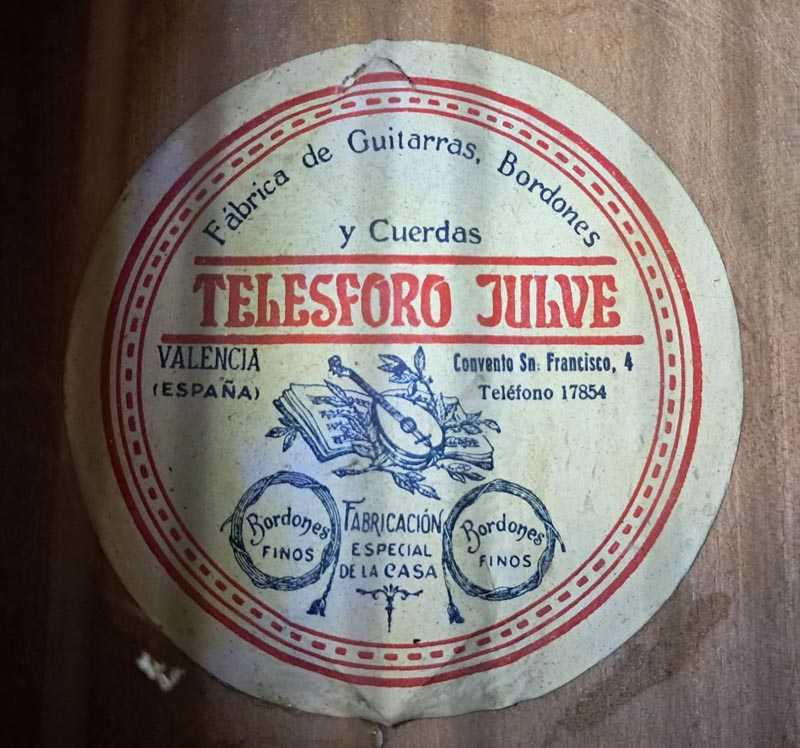
Bandurria - Telesforo Julve - Valencia
| Dimensions | 602 × 276 × 82 mm |
|---|---|
| Name of musical instrument | |
| Type of musical instrument | |
| Typical place of occurrence | |
| Date of manufature of instrument | |
| Place of manufacture | |
| Made by | |
| Restored by | |
| Scale | |
| Number of strings | |
| How to play musical instrument | |
| Continent | |
| Country |
The bandurria is a plucked chordophone from Spain, similar to the mandolin and bandola, primarily used in Spanish folk music, but also found in former Spanish colonies.
Instrument development
Prior to the 18th century, the bandurria had a round back, similar or related to the mandore. It had become a flat-backed instrument by the 18th century, with five double courses of strings, tuned in fourths. The original bandurrias of the Medieval period had three strings. During the Renaissance they gained a fourth string. During the Baroque period the bandurria had 10 strings (5 pairs).
The modern bandurria has 12 strings (6 pairs). The strings are tuned in unison pairs, going up in fourths from the low G#. The lowest four strings are a major-third above those of a standard guitar and the highest two strings are a fourth above a standard guitar, i.e. G♯, c♯, f♯, b, e and a.
Variations and uses in different parts of the world
Spain
Juan Ruiz first mentioned the term “mandurria” in the 14th century in his “Libro De Buen Amor.” After that, Juan Bermudo gave the description of the bandurria in his “Comiença el libro llamado declaraciõ de instrumentos” as a three-string instrument in 1555, but he also mentioned other types with four or even five strings. In the early 1870s, a child’s wake was accompanied with the bandurria music in Jijona, Alicante Province. The zapateo, a dance derived from the Spanish zapateado and introduced by tobacco cultivators from the Canary Islands, is accompanied with bandurria and other instruments before 1900.
Philippines
The Philippine harp bandurria is a 14-string bandurria used in many Philippine folkloric songs, with 16 frets and a shorter neck than the 12-string bandurria. This instrument most likely evolved in the Philippines during the Spanish period, from 1521 to 1898. The Filipino bandurria (also banduriya) is used in an orchestra of plucked string instruments called rondalla. It is tuned a step lower than the Spanish version, that is, low to high: F# B E A D G. Filipino bandurrias have been made with coconuts, and as banjoleles with banjo bodies and goatskin soundboards.
South America
There are also many different varieties of bandurria in South America, especially Peru and Bolivia. They have four courses, unlike the traditional Spanish six courses. The four courses are double, triple or quadruple, and the tuning is guitar-like, rather than the fourths tuning used on the Spanish type. In Lima, Peru, harp and bandurria duos were common in the early 20th century. Nowadays people there still play bandurria accompanying with the popular vals peruano, or vals criollo.
Telesforo Julve Jordán (11 January 1884, Villarroya – 1945, Valencia) was a Spanish guitar maker, based in Valencia.
His guitars were very popular during the first decades of the 20th century, being exported internationally. The musicologist and guitar builder José Luis Romanillos includes him in his dictionary of guitar makers.
Biography
He was born on 11 January 1884 in Villarroya de los Pinares (Teruel) and died in Valencia in 1945. He learned his trade as a guitar maker from his uncle Andres Marín.
In 1909 he opened a workshop with two other partners, Francisco Armengol and Francisco Lloréns, a partnership that existed until 1915 when Armengol left, leaving Lloréns and Julve alone. It was in 1918 when Julve began to work independently.
In addition to guitars, the company also manufactured strings, which were also often imported from other countries. From Julve’s workshop came many makers who, after a period of training, left the workshop to try their luck on their own, with mixed fortune. Among them was Ricardo Sanchis who, after eight years in the workshop, set up on his own in 1925.
It is estimated that for several years he produced several thousand musical instruments.
After his death in 1945 the business was continued by his sons Juan and Telesforo Julve Torres.

Reviews
There are no reviews yet.