Skip to main content Scroll Top
Instruments from all over the world!
  • Home
  • Europe
  • Hungary
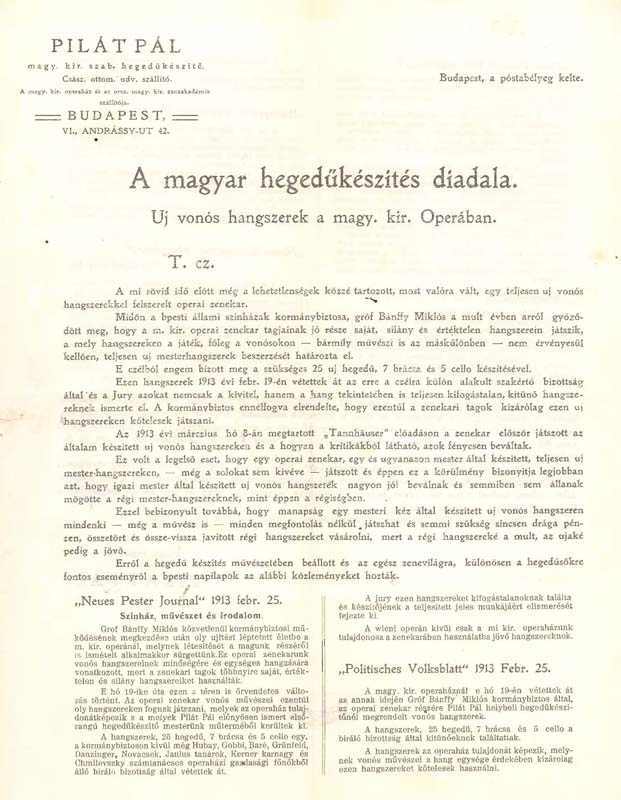
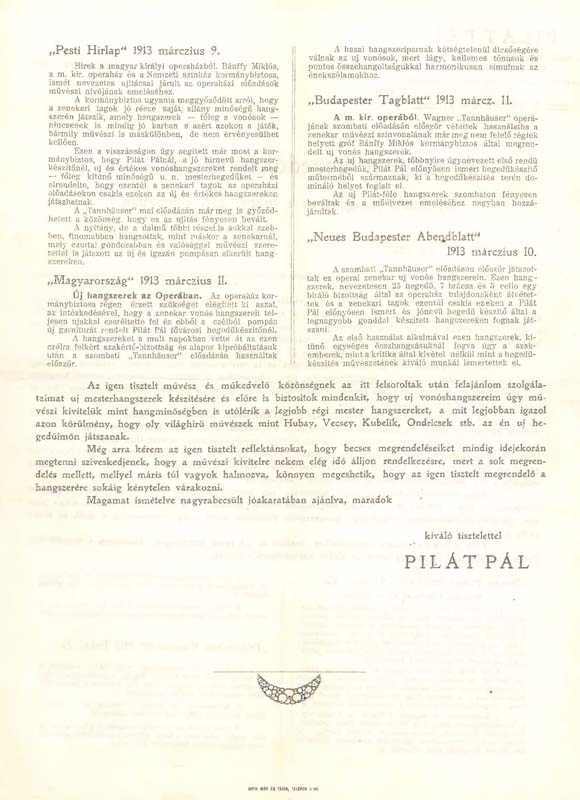
  • Print – Advertisement – Pál Pilát: The Triumph of Hungarian Violin Making

Print - Advertisement - Pál Pilát: The Triumph of Hungarian Violin Making

Add to favorites
Added to Cart View Cart Checkout
Added to Wishlist View Wishlist
Removed from Wishlist
Information:
Author and Title

Published by

Place of Edition

Year of Edition

Number of pages

2

Language

Hungarian

Country

Size (length x width – mm)

295 x 232

Within other caregory

Paper collectible

Sharing:
Categories:

Address: Budapest, VI. Andrássy-út 42.

Pál Pilát Sr. (Benešov, Czech Republic, 1860 – Budapest, 20 March 1931) was an outstanding violinist of Czech origin who worked mainly in Hungary.

His life

He was born to János Pilát and Anna Druk. From his native town near Prague, he went to study with Thomas Zach in Vienna, where he worked with Gabriel Lemböck and David Bittner. He then moved to Budapest, no doubt on the advice of his masters, where he became assistant to József Vencel Schunda and later to Ede Bartek. In 1883, Bartek became independent with the transfer of his shop at 42 Andrássy út.

From 1885 onwards, he received medals at all the major European exhibitions and, it is said, even in America. In the first third of the 20th century he was the leading violin maker in Hungary. In 1926 he was awarded the gold medal of master violinist.

His widow continued to run his business, which had meanwhile moved to Liszt Ferenc Square, next to the Academy of Music, selling musical instruments and sewing violin covers.

His death was caused by atherosclerosis, stroke and pneumonia. His wife was Belohorszky Margit Izabella Lujza.

Professional merits

He also holds a patent for bass beams, for which Hungarian and Czech experts have issued certificates of recognition. He also experimented with violin lacquer for years, and when he found the right one, he supplied it to hundreds of instrument makers.

The construction of the violin is ideal, the workmanship meticulous and skilled. Its varnish is a thickly applied amber or reddish yellow, with satin or inky finish. The latter is a technique adopted from the Mirecourt violins: the contours of the pulley and the lines where the sides meet are highlighted in black or dark brown.

Dr. József Geyer’s denigrating statement that Pilat’s instruments ‘lose their sound within a year or two’ and ‘sound mellow and muffled’ has been refuted by posterity, and was probably based on some of Pilat’s less successful experiments with beam repair. Pilat’s violins are very suitable for symphonic orchestral playing. They were also recommended for young, dynamic virtuosi with their ‘splendid brilliance’ of tone.

According to Ferenc Némethy, he also made bows, presumably with a similar level of sophistication.

His labels show a circle at the beginning and end of the text, with an isosceles cross above it and the initials ‘PP’ below, which he burnt above the label. The violin with label “Paulus Pilát fecit Budapestini anno 1911 Op.166″ is preserved at the Institute of Musicology of the Hungarian Academy of Sciences (Accession Number. 71.03.1).

https://hu.wikipedia.org/wiki/Pil%C3%A1t_P%C3%A1l

You might also be interested in this

Privacy Preferences
When you visit our website, it may store information through your browser from specific services, usually in form of cookies. Here you can change your privacy preferences. Please note that blocking some types of cookies may impact your experience on our website and the services we offer.