Skip to main content Scroll Top
Instruments from all over the world!
  • Home
  • Europe
  • Hungary
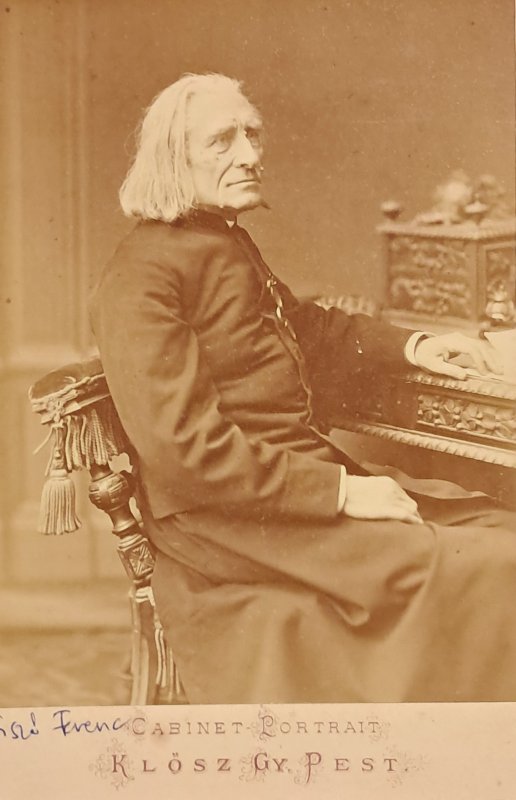
  • Photo – Ferenc Liszt – From György Klösz’s studio – Budapest

Photo – Ferenc Liszt – From György Klösz’s studio – Budapest

Add to favorites
Added to Cart View Cart Checkout
Added to Wishlist View Wishlist
Removed from Wishlist
Information:
Author and Title

Published by

Place of Edition

Year of Edition

Number of pages

2

Language

Hungarian

Size (length x width – mm)

136×100

Within other caregory

Photo

Sharing:
Categories:

Ferenc Liszt

Ferenc Liszt (known worldwide by his German name, Franz Liszt; Doborján, October 22, 1811 – Bayreuth, July 31, 1886) was a Hungarian composer, pianist, conductor, and music teacher, one of the most significant composers of the 19th-century Romantic period.

His father, Ádám Liszt, an official of Prince Esterházy, recognized his son’s exceptional musical talent early on and seized every opportunity to develop it. At the age of nine, Liszt was already playing the piano in public in Sopron and Pozsony, and soon after, with the support of noble patrons, he was able to continue his studies in Vienna as a pupil of Czerny and Salieri. He made his debut in Vienna on December 1, 1822. The 11-year-old Liszt’s first concert caused a great sensation. It was here that he met Beethoven, through Czerny, who had previously been Beethoven’s pupil. It was also here that his first work was published, his variations on the same Diabelli theme (waltz) on which Beethoven wrote his famous piano piece. Following his appearance in Vienna and four highly successful concerts in Pest and Buda, the young Liszt traveled to France with his father in the fall of 1823 and moved to Paris, one of the centers of European artistic life.

His admission to the Paris Conservatoire was blocked by Luigi Cherubini, the head of the institution, so he returned to Vienna, where he studied music theory and counterpoint privately, while also embarking on a concert tour. His debut in London was followed by numerous invitations to France, Switzerland, and then back to England. His program mostly featured fantasies and paraphrases written for popular operas. In 1827, he settled in the French capital for a time, where his talent made him a celebrated hero of society. It was here that he met Chopin, from whom he learned the nuances of piano playing, and Berlioz, from whom he mastered the language of orchestration and the new achievements of program music. At the end of the 1830s, he embarked on new concert tours, traveling throughout Europe, from Portugal to Russia. In 1835, he became a teacher at the Geneva Conservatory. He supported the victims of the 1838 flood disaster in Pest with the proceeds from his concerts in Vienna. A few years later, he contributed just as generously to the creation of the Beethoven Memorial in Bonn. During his concert tours in Russia, he became acquainted with the art of Russian composers and with Princess Carolyne zu Sayn-Wittgenstein, who later contributed to his literary work. In the early 1840s, he became conductor of the court theater in Weimar, where he promoted and conducted the works of his contemporaries and taught young musicians and composers from all corners of the continent. 

Liszt divided the last decades of his life between Weimar, Rome, and Budapest. In the early years of the Budapest Academy of Music, he willingly supported the newly emerging center of Hungarian musical culture and agreed to teach there for a few months each year.

Liszt was an extremely prolific composer. He composed most of his works for the piano, and most of them require extraordinary technical skill to play. The relative obscurity of his compositions can be explained by the fact that he composed a huge number of pieces: most of his 400 original works are virtuoso piano pieces, symphonies, symphonic poems, and masses. He composed a total of about 1,400 works (including his original works, transcriptions, etc.), making him one of the most prolific composers of all time. He was an enthusiastic supporter of program music. He also worked on musical transcriptions and tackled some of the most complex orchestral works, such as Beethoven’s symphonies. His works are an indispensable part of concert programs all over the world. In addition to his musical work, he wrote numerous essays on various topics, including the social status of composers and work analyses.

https://hu.wikipedia.org/wiki/Liszt_Ferenc

György Klösz

György Klösz (originally Johann Justus Georg Kloess (Klöss), Darmstadt, Germany, November 15, 1844 – Budapest, Erzsébetváros, July 4, 1913) was a German-born Hungarian photographer, painter, pioneer of urban photography in Hungary, and one of its most significant figures.

Career

He was born on November 15, 1844, in Darmstadt, the son of Pál Klöss and Ernesztina Gratz, into a Lutheran family. His wife was Karolina Zeller, and his son was Pál Klösz (1874-1951). After studying pharmacy, chemistry, and photography, he began his career in Vienna. He arrived in Pest with two partners around 1866. Together they opened a photo studio on the corner of Herrengasse, today’s Petőfi Sándor Street and Régi posta Street, which he soon ran on his own, then moved to the building behind the Franciscan church, at 1 Hatvani Street, in 1872 at the latest. He became a founding member of the Hungarian Photographers’ Association. In 1873, he was one of a group of six photographers who had the exclusive right to photograph the World’s Fair in Vienna.

It was then that he began creating and distributing views of Budapest. In 1875, he captured the devastation caused by the flooding of the Ördög-árok, and in 1876, transporting his equipment by boat, he photographed the banks flooded by the Danube. In 1877, he set up his new two-story studio in the new Ferenciek Bazaar, above the gate on what is now Kossuth Lajos Street. In 1878–79, he photographed floods again in Miskolc, Eger, and then the largest one in Szeged. In 1879, he set up a lithographic press and from then on turned to the reproduction industry. In 1882, he built a villa and a summer studio on Svábhegy. He became a member of the Svábhegy Association’s board. In 1884, he moved his Pest studio to the medical school building at 18 Hatvani Street, on the corner of what is now Semmelweis and Kossuth Lajos Streets.

In 1885, he presented his panoramic series depicting the entire Andrássy Avenue on a scale of 1:100 at the National General Exhibition. He photographed the first trams in Pest on behalf of Siemens and Halske. Between 1890 and 1894, he was co-owner of the multilingual tourist magazine Budapesti Látogatók Lapja (Budapest Visitors’ Journal). In 1894, he and his team of cameramen photographed the funeral procession of Lajos Kossuth. From the second half of the 1890s, he produced series of photographs of houses awaiting demolition due to urban redevelopment. In 1892, he built his own villa on Hunfalvy Street, and from 1894, he had a house, studio, and printing press (and a tenement house next door) built at 49 Városligeti fasor.

He took at least seven hundred photographs of the millennium exhibition under the auspices of the exclusive Photographic Association, exhibited independently, and his photographs were featured in numerous pavilions. His photographs appeared regularly in the press of the time, and his awards multiplied.

In preparation for the 1900 World’s Fair in Paris, he took exterior and interior photographs of nearly a hundred country castles. He sent his son, Pál Klösz, to study at the graphic arts college in Vienna, but he himself also became a photographer. In 1903, he made 29-year-old Pál a co-owner, and from then on, the company was registered as Klösz György és fia udvari fényképészeti, térképészeti és kőnyomdai műintézet (Klösz György and Son Court Photography, Cartography and Lithography Institute) until its nationalization in 1948. He was elected vice president of the Hungarian Photographers’ National Association, founded in 1906. Although he gradually retired, his photographs of the telephone network date from this period.

He died on July 4, 1913. His grave is located in the Kerepesi Cemetery.

His workshop also produced paintings; the only known work signed by Klösz depicts the elderly Miklós Ybl (1881).

https://hu.wikipedia.org/wiki/Liszt_Ferenc


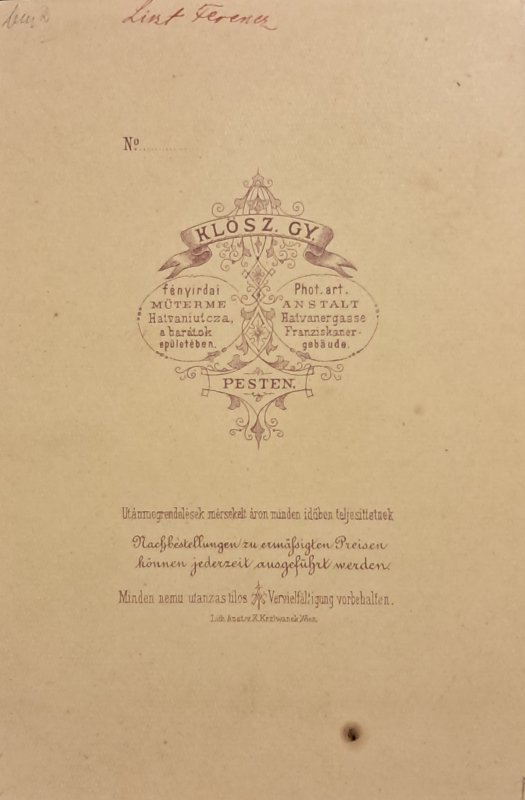
Ferenc Liszt celebrated his 50th birthday in Budapest in 1873. This photograph was probably taken at this time, and several versions (standing figure, bust, at the pianino) of it were made by György Klösz, one of the most important Budapest photographers of the 19th century. This is the less common version.

You might also be interested in this

Privacy Preferences
When you visit our website, it may store information through your browser from specific services, usually in form of cookies. Here you can change your privacy preferences. Please note that blocking some types of cookies may impact your experience on our website and the services we offer.