Skip to main content Scroll Top
Instruments from all over the world!

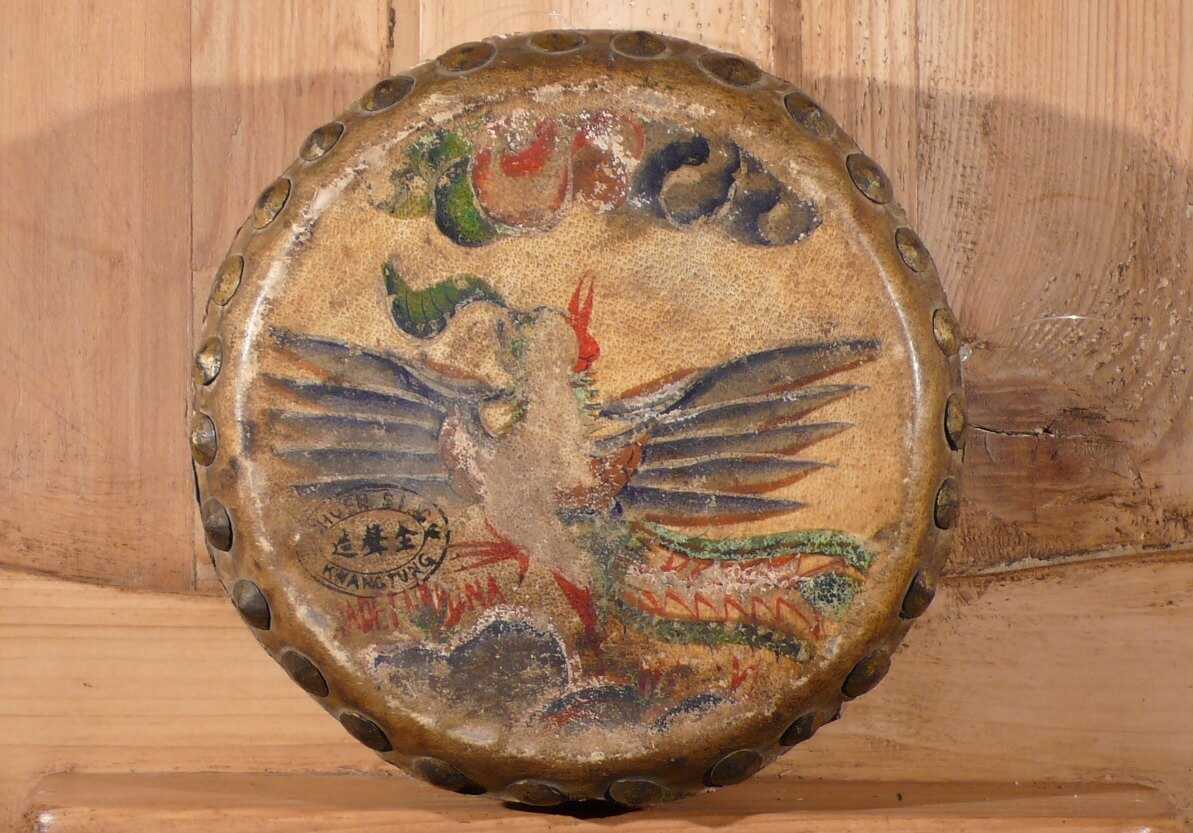
Drum - Tacked head drum

Add to favorites
Added to Cart View Cart Checkout
Added to Wishlist View Wishlist
Removed from Wishlist
Information
Dimensions 225 × 225 × 102 mm
Name of musical instrument

Type of musical instrument

Typical place of occurrence

Date of manufature of instrument

Place of manufacture

,

Made by

Restored by

How to play musical instrument
Continent

Country

Sharing:
Categories:

Drum - Tacked head drum

Information
Dimensions 225 × 225 × 102 mm
Name of musical instrument

Type of musical instrument

Typical place of occurrence

Date of manufature of instrument

Place of manufacture

,

Made by

Restored by

How to play musical instrument
Continent

Country

Sharing:
Categories:

The first tom toms were brought to the US by Chinese and other immigrant groups in the second half of the 1800s. By the early 20th century, drum set players (then known as “trap drummers”) were adapting them for a variety of uses.

Although not tunable (the heads were usually tacked or glued in place), Chinese toms boasted cool, colorful paint jobs, and the tone they produced was useful in creating sound effects for stage shows, silent films, and radio programs.

Tom toms also found a place in early jazz. Fletcher Henderson used them to create an “oriental flare” in songs like “Shanghai Shuffle,” and toms played a key role in the pseudo-African “jungle” sound that Duke Ellington pioneered at the Cotton Club.

By the 1920s, tom toms had become so popular that companies like Ludwig and Slingerland started marketing them as a standard component of the drum set. Initially, the drums were imported in quantity from China with a company logo added for US distribution, but soon American companies began manufacturing “tacked toms” on their own.

These toms were typically mounted to the bass drum hoop or on a “trap” table. Larger sizes sat on the floor on custom-made tripod stands.

The rise of big band swing in the 1930s meant that drummers could begin to play their toms more aggressively, without fear of drowning out the instruments around them. Gene Krupa, whose meteoric rise with Benny Goodman made him into the first drumming superstar, put tom toms squarely in the spotlight with his now famous groove on “Sing, Sing, Sing.”

By the end of the decade, every prominent swing band had a tom tom feature in its repertoire. Krupa also worked with Slingerland to ensure that all tom toms would be produced with “dual tension” tuning. This not only allowed a tom to be tuned with the same sensitivity as a snare drum, but also ensured that a broken head did not mean the end of the drum.

https://drummagazine.com/a-brief-history-of-the-tom-tom/

no data

You might also be interested in this

Privacy Preferences
When you visit our website, it may store information through your browser from specific services, usually in form of cookies. Here you can change your privacy preferences. Please note that blocking some types of cookies may impact your experience on our website and the services we offer.