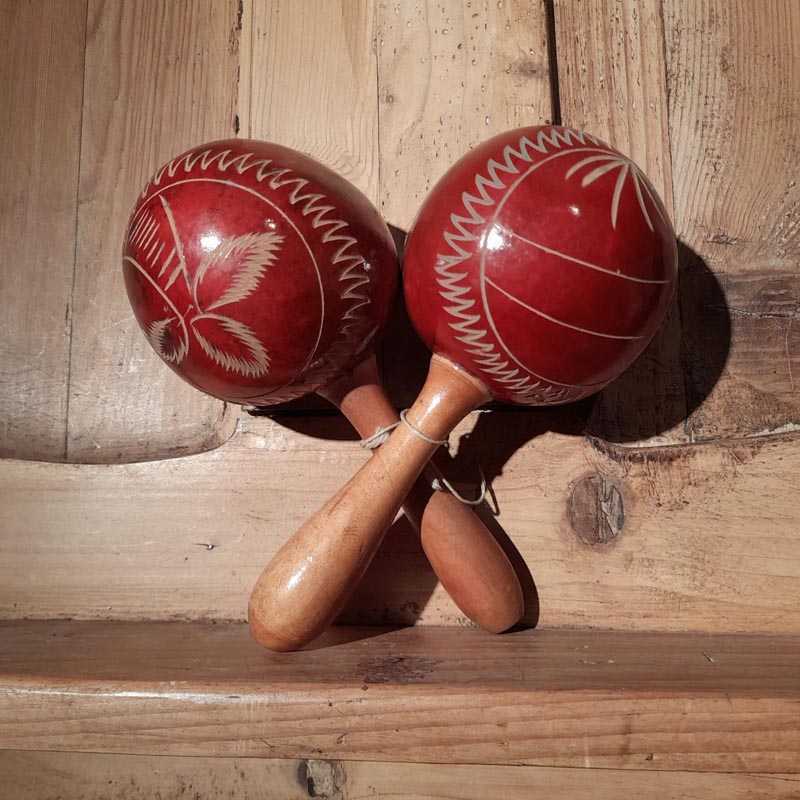
Rattle - Maracas 1.
| Dimensions | 175 × 80 × 82 mm |
|---|---|
| Name of musical instrument | |
| Type of musical instrument | |
| Typical place of occurrence | |
| Date of manufature of instrument | |
| Place of manufacture | |
| Made by | |
| Restored by | |
| Scale | |
| How to play musical instrument | |
| Continent | |
| Country |
An idiophone instrument used with a pair of maracas, played by shaking. It is traditionally made of a small oval-shaped dried pumpkin, with a wooden handle, into the hollow interior of which are placed seeds and small pebbles, the clinking of which produces a sharp, high-pitched sound. It can also be made from other dried fruits, wood, hard leather, plastic. Of Indian origin, it became popular in the Latin American dance craze, and is a favourite instrument, especially in popular music. It was introduced to classical music by Varèse and Milhaud, and has since been used extensively in this genre.
Playing the maracas is seemingly simple, but in reality, it requires great skill and practice. Definite, short, precise rhythms can only be achieved by a coordinated, well-practised movement of the two hands, using the pips to strike back and forth on the two opposite walls of the instrument’s cavity. A rapid shaking produces a tremolo sound, a circular rocking movement a soft, continuous whirring sound. In the various styles of traditional Latin American music, it is usually used as the cymbals of the drum kit, with its high, neutral sound.
no data

Reviews
There are no reviews yet.