Subu
| Dimensions | 618 × 95 × 90 mm |
|---|---|
| Name of musical instrument | |
| Type of musical instrument | |
| Typical place of occurrence | |
| Date of manufature of instrument | |
| Place of manufacture | |
| Made by | |
| Restored by | |
| Scale | |
| Number of strings | |
| How to play musical instrument | |
| Continent | |
| Country |
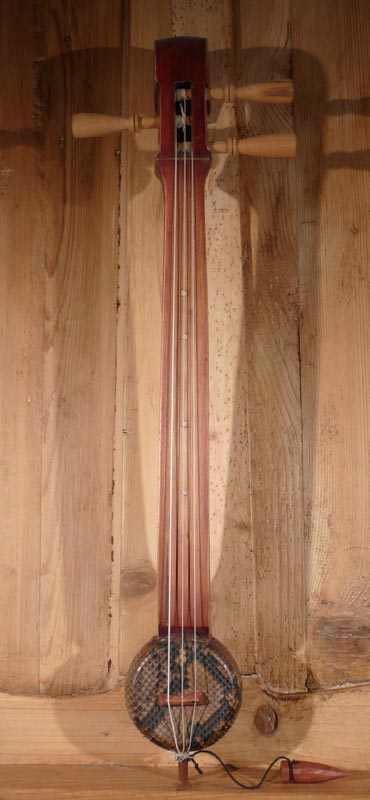
This is a small folk instrument, based on the Chinese sanxien and the Thai sueng. It is made by the Lisu, one of the hilltribes in North Thailand. It is locally known as tseubeu, or subu or dsyböö. The Akha tribe calls it deuham, and the Lahu calll it sae mu. Internet shops usually call it sung lisu. It is made in several sizes, from around 300mm to about 750mm.
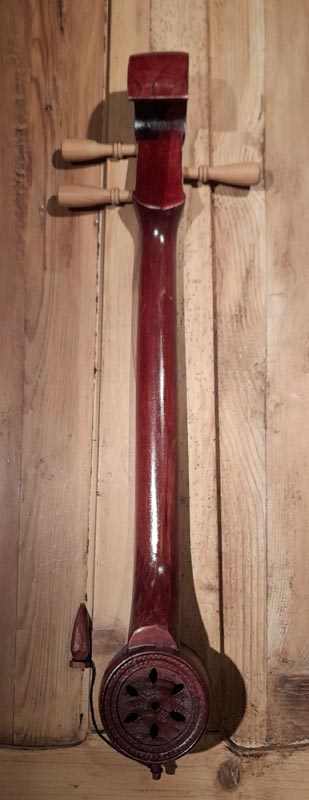
The body of a sung lisu is a small round piece of hardwood, like a bowl. The bottom is pierced with holes and has decoration around the edges. The front is covered with skin, like python or monitor lizard. The straight neck is carved from one piece of hardwood which extents to the pegbox. The pegbox bends back in a sharp curl.
It has three round friction pegs: two on the right side and one on the left side of the open pegbox. Three metal strings (of the same thickness) run over a small loose bridge to a wooden pin at the end of the neck, which goes right through the body.
A round plectrum is fixed to that pin with a rope.