Skip to main content Scroll Top
Instruments from all over the world!

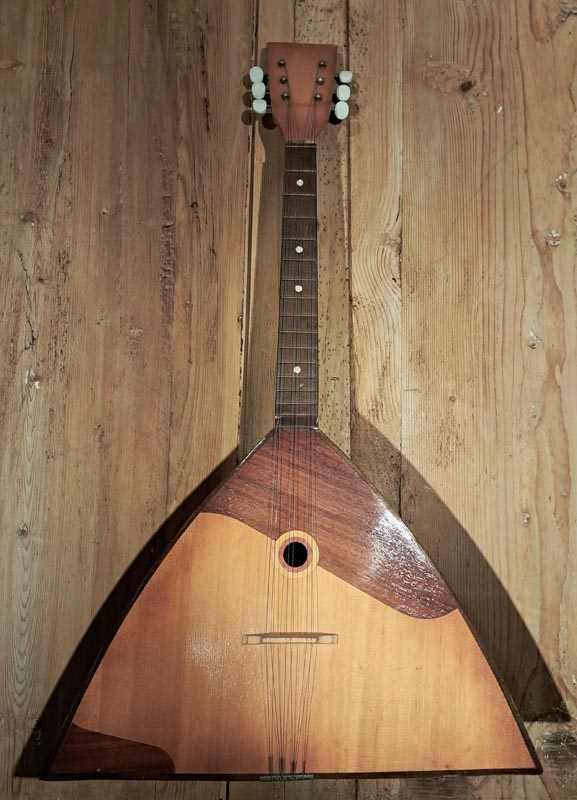
Balalaika - prim - 6 string

Add to favorites
Added to Cart View Cart Checkout
Added to Wishlist View Wishlist
Removed from Wishlist
Information
Dimensions 677 × 400 × 105 mm
Name of musical instrument

Type of musical instrument

Typical place of occurrence

Date of manufature of instrument

Place of manufacture

Made by

Restored by

Donor

Scale

Number of strings

How to play musical instrument

Continent

Country

Sharing:
Categories:
Labels:

Balalaika - prim - 6 string

Information
Dimensions 677 × 400 × 105 mm
Name of musical instrument

Type of musical instrument

Typical place of occurrence

Date of manufature of instrument

Place of manufacture

Made by

Restored by

Donor

Scale

Number of strings

How to play musical instrument

Continent

Country

Sharing:
Categories:
Labels:

Balalaika

The balalaika is a Russian stringed musical instrument with a characteristic triangular wooden, hollow body, fretted neck, and three strings. Two strings are usually tuned to the same note and the third string is a perfect fourth higher. The higher-pitched balalaikas are used to play melodies and chords. The instrument generally has a short sustain, necessitating rapid strumming or plucking when it is used to play melodies. Balalaikas are often used for Russian folk music and dancing.

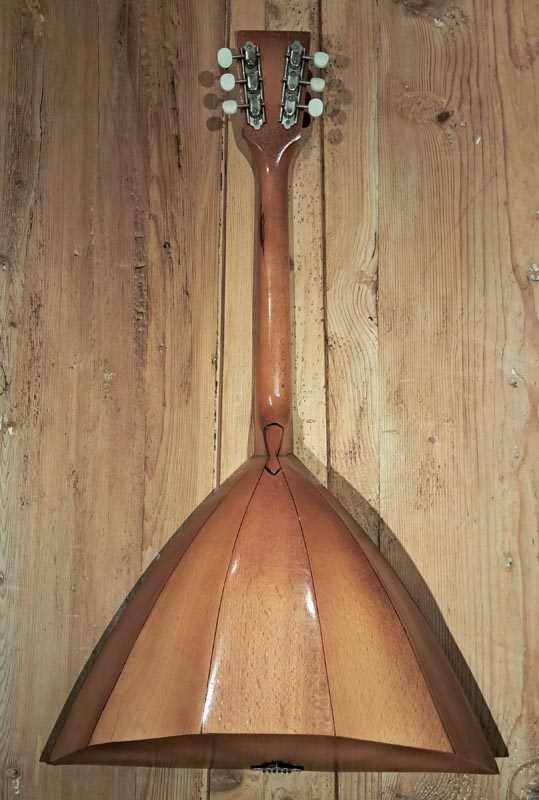
The balalaika family of instruments includes instruments of various sizes, from the highest-pitched to the lowest: the piccolo balalaika, prima balalaika, secunda balalaika, alto balalaika, bass balalaika, and contrabass balalaika. There are balalaika orchestras which consist solely of different balalaikas; these ensembles typically play Classical music that has been arranged for balalaikas. The prima balalaika is the most common; the piccolo is rare. There have also been descant and tenor balalaikas, but these are considered obsolete. All have three-sided bodies; spruce, evergreen, or fir tops; and backs made of three to nine wooden sections (usually maple).

The prima, secunda, and alto balalaikas are played either with the fingers or a plectrum (pick), depending on the music being played, and the bass and contrabass (equipped with extension legs that rest on the floor) are played with leather plectra. The rare piccolo instrument is usually played with a pick.

Types

The most common solo instrument is the prima, which is tuned E4–E4–A4 (thus the two lower strings are tuned to the same pitch). Sometimes the balalaika is tuned “guitar style” by folk musicians to G3–B3–D4 (mimicking the three highest strings of the Russian guitar), whereby it is easier to play for Russian guitar players, although classically trained balalaika purists avoid this tuning. It can also be tuned to E4–A4–D5, like its cousin, the domra, to make it easier for those trained on the domra to play the instrument, and still have a balalaika sound. The folk (pre-Andreev) tunings D4–F♯4–A4 and C4–E4–G4 were very popular, as this makes it easier to play certain riffs.

Balalaikas have been made in the following sizes:

Name Length Common tuning
descant[a] c. 46 cm (18 in) E5 E5 A5
piccolo[b] c. 61 cm (24 in) B4 E5 A5
prima[c] 66–69 cm (26–27 in) E4 E4 A4
secunda[c][d] 68–74 cm (27–29 in) A3 A3 D4
alto[c] 81 cm (32 in) E3 E3 A3
tenor[a] 91–97 cm (36–38 in) A2 A2 D3
bass[c] 104 cm (41 in) E2 A2 D3
contrabass[b][c] 130–165 cm (51–65 in) E1 A1 D2
a Obsolete
b Rare
c Members of the modern balalaika orchestra
dSecundas are often the same instrument as primas, just tuned to a lower pitch range

Factory-made six-string prima balalaikas with three sets of double courses are also common. These have three double courses similar to the stringing of the mandolin and often use a “guitar” tuning.Four-string alto balalaikas are also encountered and are used in the orchestra of the Piatnistky Folk Choir.

The piccolo, prima, and secunda balalaikas were originally strung with gut with the thinnest melody string made of stainless steel. Today, nylon strings are commonly used in place of gut.

Amateur and/or souvenir-style prima balalaikas usually have a total of 16 frets, while in professional orchestra-like ones that number raises to 24.

Technique

An important part of balalaika technique is the use of the left thumb to fret notes on the lower string, particularly on the prima, where it is used to form chords. Traditionally, the side of the index finger of the right hand is used to sound notes on the prima, while a plectrum is used on the larger sizes.

Because of the large size of the contrabass’s strings, it is not uncommon to see players using a plectrum made from a leather shoe or boot heel. Bass and contrabass balalaikas rest on the ground, on a wooden or metal pin that is drilled into one of its corners.

History

It is possible that the emergence and evolution of the balalaika was a product of interaction with Asian-Oriental cultures. In addition to European culture, early Russian states, also called Rus’ or Rusi, were also influenced by Oriental-Asian cultures. Some theories say that the instrument is descended from the domra, an instrument from the East Slavs. In the Caucasus, similar instruments such as the Mongolian topshur, used in Kalmykia, and the Panduri used in Georgia are played. It is also similar to the Kazakh dombra, which has two strings. Variants of the dombra played by the Bashkirs often have 3 strings and may represent an instrument related to both the dombra and the balalaika.

The Pre-Andreyev period

The earliest mention of the balalaika comes from a Russian document from 1688. A guard’s diary of the Moscow Kremlin records that two drunken commoners were stopped playing the balalaika.

Another occurrence of the word is recorded in a document dated October 1700 from the Verkhotursky district of Russia. It is also mentioned in a document dated 1714, signed by Peter the Great, about the wedding celebration of N. M. Zotov in St. Petersburg. In Ukrainian, the word was first documented in the 18th century as ‘balabaika’; this form also occurs in South Russian dialects and in Belarusian, as well as in Siberian Russia. It has also entered literature and first appeared in the poem ‘Elysei’ by V. Maykov in 1771. It also appears in Gogol’s Dead Souls, written between 1837 and 1842. In the 19th century, the balalaika evolved into a triangular instrument with a much shorter neck than its Asian counterparts. For centuries, it was popular as a village instrument, especially among the skomorokhs, the freelance music clowns who mocked the Tsar, the Russian Orthodox Church and Russian society in general with their songs.

The Andreyev period

In the 1880s, Vasily Vasilievich Andreyev, who was then a professional violinist in the music salons of St Petersburg, developed what became the standardized balalaika, with the assistance of violin maker V. Ivanov. The instrument began to be used in his concert performances. A few years later, St. Petersburg craftsman Paserbsky further refined the instruments by adding a fully chromatic set of frets and also a number of balalaikas in orchestral sizes with the tunings now found in modern instruments. One of the reasons why the instruments were not standardised, was because people in the outlying areas built their own instruments because there was so little communication for them. There were no roads and weather conditions were generally bad. Andreyev patented the design and arranged numerous traditional Russian folk melodies for the orchestra. He also composed a body of concert pieces for the instrument.

Balalaika orchestra

The end result of Andreyev’s labours was the establishment of an orchestral folk tradition in Tsarist Russia, which later grew into a movement within the Soviet Union. The balalaika orchestra in its full form consists of balalaikas, domras, gusli, bayan, Vladimir Shepherd’s Horns, garmoshkas, and several types of percussion instruments.

With the establishment of the Soviet system and the entrenchment of a proletarian cultural direction, the culture of the working classes (which included that of village labourers) was actively supported by the Soviet establishment. The concept of the balalaika orchestra was adopted wholeheartedly by the Soviet government as something distinctively proletarian (that is, from the working classes) and was also deemed progressive. Significant amounts of energy and time were devoted to support and foster the formal study of the balalaika, from which highly skilled ensemble groups such as the Osipov State Russian Folk Orchestra emerged. Balalaika virtuosi such as Boris Feoktistov and Pavel Necheporenko became stars both inside and outside the Soviet Union. The movement was so powerful that even the renowned Red Army Choir, which initially used a normal symphonic orchestra, changed its instrumentation, replacing violins, violas, and violoncellos with orchestral balalaikas and domras.

Solo instrument

Often musicians perform solo on the balalaika. In particular, Alexey Arkhipovsky is well known for his solo performances. In particular, he was invited to play at the opening ceremony of the second semi final of the Eurovision Song Contest 2009 in Moscow because the organizers wanted to give a “more Russian appearance” to the contest.

https://en.wikipedia.org/wiki/Balalaika

no data

Reviews

There are no reviews yet.

Add a review

For security, use of CloudFlare's Turnstile service is required which is subject to the CloudFlare Privacy Policy and Terms of Use.

You might also be interested in this

Privacy Preferences
When you visit our website, it may store information through your browser from specific services, usually in form of cookies. Here you can change your privacy preferences. Please note that blocking some types of cookies may impact your experience on our website and the services we offer.