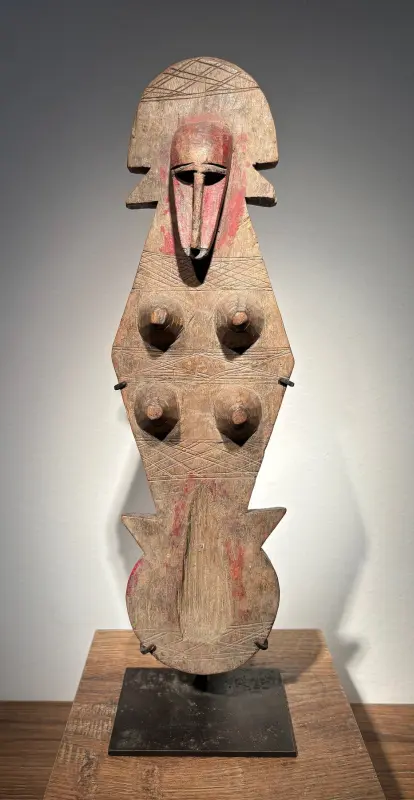
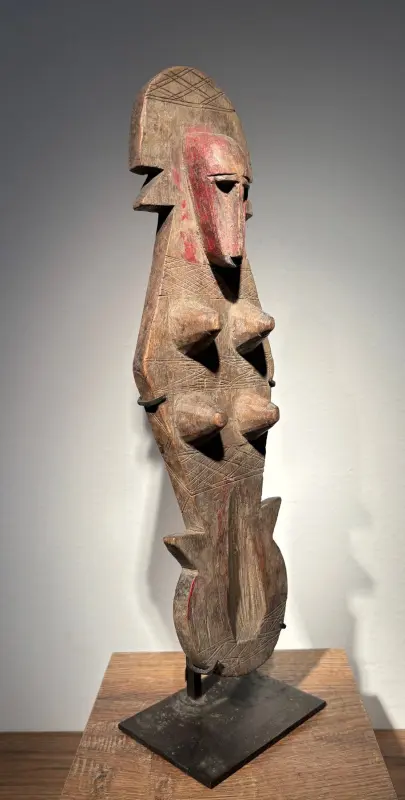
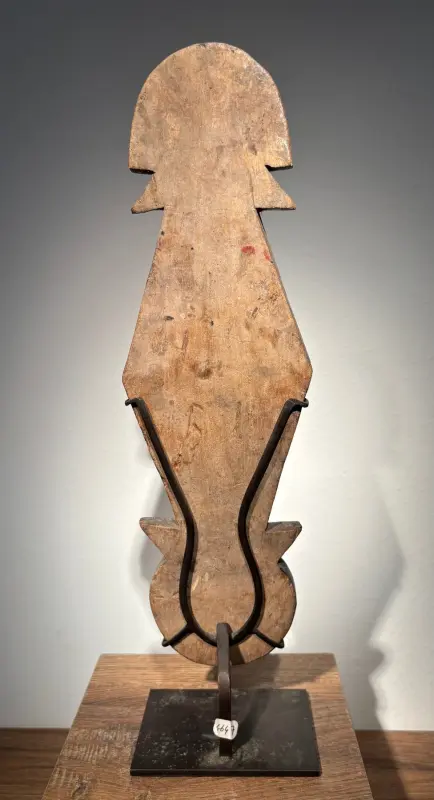
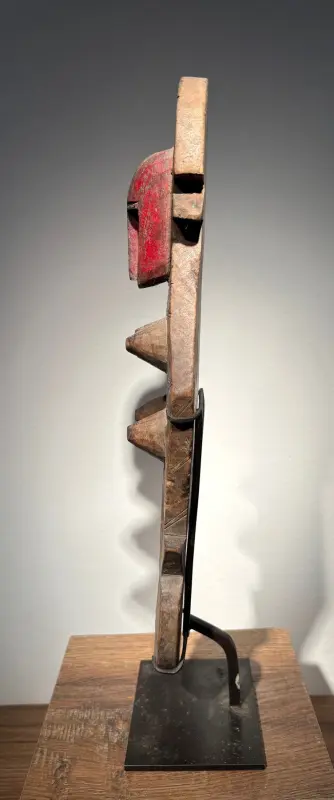
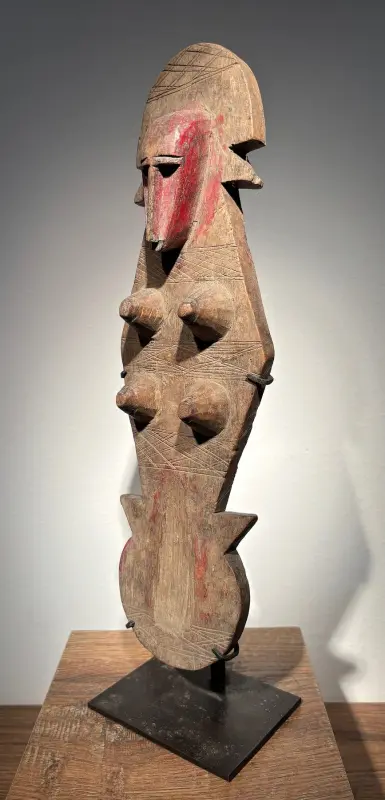
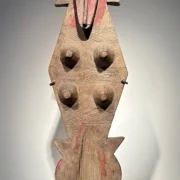
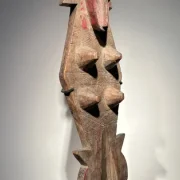
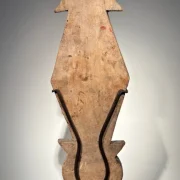
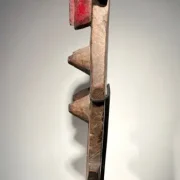
Clapper - Bambara - antropomorphic - Human shaped
| Dimensions | 297 × 90 × 36 mm |
|---|---|
| Name of musical instrument | |
| Type of musical instrument | |
| Typical place of occurrence | |
| Date of manufature of instrument | |
| Place of manufacture | |
| Made by | |
| How to play musical instrument | |
| Continent | |
| Country |
CLAPPER
A clapper is a basic form of percussion instrument. It consists of two long solid pieces that are struck together producing sound. They exist in many forms in many different cultures around the world. Clappers can take a number of forms and be made of a wide variety of material. Wood is most common, but metal and ivory have also been used. The plastic thundersticks that have recently come to be popular at sporting events can be considered a form of inflated plastic clapper.
Several specific forms of clapper have their own names, such as the Chinese guban, Japanese hyoshigi, or the Korean bak. In the classical music of Thailand, a similar instrument is called krap. In India cooking tongs or cimṭā are often used to provide rhythm while singing religious hymns in many areas (sometimes tongs made specifically for the purpose are also equipped with bells). In Vietnam, the coin clapper called sinh tiền is widely used. In medieval French music, clappers called tablettes or cliquettes were used.
In the Middle Ages, the clapper was used at certain points during the liturgy, as well as to call for alms.
People with leprosy, whose voices were affected by the disease, also used it for this purpose, and to signal their presence. It was in the 14th century that the clapper became a means of prevention.
Subsequently, the instrument was used by travelling merchants and musicians.
In the Western symphony orchestra, a clapper called the whip (also called slapstick) is occasionally used in the percussion section.
Whip/slapstick
In music, a whip or slapstick is a clapper (percussion instrument) consisting of two wooden boards joined by a hinge at one end. When the boards are brought together rapidly, the sound produces a sound reminiscent of the crack of a whip. It is often used in modern orchestras, bands, and percussion ensembles.
There are two types of whips. The first has two planks of wood connected by a hinge, with a handle on each. The percussionist holds the instrument by the handles and hits the two pieces of wood together, creating a loud whip noise. The other type also has two planks of wood, one longer than the other, with one handle, connected with a spring hinge so it can be played with just one hand, though it cannot produce sounds as loud as a whip requiring both hands. This second type of whip is technically a separate instrument called a slapstick.
Usage in classical music
The whip is sometimes indicated in scores by the native words for “whip” (French fouet, German Peitsche, or Italian frusta) or a term indicating the clapper construction (French claquette or German Holzklapper).
A traditional percussion instrument of the Bambara or Bozo ethnic groups; the instrument shown in the photo features depictions of breasts, which are common motifs in these regions and generally symbolize fertility. Another similar piece was also part of the set, used to produce a clicking sound.
The Bambara (Bambara: ߓߡߊߣߊ߲, romanized: Bamana or ߓߊ߲ߡߊߣߊ߲ Banmana) are a Mandé ethnic group native to West Africa, primarily southern Mali, Ivory Coast, Guinea, Burkina Faso and Senegal. They have been associated with the historic Bambara Empire. Today, they make up the largest Mandé ethnic group in Mali, with 80% of the population speaking the Bambara language, regardless of ethnicity.
Ethnonym
According to the Encyclopedia of Africa, “Bambara” means “unbeliever” or “infidel”; the group supposedly acquired the name because they resisted forced conversion to Islam after the religion was introduced in 1854 by Toucouleur conqueror Omar Saidou Tall.
The anthropologist Germaine Dieterlen posited an alternative explanation; suggesting that the name translates as “rejection of a master” and originates from the escape of Bambaran slaves from the Malinke Empire during the 13th century.
https://en.wikipedia.org/wiki/Bambara_people
Photos:

Reviews
There are no reviews yet.