Skip to main content Scroll Top
Instruments from all over the world!

Laúd

Add to favorites
Added to Cart View Cart Checkout
Added to Wishlist View Wishlist
Removed from Wishlist
Information
Dimensions 835 × 322 × 86 mm
Name of musical instrument

Type of musical instrument

Typical place of occurrence

Date of manufature of instrument

Place of manufacture

Made by

Restored by

Scale

Number of strings

How to play musical instrument

Continent

Country

Sharing:
Categories:
Labels:

Laúd

Information
Dimensions 835 × 322 × 86 mm
Name of musical instrument

Type of musical instrument

Typical place of occurrence

Date of manufature of instrument

Place of manufacture

Made by

Restored by

Scale

Number of strings

How to play musical instrument

Continent

Country

Sharing:
Categories:
Labels:

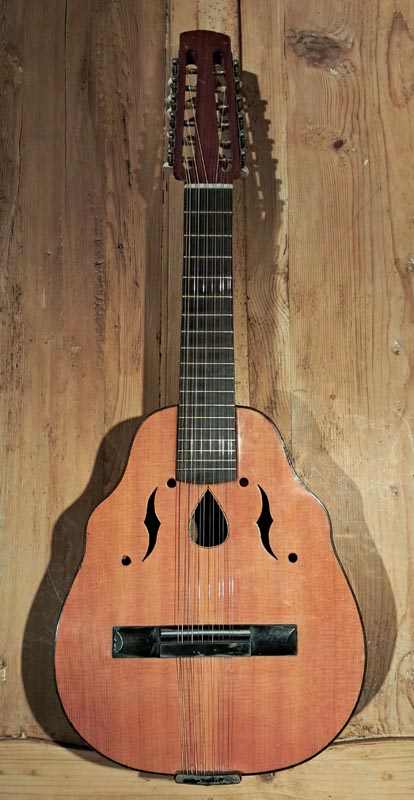
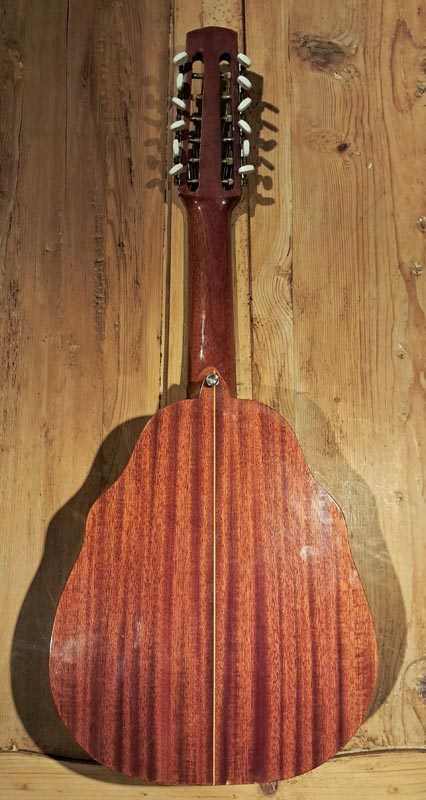
Laúd (Spanish: “lute”) is a plectrum-plucked chordophone from Spain, played also in diaspora countries such as Cuba and the Philippines.

The laúd belongs to the cittern family of instruments. The Spanish and Cuban instruments have six double courses in unison (i.e. twelve strings in pairs); the Philippine instrument has 14 strings with some courses singled or tripled. A similar, but smaller instrument, with a shorter neck, is the bandurria, which also exists in 12- and 14-string versions.

Traditionally the laúd is used by folk string musical groups, such as Spanish or Filipino rondalla string ensembles, together with the guitar and the bandurria. Like the bandurria, it is tuned in fourths, but its range is one octave lower.

Tuning

For the Spanish laud the tuning is:

1st: A4 A4

2nd: E4 E4

3rd: B3 B3

4th: F#3 F#3

5th: C#3 C#3

6th: G#2 G#2

The Filipino version, has (from bass to treble) one single course, two double courses and three triple courses (i.e. fourteen strings), and is tuned a step lower than the Spanish instrument.:

1st: G4 G4 G4

2nd: D4 D4 D4

3rd: A3 A3 A3

4th: E3 E3

5th: B2 B2

6th: F#2

Steve Howe plays a laúd in both Yes (band) and as a solo artist, but he incorrectly refers to it in his guitar book as a Portuguese guitar. His tuning is:

1st: A-flat E

2nd: B E

3rd: B E

4th: A-flat A-flat

5th: E E

6th: B B

Cuban laúd

There is also a Cuban variety of laud—called the “Cuban laud” — (such as played by Barbarito Torres of the Buena Vista Social Club). It has the same appearance and use as the Spanish version, six sets of doubled strings, but a shorter scale length and higher tuning. Sometimes the Cuban variety has a different body shape, with two points instead of the lute-style or wavy shapes used for the traditional Spanish variety. The tuning is:

1st: D5 D5

2nd: A4 A4

3rd: E4 E4

4th: B3 B3

5th: F#3 F#3

6th: D3 D3

https://en.wikipedia.org/wiki/La%C3%BAd

no data

Reviews

There are no reviews yet.

Add a review

For security, use of CloudFlare's Turnstile service is required which is subject to the CloudFlare Privacy Policy and Terms of Use.

You might also be interested in this

Privacy Preferences
When you visit our website, it may store information through your browser from specific services, usually in form of cookies. Here you can change your privacy preferences. Please note that blocking some types of cookies may impact your experience on our website and the services we offer.