





The origins and brief history of the instrument
The earliest record of the shape, dimensions and holding of the instrument we have today is found on Uyghur Chotso/Turfani Manicheus miniatures from the 8th and 9th centuries. The miniatures depict a musician and a cantor. It is almost touching to see the strong resemblance between the image and the cobzing of today.
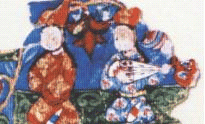
The earliest European short-necked lute depictions date from the 9th to 10th centuries. The instrument arrived in Europe in the form of an invasion from Central Asia. This instrument, like the cobza, has no frets.
 |
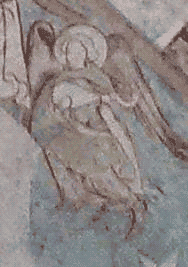 |
| Qopuc with crescent-shaped peg-box |
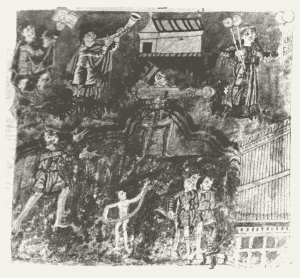
The Arabic qopuc, whose flat, pear-shaped, carved wooden body continues directly into the fretless neck, also came to Europe via Spain. It’s possible that the cobza came to Hungary via Byzantium in the same way that the Arabs took the short-necked lute all the way to North Africa and thence to Spain. The cobza, which has become established in Hungary and bears a formal resemblance to the Uighur instrument mentioned above, the qopuc, and also to the instrument depicted in the Stuttgart Psalter, can be clearly observed on the Suki-chalice. The depiction of a plucked instrument on the Suki chalice is certainly an indication of the instrument’s contemporary use, the work of a goldsmith from Cluj dating from around 1437-1440.
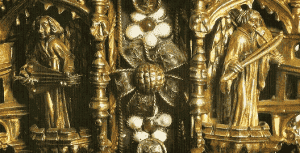
The Suki Chalice
The name ‘cobza’ is very common in Asia: among Kazakhs, Karakalpak and Tatars it is “kobüz” and among Bashkirs it is ‘kubizon’. In the Far East, it is related – not in name but in instrument form – to the Chinese “pipa”, Japanese “biva” and Vietnamese “kipa”. The Kazakh kobüz and Kyrgyz komuz are also related to the cobza. A Turkish folk instrument is also known as kopuz.
The name cobza has been known in Hungary since the early Middle Ages. First mentions of the name:
-1237-1325: personal name Choboz in Veszprém county;
-1327: Johannes dictus Kobzos de Zabadi;
-1364: Nicolaus dictus Kobzos;
-1470: Michael Koboz.
The name is known in Western Europe, and the instrument also appears:
-Kobus – a relatively long-necked instrument from the 15th century in Wartburg Castle,
-Polish sources mention the kobza as a lute-like instrument in the 17th century,
-The Cossacks of Don accompany their heroic songs with kobzas in the 17th and 18th centuries,
-According to Romanian sources, the first mention of cobza players and orchestras dates back to 1570,
-Balázs Orbán mentions it as a Hungarian instrument in his description of the dance music of the Csángos of Hétfalu; the description of the instrument fits perfectly with the short-necked instrument that Ferenc Liszt experienced in Jászvásár.
Shape, parts and dimensions of the instrument
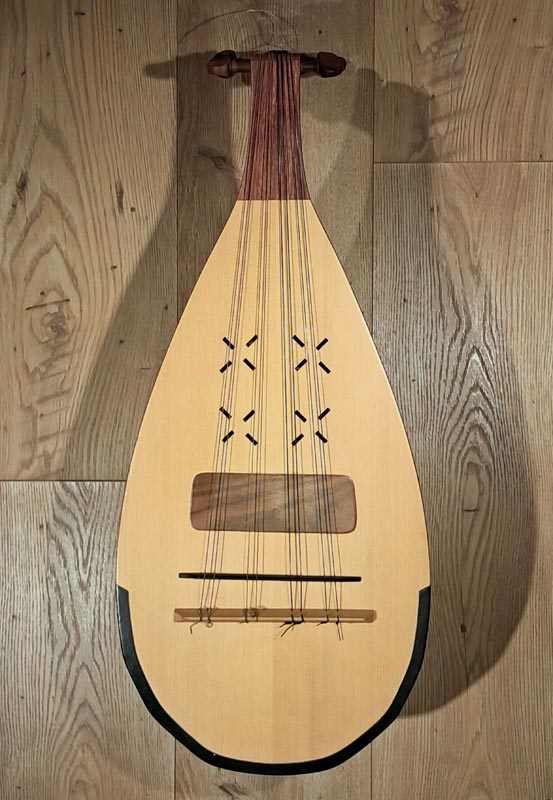
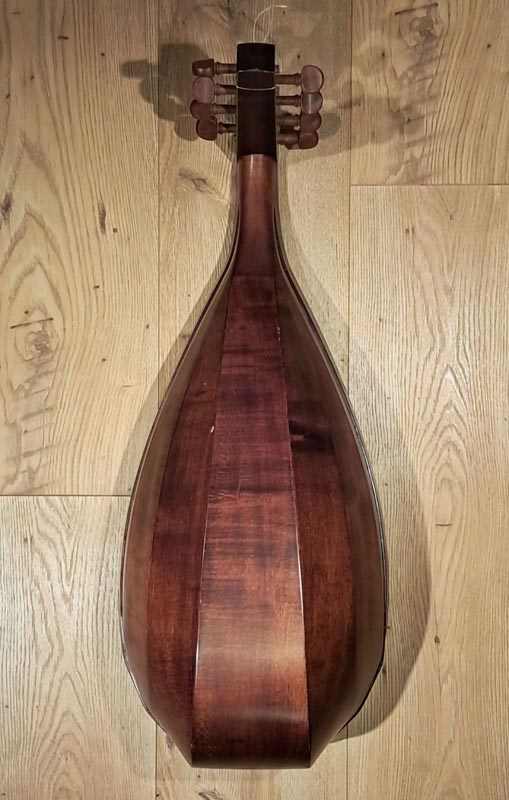
According to the data known since the beginning of the 20th century, the cobza is a typical semicircular short-necked plucked instrument, the neck (2) of which, strongly broken, forms an angle of about 60-80 degrees with the peg-box (1). The widening part of the neck of the instrument continues organically into the widening body of the instrument. The part of the neck towards the strings is flat and has no frets. The head is where the tuning keys are located, and this is where the ebony or other hardwood tuning keys (4) are placed. The strings are 8, 9 or 10 in number, and are arranged in courses of two or three. According to the direction of plucking from head to foot, in the ten-stringed cobza three strings are found in the second and fourth courses, and in the nine-stringed tuning three strings are arranged in the fourth course.
The body of the instrument is glued together with five – seven – nine curved ribs (11). The top (10) is made of one or two pieces of spruce (3-5 mm thick). The soundboard is decorated with a rosette (6) consisting of four X-shaped slots or small openings arranged in a circular pattern, with a triangular hole (5) to the left of the four X-shaped slots. The belly of the box (3) is glued under the rosette, formerly with a piece of leather, more recently with a hard wooden pickguard (7). The strings are broken on a 5-10 mm high bridge (8) to reach the hardwood string holder (9). The strings are attached to the string holder: “d” string course (12), “a” string course (13), “d” string course (14), “g” string course (15).
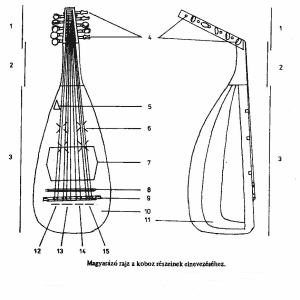
Explanatory drawing for naming the parts of the cobza
From 1955 to the 1970s, we saw the same ‘slender’ box shape as shown in the Figure. From the 1970s onwards, only the instrument factory in Reghin produced cobza. The strings are all numbered 8 and there is a significant change in the shape of the instrument, when the top becomes about two centimetres wider, while the string holder slides forward by three centimetres to the position of the instrument’s largest top width.
Nowadays: in Hungary, instruments reflecting the box sizes used in the seventies and eighties are made in Veresegyháza – Endre Pásztor’s workshop, in Budapest – Szabolcs Bárdi’s workshop, in Szeged – Norbert Darufi’s workshop, in Magyarkanizsa, Vojvodina – Tibor Domokos’ workshop, in Transylvania – in the Reghin manufactory. In Szentkirályfalva, near Sfântu Gheorghe, Szabolcs Csibi also makes carved-body cobza from a piece of poplar wood.
The role of the cobza in the Hungarian dance house movement
The cobza became a popular instrument in dance halls of Moldva relatively late, from the early 1990s. In today’s dance-hall practice, it appears as an accompaniment to Csángó dance music from Moldva, but it is also used to accompany singing and as a virtuoso solo instrument. The history of the instrument shows that it is a common Eurasian cultural treasure. It can therefore be used not only to sing Csángó folk songs but also historical melodies, Renaissance court dance tunes and poems sung by contemporary poets.
The cobza is also used in contemporary folk music and alternative music ensembles.
Géza Fábri


Reviews
There are no reviews yet.