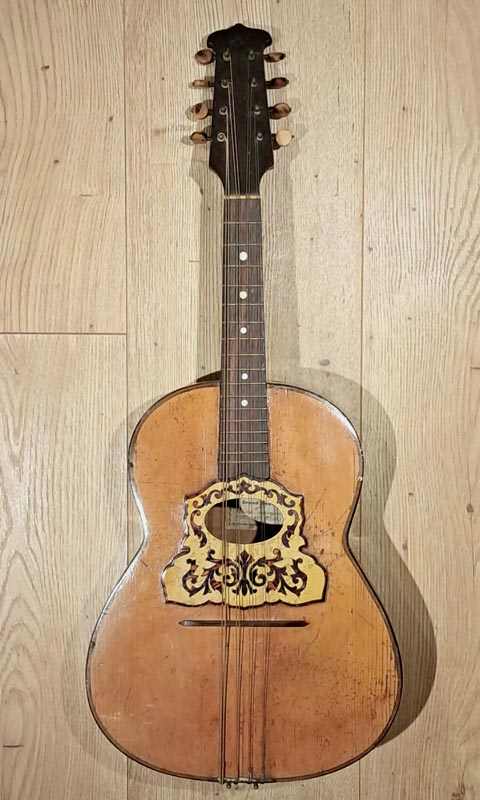
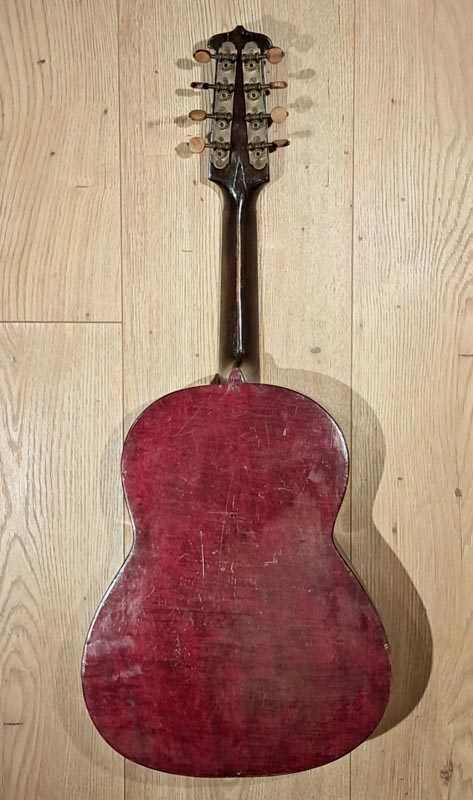
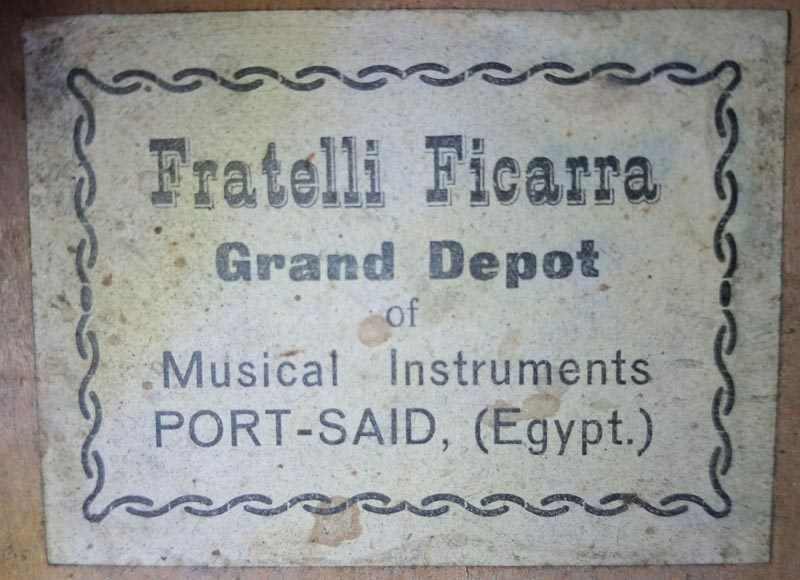
Mandolin - Mandolinetto - Fratelli Ficarra - Naples - Port Said
| Dimensions | 602 × 251 × 60 mm |
|---|---|
| Name of musical instrument | Mandolin – Mandolinetto – Fratelli Ficarra – Naples – Port Said |
| Type of musical instrument | |
| Typical place of occurrence | |
| Date of manufature of instrument | |
| Place of manufacture | |
| Made by | |
| Restored by | |
| Scale | |
| Number of strings | |
| How to play musical instrument | |
| Continent | |
| Country |
From the beginning of the 17th century we find references to mandor, mandora, mandola, mandolino, small lute-like instruments with a blade. These were presumably not developments of the lute, but rather instruments that developed in parallel with it. Unlike the lute, their key cases were not broken at right angles, but gently curved backwards. Initially they were four-stringed (chorus), but soon a fifth or sixth string (pair of strings) was added. They were equipped with gut strings, sometimes plucked with a plectrum, sometimes finger-played.
The ancestor of the modern mandolin first appeared around 1740. At first glance, this instrument looks similar to the older mandolins, but on closer inspection there are important differences:
– metal strings instead of gut strings;
– a semi-circular body instead of a semi-coffee, semi-lanceolate, very oval body;
– a flat tuning head, with keys that extend backwards, instead of a curved, trough system, similar to that of contemporary guitars;
– the lance-shaped string-holder has been replaced by a similar solution to that used for the violin, i.e. the string-holder and the string-holder are separated;
– accordingly, to use a low stringing foot, the flat top is broken transversely so that the strings, even when using a low stringing foot, exert sufficient pressure on the foot and thus on the top.
These characteristics together suggest that this instrument evolved not so much from the older mandola, but from the chitarra battente, a 17th century guitar variety with the above-mentioned characteristics. This new instrument was called the Neapolitan mandolin. It has only four double metal strings, but because they are tuned in fifths, it has a relatively large range. Its tuning, identical to that of the violin, makes it easier to learn to play. Most mandolins today are descendants of this instrument. https://hu.wikipedia.org/wiki/Mandolin
The term “mandolinetto” is commonly used today to refer to guitar-shaped mandolins. Most of the manufacturers simply called them mandolins – which while technically correct, ignores their uniqueness and significantly different appearance from both traditional bowl-back mandolins and the various later scroll and pear-shaped instruments.
no data

Reviews
There are no reviews yet.