Skip to main content Scroll Top
Instruments from all over the world!

Rubab - Uzbek

Add to favorites
Added to Cart View Cart Checkout
Added to Wishlist View Wishlist
Removed from Wishlist
Information
Dimensions 850 × 185 × 195 mm
Name of musical instrument

Type of musical instrument

Typical place of occurrence

Date of manufature of instrument

Place of manufacture

Made by

Restored by

Scale

Number of strings

How to play musical instrument

Continent

Country

Sharing:
Categories:
Labels:

Rubab - Uzbek

Information
Dimensions 850 × 185 × 195 mm
Name of musical instrument

Type of musical instrument

Typical place of occurrence

Date of manufature of instrument

Place of manufacture

Made by

Restored by

Scale

Number of strings

How to play musical instrument

Continent

Country

Sharing:
Categories:
Labels:

RABAB UZBEK

In Uzbekistan they use a special version of the Afghan rabab. The Uzbek rabab has only 3 courses and usually no resonance strings. It is less popular than the kashgar rabab or the (Azari) tar.

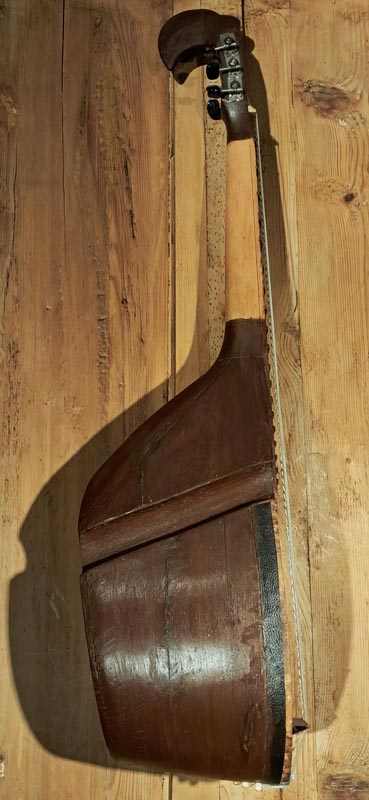
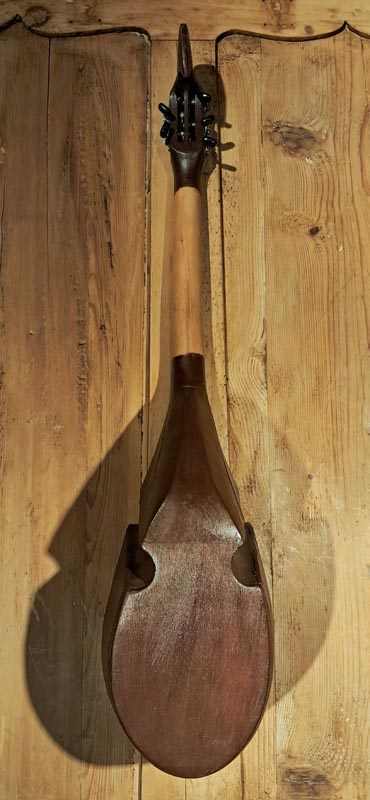
The body of the Uzbek rabab is not made by carving a solid block of mulberry wood, but by building it from separate pieces of wood: some curved pieces for the sides, one for the join under the neck and two for the side ridges, plus a flat top and a flat back.

The lower half of the body has a (quite thick) piece of skin glued to it, the top half is covered with part of the fingerboard. The neck is joined to the body and the top of the neck is carved as tuning head, with the back in a flat backwards curl.

There are 5 tuning pegs (violin style), 2 on the right, 3 on the left side of the open tuning head. Sometimes they use (guitar-like) tuning machines. Some rababs have resonance strings, similar to the Afghan rabab.

The thin fingerboard has about 20 thick wooden inlayed frets, slightly curved, in a western scale.

The 5 nylon strings are in 3 courses: first and second double, third single.

Tuning is probably : c gg c’c’.

The strings run over a loose wooden bridge on the lower skin, to 5 pins fixed to the bottom of the body.

There is no decoration, like on the Afghan rabab. The complete instrument is varnished, with the neck in a lighter, clear varnish.

Playing the Uzbek rabab is similar to playing the Afghan rabab, with a plectrum, accompanying songs and dance music.

https://www.atlasofpluckedinstruments.com/central_asia.htm#uzbekistan

Reviews

There are no reviews yet.

Add a review

For security, use of CloudFlare's Turnstile service is required which is subject to the CloudFlare Privacy Policy and Terms of Use.

Privacy Preferences
When you visit our website, it may store information through your browser from specific services, usually in form of cookies. Here you can change your privacy preferences. Please note that blocking some types of cookies may impact your experience on our website and the services we offer.