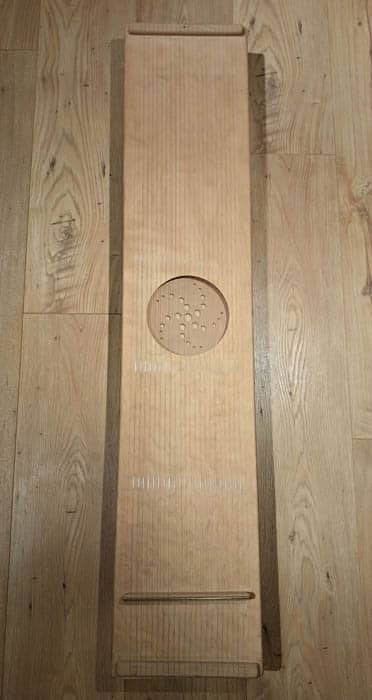
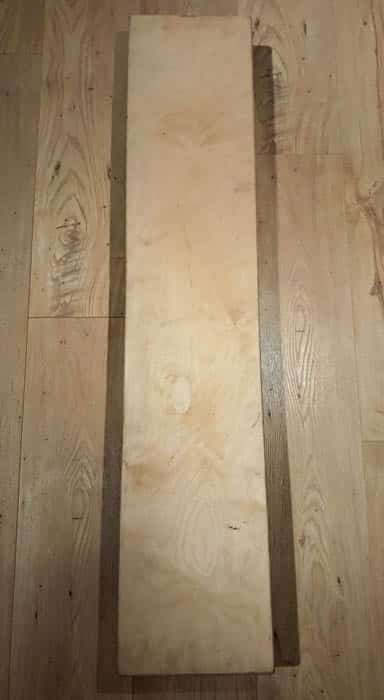
Monochord
| Dimensions | 1115 × 227 × 680 mm |
|---|---|
| Name of musical instrument | |
| Type of musical instrument | |
| Typical place of occurrence | |
| Date of manufature of instrument | |
| Place of manufacture | |
| Made by | |
| Restored by | |
| Scale | |
| Number of strings | |
| How to play musical instrument | |
| Continent | |
| Country |
A monochord, also known as sonometer, is an ancient musical and scientific laboratory instrument, involving one (mono-) string (chord).
https://en.wikipedia.org/wiki/Monochord
But isn’t the name “monochord” a misnomer?
Well, maybe… Pythagoras is said to have developed a one string instrument called a monochord (mono=one, chord=string). He used this instrument to demonstrate the mathematical ratios between notes and was able to show, for example, the ratio between a perfect fifth (C and G) is 3:2. Since we no longer need to prove the ratios between musical intervals, a one string zither just isn’t all that exciting. But add a bunch more strings and tune them all to the same note or an open chord and it becomes irresistible.
Purists may complain about the name but that doesn’t bother us. Language is fluid and changes over time and currently, the term monochord is widely used to describe an instrument like this one.
The therapy monochord belongs to the family of body sound instruments. These are instruments which can be laid on the body or on which you can lie (sound bed) or sit (sound chair). The sound or resonances are not only absorbed by the ears but also transmitted directly from the instrument to the body.
no data

Reviews
There are no reviews yet.