Skip to main content Scroll Top
Instruments from all over the world!

Lyra - Cretan lyra

Add to favorites
Added to Cart View Cart Checkout
Added to Wishlist View Wishlist
Removed from Wishlist
Information
Dimensions 520 × 315 × 50 mm
Name of musical instrument

Type of musical instrument

Typical place of occurrence

Date of manufature of instrument

Place of manufacture

Made by

Restored by

Scale

Number of strings

How to play musical instrument

Former owner

Géza Orczi (musician/instrument maker)

Continent

Country

Sharing:
Categories:
Labels:

Lyra - Cretan lyra

Information
Dimensions 520 × 315 × 50 mm
Name of musical instrument

Type of musical instrument

Typical place of occurrence

Date of manufature of instrument

Place of manufacture

Made by

Restored by

Scale

Number of strings

How to play musical instrument

Former owner

Géza Orczi (musician/instrument maker)

Continent

Country

Sharing:
Categories:
Labels:

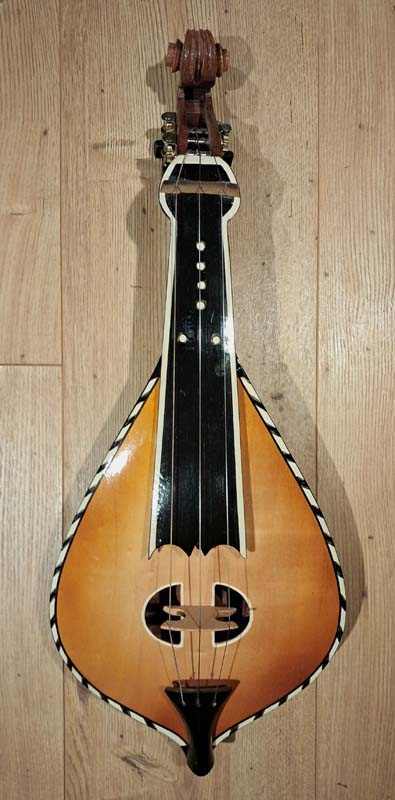
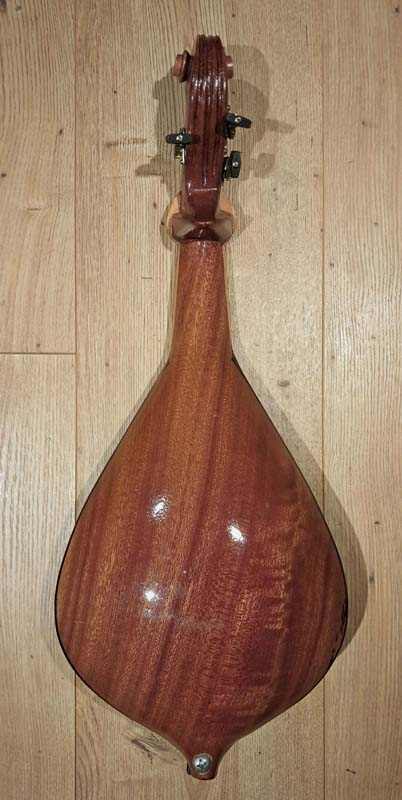
The Cretan lyra (Greek: Κρητική λύρα) is a pear-shaped three-stringed Greek Violin, a traditional musical instrument, central to the traditional music of Crete and other islands in the Dodecanese and the Aegean Archipelago, in Greece. The Cretan lyra is considered to be the most popular surviving form of the medieval Byzantine lyra, an ancestor of most European bowed instruments.

Playing style

The lyra is held vertically on the player’s lap, in the same way as a small viol, rather than being placed under the chin of the player like a violin. For normal right-handed playing, the player’s right hand holds the bow. The strings are stopped by pressing the fingernails of the player’s left hand against the side of the string, rather than by pressing the string against the fingerboard. This gives it a different tone from the violin. Older lyras (lyrakis) have one string which is normally not fingered and is used as a drone, playing the same note while tunes are played on the other two strings

Origins

The Cretan lyra is closely related to the bowed Byzantine lyra, the ancestor of many European bowed instruments. The 9th-century Persian geographer Ibn Khurradadhbih (d. 911), in his lexicographical discussion of instruments, cited the lyra as a typical instrument of the Byzantines along with the urghun (organ), shilyani (probably a type of harp or lyre) and the salandj (probably a bagpipe) (Margaret J. Kartomi, 1990).

The Byzantine lyra spread westward through Europe with uncertain evolution; a notable example is the Italian lira da braccio, a 15th-century bowed instrument and possibly the predecessor of the modern violin. Bowed instruments similar to the Cretan lyra and direct descendants of the Byzantine lyra have continued to be played in many post-Byzantine regions until the present day with small changes, for example the Gadulka in Bulgaria, the bowed Calabrian lira in Italy and the Classical Kemenche (Turkish: Armudî kemençe, Greek: Πολίτικη λύρα) in Istanbul, Turkey.

With regard to the period of introduction of the bowed instrument in the island, there are four schools of thought:

-1.The Byzantine lyra was introduced after 961 AD, when the island was reconquered from Arabs by the Byzantine Empire under the command of Nikephoros Phokas. At that time, noble families from Constantinople were sent to settle on Crete to inject new life and replenish the Greek population, who introduced many Byzantine traditions from Constantinople.

-2.The lyra was introduced from the islands of the Dodecanese, and entered the island through the eastern town of Sitia (where it was most popular), which is the neighbor of Kassos and Karpathos; this must have happened by the 12th century.

-3.The lyra was gradually introduced into the island’s traditions as a popular element of the Byzantine music and tradition, in a similar manner that lyra was introduced in other regions (e.g. the Lira da braccio and Calabrian lira in Italy and the Gadulka in Bulgaria).

Over the centuries and especially during the island’s Venetian era, the violin exerted its influence on the music of Crete both under the organological and musical aspect, bringing about profound changes in the instrument’s repertory, tunning, organology, musical language and performance practice.

Types

There are three major types of Cretan lyras:

-1.the lyraki (Greek: λυράκι), a small model of lyra, almost identical to the Byzantine lyra, used only for the performance of dances (Anoyanakis, 1976)

-2.the vrontolyra (Greek: βροντόλυρα), which has a very strong sound, ideal for accompaniment of songs

-3.the common lyra (Greek: λύρα κοινή), popular in the island today; designed based on the combination of lyraki with the violin.

The influence of the violin caused the transformation of many features of the old form of Cretan Lyra (lyraki) into the contemporary lyra, including its tuning, performance practice, and repertory. In 1920, the viololyra was developed in an effort by local instrument manufacturers to give the sound and the technical possibilities of the violin to the old Byzantine lyraki. Twenty years later a new combination of lyraki and violin gave birth to the common lyra. Other types include the four-stringed lyra.

In 1990, Ross Daly designed a new type of Cretan lyra which incorporates elements of lyraki, the Byzantine lyra and the Indian sarangi. The result was a lyra with three playing strings of 29 cm in length (the same as the standard Cretan lyra), and 18 sympathetic strings which resonate on Indian-styled jawari bridges (the number of sympathetic strings was later increased to 22).

Construction

The Lyra has a body (kafka, or kafki) with a pear-shaped soundboard (kapaki), or one which is essentially oval in shape, with two small semi-circular soundholes. The body and neck are carved out of one piece of aged wood (minimum 10 years old). Traditionally the body’s wood was sourced from trees growing in Crete such as walnut, mulberry and asfadamos, the local plane tree; today it is mostly imported.

The soundboard is also carved with a shallower arch and is usually made of straight-grained softwood: traditionally the aged wooden beams of buildings (katrani) and, ideally the 300-year-old wooden beams from Venetian ruins. In the past, the strings were made of animal gut and the bow (doxari) of horse-tail hair. In the past, the bow’s arc usually had a series of spherical bells, gerakokoudouna (hawk bells), to provide rhythmic accompaniment to the melody when the bow was moving. Today, most lyras are played with violin bows.

A method for the vibration analysis and characterization of the Cretan lyre top plates was reported in 2006.

Tuning

The old model of the Cretan lyra (also called lyraki ~ small lyra), is tuned 5-1-4. That is, the middle string is the lowest in pitch and the others are a 4th and a 5th above it. The performer plays the melody on the 1st and 3rd string, using the 2nd string as a drone (Magrini 1997), similarly to the Byzantine lyras from ca. 1190 AD, found in the excavations of Novgorod (Anthony Baines, 1992).

The contemporary lyra, modeled after Stagakis’ design, is tuned in fifths (to G-d-a’), similar to the lowest three strings of a violin, albeit without a droning string. All strings may be fingered and used as melody strings. Some Lyras have a fourth string at the top tuned, to “e” (E5), as a violin E-string, to allow for a larger octave range.

In use

The Cretan lyra is still widely used in Crete, in some islands of the Dodecanese and the Aegean archipelago as well as in parts of northern Greece.

Artists

Noted Cretan Lyra performers include Andreas Rodinos, Thanassis Skordalos, Kostas Mountakis, Kareklas, Nikos Xilouris, Leonidas Klados, Ross Daly, Michalis Kallergis, Nikos Gonianakis, Kelly Thoma, Zacharias Spyridakis, Paris Perysinakis, Dimitris Vakakis, Stelios Petrakis, Vassilis Skoulas, Yiorgos Kaloudis and Psarantonis. Today in Rhodes, Yiannis Kladakis is known for reviving this type of lyra in the island. Georgia Dagaki is known for playing the instrument at the current shows of rock singer Eric Burdon. Yiorgos Kaloudis has interpreted Johan Sebastian Bach’s suites for violoncello on the Cretan Lyra.

https://en.wikipedia.org/wiki/Cretan_lyra

Géza Orczi


Géza Orczi (Nagykáta, September 29, 1955 – April 8, 2021) Hungarian musician, percussionist and plucked-string instrumentalist, master instrument maker and restorer, founding member of Gandharvák, the group that created the Uplifting Classical genre, and Artisjus Award-winning performer.


Career

He began studying plucked string instruments at the age of nine. He was part of the pol-beat movement of the 1970s and 1980s. Later, his interests expanded to include percussion and wind instruments, as well as instrument making. In 1987, he passed the ORI exam in percussion and plucked string instruments, and in 1988, he also qualified as a bandleader. As a dancer, he became acquainted with the dance culture and folk music of the Balkan peoples, fields in which he has been continuously active. He was a permanent member and collaborator of ensembles and dance groups that play Balkan music and preserve traditions. He has participated in numerous productions as an accompanist for dance and theater performances. He is the recipient of several gold and platinum records.


His main instruments include the tapan, ud, saz, bouzouki, dzura, tambura, tamburica, and kaval.


As a master instrument maker and restorer, he specialized in traditional folk instruments.


Orchestral Activities

Orchestral Memberships

Kálmán Balogh, Besh o droM, Carmina Danubiana, Dilbere, Falkafolk, Gandharvák, Kolo, Kremenica, Makám, Rila, Szabotage, Sebő, Sirtos, Udrub, Vágtázó Csodaszarvas, Zora, Zsarátnok

Collaborations, Guest Appearances

Brathanki, Etnofon Music Association, Kaláka, Kálmánia, Korai öröm, Maskarades, Mydros, Pyrgos, Rece-Fice, Söndörgő, Vándor Vokál, Vizin


Performances

Plays

A Midsummer Night’s Dream (Besh o DroM, Szeged National Theater), Romeo and Juliet (Szabotage, Bárka Theater), The Lazy Tempefői (Sebő Band, Kőszeg Castle Theater), Dancing Hungarians, Pannon Fresco

Film music

Mátyás, the Prince Who Never Was (Sebő Band)

Festival Appearances

Mallorca World Folkdance 1997, 1999 – Grand Prize (Rila Ensemble), Womex, Sziget, Sopot, Volt, Kaláka, Misztrál, Magyarsziget, Philharmonic Tour with the Zsarátnok and Sebő Ensembles

Accompaniment for dance groups

Martenica, Tabán, Opanke, Jantra, Zdravec


Awards and recognitions

2004 “Honorary Bulgarian” certificate

2005 Artisjus Award (for promoting contemporary music)

2006 Bartók Commemorative Certificate


Discography

Balkandzsijszka Racsenica / Balkan Folk Music (as Géza Orczi) (Hungaroton, 1989)

Vándor Vokál: Polyphonic Folk Songs of Eastern Europe (Etnofon, 1995), The Moon Has Risen (Periferics, 2000), I Planted Roses (Belgium, Wildboar Music, 2002)

Zsarátnok: The Balkan Legends (New Tone Records, 1994)

Kálmán Balogh & The Gipsy Cimbalom Band: Gypsy Jazz (Rounder Select, 1999)

Rila: Bolgárkert (Fonó Budai Zeneház, 1999)

BesH o droM: Macsó Hímzés (Fonó, 2000) – gold record

Sebő Ensemble: Rejtelmek (Gryllus, 2001)

Makám: Anzix (FolkEuropa, 2003)

BesH o DroM: Don’t Point at Me (Asphalt Tango Records, 2003)

Ferenc Sebő: László Nagy (2004)

Ferenc Sebő: Attila József (2005)

Vágtázó Csodaszarvas: Pure Spring (2006) gold record

Vágtázó Csodaszarvas: Endless Asia! (Fonó Records, 2008) Gold Record

Carmina Danubiana: At the Foot of Buda Castle – The Hunyadis in Folklore (Csörsz Rumen István, 2008)

SzaboTage (Géza Orczi – Zoltán Szabó): Fairies and Witches (István Csörsz Rumen, 2009)

Vágtázó Csodaszarvas: Star Riding (2011) Early Joy Recycled 1998

Gandharvák: Uplifting Classical 1. (Gandharva Sound, 2012)

Ferenc Sebő: Weöres 100 (Gryllus, Hungarian Radio, 2013)

Gandharvák: Uplifting Classical 2. (Gandharva Sound, 2014)

Gandharvák: MAGIC (Gandharva Sound, 2016)

Additional albums were released in collaboration with the Brathanki, Zsarátnok (1994), Udrub (2004), Kálmán Balogh, and Vándor Vokál ensembles.


https://hu.wikipedia.org/wiki/Orczi_G%C3%A9za

Reviews

There are no reviews yet.

Add a review

For security, use of CloudFlare's Turnstile service is required which is subject to the CloudFlare Privacy Policy and Terms of Use.

You might also be interested in this

Privacy Preferences
When you visit our website, it may store information through your browser from specific services, usually in form of cookies. Here you can change your privacy preferences. Please note that blocking some types of cookies may impact your experience on our website and the services we offer.