





Zither - Nándor Hock - Rákospalota - Budapest
| Dimensions | 520 × 315 × 50 mm |
|---|---|
| Name of musical instrument | |
| Type of musical instrument | |
| Typical place of occurrence | |
| Date of manufature of instrument | |
| Place of manufacture | |
| Made by | |
| Restored by | |
| Scale | |
| Number of strings | |
| How to play musical instrument | |
| Continent | |
| Country |
CITERA
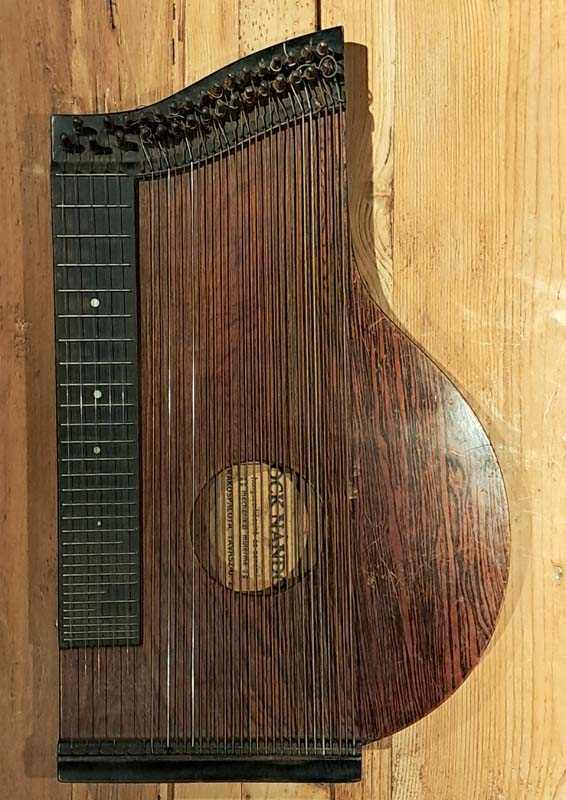
A citera magyar népi húros hangszer, amelyet pengetéssel szólaltatnak meg. Játék közben asztalra fektethető, legegyszerűbb változatában téglalap alakú hasáb formájú.
A citerafélék családjába tartozó hangszerek a világ szinte minden táján megtalálhatóak, gyakran egymástól nagymértékben eltérő méretű és formájú hangszerek tartoznak ide. A citerák fontos közös jellemzője, hogy a húrok a hangszertest felett húzódnak végig, nyakuk nincsen.
A magyar citera zömében mixolid hangsorú, kvintelő hangszer. Transzponálás nélkül harmonikusan szól rajta a C-dúr, d-dúr, g-mixolid típusú dallam. A kísérőhúrok nélkül szinte bármi lejátszható rajta.
A ma leggyakrabban elterjedt változat a “Dunántúli hasas” és az “Alföldi kölyökfejes” citeratípus keveréke.
Eredete
Magyarországon
A közhiedelemmel ellentétben, nincs arra vonatkozó megbízható adatunk, hogy a honfoglaló magyarság használt volna a néphagyományból ismert citerafélékkel rokonítható, pláne nem azokkal történeti kapcsolatba hozható citera típusokat. Habár a Gesta Hungarorum 46. fejezetében található „Et omnes symphonias atque dulces sonos cythararum et fistularum cum omnibus cantibus ioculatorum habebant ante se.” szövegrészben található cythara alakban némelyek a citerát vélik felfedezni, de a középkori hangszerelnevezések nyelvészeti elemzése inkább arra mutat, hogy az Anonymus által említett cythara hangszernév a kora középkorban elterjedt, vonóval is megszólaltatott kithara, a Cythara Teutonica lehetett. Emellett a korszak hangszerábrázolásainak az elemzése arra enged következtetni, hogy ebben az időszakban húros hangszer jelentéstartalommal kithara-nak nevezték a hárfát, lo. „Hortus Deliciarium” (1167-85) és a citerákhoz hasonló, de azokkal történetileg nem rokonítható pszaltériumokat is, lo. „De rerum naturis” (842-847).
Magyar nyelvterületről a citera legkorábbi leírása Balla Antal 1774-es zeneelméleti írásának „Az Tombora és Czimbalom honnét vette eredetét” fejezetében olvasható, ahol a monochord készítésének leírásában a „citera” szó helyett a „tombora” elnevezés szerepel és nem véletlen, hogy a tambura kifejezés az 1940-50-es évekig a citera általános elnevezése volt az Alföldön. Szintén az ún. hasábcitera „tambura” elnevezését látszik igazolni, hogy az Udvarhely (Hargita) megyei Etéden használt timbora, amit már Orbán Balázs is leírt, egy éllel összeenyvezett, falapokból álló, hat fakulcsos húrrögzítésű hasábcitera jellegű népi zeneszerszám.
A manapság használt citera elnevezés csak a 19. század első felében a Dunántúlon megjelenő salzburgi citera típussal együtt kezd elterjedni. A hasábciterák ősének tekinthető Scheitholtból a keleti Alpokban a fejlődött ki a 18. század végén az ún. Mittenwaldi forma, ami egy diatonikus, fogólappal ellátott, jellegzetes körte alakú hangszertestű citera típus. A hangszertest formai változásához a lanttípusú ciszter szolgálhatott mintául, amelynek elnevezése szintén indirekt kapcsolatba hozható a citerával. Ugyanebben az időszakban megjelent Halleinban egy hasas-kisfejes kiképzésű, diatonikus fogólappal ellátott citeraforma, amelyet a közeli nagyvárosról salzburgi citera típusnak neveznek és amely típus morfológiailag egyértelműen rokonítható a Dunántúl területén elterjedő népi elnevezéssel hasas citera típussal.
Európa
Habár a Kínában elterjedt guqin/kucsin (’ősi csin’) elnevezésű, 7 húros, domború hangszertestű citera típus a legendák szerint 3000 éves múltra tekint vissza, az adatok áttekintése kétségessé teszi, hogy a távol-keleti citeratípusok Európába is eljutottak volna. A távol-keleti, domború hátú citeratípusok felépítése a korábbi, idiochord, bambuszból készült változatokkal magyarázható, és ezek Délkelet-Ázsiából terjedtek el északi irányba és jutottak el kínai nyelvterületre. Az európai lapos citerák azonban morfológiailag eltérő típusok, és eddigi adataink szerint Európában nincs nyoma a távol-keleti, domború kialakítású citeratípusoknak.
A történeti adatok áttekintése arra enged következtetni, hogy az európai citera valószínűsíthetően az ókori monochordból fejlődött ki, amely a püthagoreus kor találmánya volt. A monochord hangközjelekkel ellátott hosszúkás doboz, amely fölé egy húrt feszítettek, és húr alatt levő mozgatható húrlábbal a húr hossza tetszés szerint osztható volt és nem a zenélés volt a célja, hanem a húr, különböző hangközeinek megfelelő bemutatására szolgált. A kora középkorban, a keresztény monostorokban a monochordot szintén hasonló funkcióban használták és a legkorábbi ábrázolása 1100-ból, az augsburgi Szt.Ulrik és Szt. Afra apátság kéziratából ismert. A monochord fontosságát igazolja, hogy a korszak legismertebb zeneteoretikusát, Arezzói Guidót és pártfogóját, Theobald püspököt szintén egy monochorddal ábrázolják egy 12. századra datált délnémet kézirat miniatúráján. De már a 11. században a Ruhr vidéki Werden apátságban készített zsoltár egyik miniatúráján jól látható, hogy a monochordot a vonós lírával és a pszaltériummal együtt tánckísérő hangszerként is alkalmazzák. A 14. század végéről a már citeraként alkalmazott hangszertípus korai ábrázolása a Westminsteri katedrális káptalani gyűléstermének 1380-as években készített freskóján is látható, ahol az egyik zenélő angyal egy kéthúros a monochorhoz hasonló felépítésű hangszeren játszik. Amint az Johannes Aventinus (Johann Georg Turmair) 1516-ban, Augsburgban kiadott „Musicae rudimenta…” című művében, Nikolaus Faber által készített „Schema monochordi” című képéről kiderül, a „monochord” ebben az időszakban már két vagy háromhúros. Az alpesi citera hangszertípus népi hangszerként való alkalmazása Svájcból 1499-ből adatolható, ahol Thomas Platter leírásában egy cserépdobozra erősített, felhúrozott hangszert fadarabbal vagy ujjakkal pengetve szólaltattak meg.
Dánia déli részén, Fyn szigetén található Rynkeby, amelynek templomi freskóján 31 zenélő angyal közül az egyik hosszú, vékony három húros citera típusú hangszeren játszik. Az 1560-ra datált ábrázoláson látható hangszertípus valószínűleg a Langeleg vagy Hummel hasáb citeratípusok egyik korai formája, amely főleg a protestáns északi népek körében terjedt el. A típus későbbi jellegzetessége, hogy a húrok feszességét a vonós hangszerekhez hasonló kialakítású kulcsszekrénnyel lehet szabályozni. Ehhez hasonló citera típusok Franciaországban a Vogézek környéki épinette des Vosges és az alpesi népek körében elterjedt Scheitholt. Ez utóbbi hangszerelnevezés az alnémet Scheitholt ’hasáb fa’ kifejezésből származik, ami Michael Praetorius „Syntagma Musicum II.” című, a kor hangszereit bemutató könyvében vándorénekes hangszerként szerepel. A történeti adatok áttekintése pedig arra mutat, hogy ez a hasábcitera típus terjedt el a 18. század folyamán cseh, morva és szlovák közvetítéssel, először az Alföldön, majd a magyar nyelvterület nagy részén.
Távol-Kelet
Kína
Az úgynevezett Cs’in citera, Kína egyik legősibb hangszere, a kultúra és a civilizáció jelképe. Pengetővel szólaltatják meg hét húrját. A húrokat nem támasztja alá egyetlen láb sem.
Korea
Koreában több, citerához hasonlító hangszer is létezik, például a kajagum és a komungo.
Felépítése
A hangszer nagyjából téglalap alakú. Hossza körülbelül fél méter. Az egyik hosszanti oldala egyenes vonalú. Itt helyezkedik el a fogólap (menzúra).
A fogólapon egymástól különböző távolságra helyezkedik el a két sor érintő. A külső soron a hét törzshang van, két és fél oktáv szélességben. A belsőn a kromatikus hangok találhatók. A két hangsor egymáshoz való viszonya megegyezik a zongorán található fekete és fehér billentyűk szerepével. A fogólap mellett jobb oldalon van az oldalrész, itt pengetnek.
A citera jobb kezünk felőli végében találjuk a húrtartó szegeket, a bal felőliben a fejet. Itt vannak a hangolószegek. Ezekre vannak hangolókulccsal rátekerve a húrok, és itt lehet a húr mélységét, magasságát beállítani, tehát hangolni. A szemben lévő oldal a fejtől lépcsőzetesen szélesedik. Az oldalrészek által bezárt korpuszt hangszertestnek vagy hangszekrénynek nevezik. A hangszekrény két végén két húremelő bak is van, ami a húrokat emelni hivatott. A citeráknak három lábuk van, kettő a fogólap felőli két végén, a harmadik a szemben lévő oldal közepén. A lábak magassága körülbelül 5–6 mm, átmérője 8–10 mm, céljuk az egyenlőtlenségek kiküszöbölése és a csúszásgátlás. A fejeket gyakran díszítik faragással.
Húrozás
Három csoportba sorolhatók, citerától (készítőtől, mérettől) függően az egyes csoport húrjainak száma változhat.
-Dallamhúrok (3-4 db a diatonikus fogólaprészen, 2-3 a pentaton fogólaprészen)
-Basszushúrok (ált. 3db)
-Kölyökhúrok (zengőhúrok) (ált. 3 pár)
Fajtái
Dunántúli hasas citera, ami a legfelső kölyökfej után hirtelen kidomborodik
Alföldi kölyökfejes citera
Pengetése
A citera pengetésére 40-50 évvel ezelőtt kizárólag kihegyezett tollat (szárny és faroktollat) használtak. Ezt mára teljesen kiszorította a szabvány háromszög alakú, közepes keménységű műanyag pengető.
A nyomó
Régen a húrokat kizárólag nyomóval szorították le.
-Tollnyomó, a pengetésre is használt tollat lefaragták, és farudacskát nyomtak bele
-Fanyomó, díszesen, legtöbbször ember alakúra faragták
Használat előtt mindkettőt megfaggyúzták.
-Előnye: a csúsztatások, glissandók szépek.
-Hátránya: a díszítéseket, gyors futamokat nehezebb vagy lehetetlen vele kijátszani.
A citerán megszólaltatható hangsorok, hangnemek
Korlátozott a hangszeren játszható hangnemek száma. Ez abból adódik, hogy a kísérőhúrok az alaphang felhangjaira vannak hangolva, így más záróhang nehezen képzelhető el, hiszen nem kapjuk a tökéletes befejezés érzetét. Bizonyos esetekben disszonáns hangzást idézhetünk elő a citerán nem játszható hangnemben való játék esetén, amikor is egy hangnemben olyan hangok vannak, amelyek a zengőhúrokkal történő együtthangzáskor disszonáns hangközöket szólaltatnak meg. A dallam záróhangjának a citerán az írott “C” hangnak kell lennie. A kísérőhúrok is ennek a hangnak a felhangjaira vannak felhangolva. Kivételes esetben lehetséges a „G”-re történő dallamzárás a kvartszextes- mixolíd és a kvartszextes- fríg hangnemek esetében.
A hangnemek korlátozottsága nem tesznek lehetővé dallamokon belüli modulációkat. Ez a magyar népzene esetében nem jelent problémát, hiszen a magyar dallamkincs többsége nem él hangnemi kitérésekkel, illetve a kivételes modulációk azonos alaphangú hangnemben maradnak. Modulációs gondok olyan táncdallamoknál lehetnek, amelyek klasszicista mintájú periódusépítkezésűek. Itt ugyanis domináns hangnemi kitérések vannak. A hangszer hangolása és a rajta játszható hangnemek lehetővé teszik az ének kísérését.
A citera hangolása
A citerán található húrokat úgynevezett húrcsoportokra oszthatjuk. Ennek megfelelően megkülönböztetünk dallamhúrokat, basszushúrokat és kísérő vagy zengőhúrokat. A dallamhúrok a kombinált fogólapon találhatók. Kombinált, mert a fogólap két részből áll: a diatonikus fogólapból (mint a zongora fehér billentyűi) és a pentaton fogólapból (mint a zongora fekete billentyűi). A gyakorlatban ezzel a fogólap-típussal találkozhatunk. A tisztán diatonikus fogólappal készült hangszerek néhány példánya a legkésőbbi időkig a Dunántúlon, Somogy és Baranya megyében voltak fellelhetőek. A dallamhúrok száma eltérő lehet, de általában 4+3 vagy 3+2 db (diatonikus + pentaton). Azonos hangra vannak felhangolva, ami általában ’G’. A ’G’ hangra történő hangolás esetén a harmadik érintőnél fogott hang ’C’ lesz. A citerások azt a hangot mondják ’C’-nek, de ha a dallamhúrok alaphangolása eltér a ’G’ hangtól, akkor a játszott ’C’ hang helyett más hangzik. A legfontosabb, hogy az „üres” dallamhúr hangja és a mindig ’C’ hangnak mondott hang között T4 hangköz van. (Gyakori, hogy a dallamhúrok alaphangolása nem ’G’, hanem ’Gisz’ vagy ’A’, ekkor ha a citerás ’C’-t játszik, valójában ’Cisz’ vagy ’D’ szól.)
Az összes többi húr a dallamhúrokhoz viszonyítva van hangolva. A következő húrcsoport a basszushúrok. Ezek száma általában három, de ezek számában is lehetnek eltérések. Hangolásuk a következőképpen alakul: „kisbasszus”, ami a diatonikus fogólap harmadik érintőjén lévő (’C’) hangra van hangolva, ezt követi a „középbasszus”, ami a dallamhúrok alsó oktávjára, és a „nagy basszus”, ami a diatonikus fogólap harmadik érintőjén lévő (’C’) hang alsó oktávjára van hangolva.
A kísérőhúrok (vagy zengőhúrok) hangolása.
Ezek számában lehet a legnagyobb eltérés, mert 3-8 darab is lehet. Ennek száma függ az oldalfejek (kisfejek) számától és attól, hogy az egyes kisfejekre hány húrt tesznek (1-2 db). A hangolásuk tematikája követi a basszushúrokéit a következőképpen. (Itt most 4 darab zengőhúrt veszünk alapul.) A „nagybasszus húrt” követően általában van egy zengőhúr, ami még a főfejen található, ennek hangolása megegyezik a dallamhúrok alaphangolásával. Az ezt követő zengőhúr ennek felső kvartjára van hangolva, vagyis a diatonikus fogólap harmadik érintőjén lévő hangra (a leggyakrabban ’C’), az ezt követő zengőhúrt a dallamhúrok alaphangjának felső oktávjára, és azt ezt követő zengőhúrt a diatonikus fogólap harmadik érintőjén lévő (általában ’C’) hang felső oktávjára hangolják.
https://hu.wikipedia.org/wiki/Citera
ZITHER
Zither is a Hungarian folk stringed instrument, played by plucking. It can be laid on a table while playing, and in its simplest version it is shaped like a rectangular oblong.
Instruments of the zither family are found in almost all parts of the world, often in widely differing shapes and sizes. An important common feature of the zithers is that the strings extend over the body of the instrument, without a neck.
The Hungarian zither is a quintal instrument, mostly with a mixolid scale. Without transposing, it plays harmonically in C major, D major and G-mixolid. Without the accompanying strings, almost anything can be played on it.
Today the most common variation is a mixture of the ‘Dunántúli hasas (Transdanubian belly)’ and the ‘Alföldi kölyökfejes (Lowland puppy-headed)’ type of zithers.
Roots of instrument
Hungary
Contrary to popular belief, there is no reliable data to suggest that the occupying Hungarians used any zither types related to the zither known from folklore, or to those that can be historically related to them. Although the Gesta Hungarorum, in chapter 46, states that “Et omnes symphonias atque dulces sonos cythararum et fistularum cum omnibus cantibus ioculatorum habebant ante se.” and as the word cithara can be found in the text of some people think that it is the citera, but a linguistic analysis of medieval instrument names suggests that the instrument name cythara mentioned by Anonymus may have been the cythara Teutonica, a kithara that was also played with a bow and was common in the early Middle Ages. In addition, an analysis of the instrumental representations of the period suggests that harps (see “De rerum naturis” 842-847) and also psalteries similar to, but not historically related to, the zithers (see “Hortus Deliciarium” 1167-85) were also called kitharas with the meaning of string instrument.
The earliest description of the zither in Hungarian is found in Antal Balla’s 1774 musicological treatise “Where the Tombora and Czimbalom originated”, where the word “tombora” is used instead of “zither” in the description of the making of the monochord, and it is no coincidence that the term tambura was the common name for the zither in the Alföld (Lowlands) until the 1940s and 1950s. The name log-zither ‘tambura’ also seems to confirmed by the name of so-called timbora used in Etéd, Udvarhely (Harghita) county, which has already been described by Balázs Orbán, being a log-zither-like folk musical string instrument consisting of wooden panels glued by edges with six wooden tuning pegs.
The name ‘zither’ as it is used today only began to be used in the first half of the 19th century, when the Salzburg zither began to appear in the Transdanubian region. In the eastern Alps, the so-called Mittenwald form, a diatonic, pear-shaped instrument with a diatonic fingerboard, developed from the Scheitholt, the ancestor of the belly zither, at the end of the 18th century. The change in the shape of the body of the instrument may have been inspired by the lute-type cittern, whose name is also indirectly related to the zither. At the same time, a form of zither with a belly-headed form, with diatonic fingerboard appeared in Hallein, which is known as the Salzburg zither type from the nearby town and which is morphologically clearly related to the popular name of the belly cittern type in the Transdanubian region.
Europe
Although the 7-stringed, convex-bodied zither type known as guqin (‘ancient chin’), which is common in China, is said to date back 3,000 years, a review of the data casts doubt on whether Far Eastern zither types have reached Europe. The Far Eastern convex-backed zither types are based on earlier idiochord bamboo versions and spread northwards from Southeast Asia to Chinese-speaking areas. However, the European flat zithers are morphologically different types, and so far there is no evidence of Far Eastern citeras of convex design in Europe.
A review of the historical records suggests that the European zither probably evolved from the ancient monochord, which was an invention of the Pythagorean period. The monochord was an elongated box with a string stretched over it and a movable string foot under the string, which allowed the length of the string to be varied at will, not for the purpose of playing music but for the purpose of presenting the string in its various pitches. In the early Middle Ages, the monochord was also used in Christian monasteries for a similar function and its earliest depiction dates from 1100 in a manuscript of the Abbey of St. Ulrik and St. Afra in Augsburg. The importance of the monochord is attested to by the fact that the most famous music theorist of the period, Guido of Arezzo and his patron Bishop Theobald, are also depicted with a monochord in a miniature of a 12th century South German manuscript. But as early as the 11th century, a miniature of a psalm from the Abbey of Werden in the Ruhr clearly shows the monochord being used as a dance accompaniment, along with the stringed lyric and the psaltery. An early depiction of the instrument, already used as a citer from the late 14th century, can be seen in a fresco of the Chapter House of Westminster Cathedral from the 1380s, where one of the angels playing a two-stringed instrument similar in construction to the monochord is shown. As can be seen from the picture of the “Schema monochord” by Nikolaus Faber in “Musicae rudimenta…” by Johannes Aventinus (Johann Georg Turmair), published in Augsburg in 1516, the “monochord” of this period already had two or three strings. The use of the alpine zither as a folk instrument dates back to 1499 in Switzerland, where Thomas Platter describes a stringed instrument attached to an earthenware box and played with a wooden stick or by finger-picking.
Rynkeby, on the island of Fyn in southern Denmark, has a church fresco showing one of 31 angels playing a long, thin, three-stringed zither-type instrument. The type of instrument depicted in the painting, dated 1560, is probably an early form of the Langeleg or Hummel belly-stringed zither, which was mainly used by Protestant northerners. A later feature of the type is the ability to adjust the tension of the strings by means of a key cabinet of a design similar to that of a stringed instrument. Similar types of zither in France are the épinette des Vosges around the Vosges and the Scheitholt, which is widespread among the Alpine peoples. The latter instrument derives its name from the German Scheitholt, meaning ‘split wood’, which is described in Michael Praetorius’ book ‘Syntagma Musicum II’ as a minstrel instrument. A review of the historical data shows that this type of log-zithe spread during the 18th century through Czech, Moravian and Slovak mediation, first in the Lowlands (Alföld) and then in most of the Hungarian-speaking area.
Far East
China
The so-called Ch’in zither, one of China’s most ancient instruments, is a symbol of culture and civilisation. Its seven strings are played with a pick. The strings are not supported by a single leg.
Korea
In Korea, there are several instruments similar to the zither, such as the kajagum and komungo.
Construction
The instrument is roughly rectangular. It is about half a metre long. One long side is straight. This is where the fingerboard (scale) is located.
On the fingerboard there are two rows of tangents at different distances from each other. On the outer row are the seven trunk teeth, two and a half octaves apart. On the inner one are the chromatic notes. The relationship of the two sets of notes to each other is the same as the role of the black and white keys on a piano. To the right of the fingerboard is the lateral part, where the plucking takes place.
The string pegs are at the right-hand end of the zither, the head at the left. Here are the tuning pins. The strings are wound onto these with tuning key, and here you can adjust the depth and height of the strings, i.e. tune them. The opposite side of the head widens in steps. The corpus, enclosed by the sides, is called the body of the instrument or the soundbox. The two ends of the soundbox also have two string bucks to lift the strings. The zithers have three legs, two at each end of the fingerboard and the third in the middle of the opposite side. The height of the legs is about 5 to 6 mm and the diameter 8 to 10 mm, their purpose being to eliminate unevenness and prevent slipping. The heads are often decorated with carving.
Stringing
There are three groups of strings, the number of strings in each group may vary depending on the citer (maker, size).
-Melody strings (3-4 on the diatonic fingerboard part, 2-3 on the pentatonic fingerboard part)
-Bass strings (usually 3 strings)
-Kid strings (accompanying strings, drone strings) (3 pairs)
Types
-Transdanubian (Dunántúli) belly zither, which suddenly bulges out after the uppermost pup
-Lowland (Alföldi) puppy-headed zither
Plucking
40 to 50 years ago, only sharpened feathers (wing and tail feathers) were used to pluck the zither. This has now been completely replaced by the standard triangular, medium-hard plastic pick.
The presser
In the old days, strings were clamped exclusively with a presser.
-feather presser, the feather, which was also used for plucking, was cut off and a wooden stick was pressed into it
-woodden presser, ornately carved, usually in the shape of a man
Both were tallowed before use.
-Pros: the slips and glissandos are beautiful.
-Cons: ornamentation of tunes, fast runs are more difficult or impossible to play with it.
The modes and scales that can be played on the zither
The number of modes that can be played on the instrument is limited. This is due to the accompanying strings are tuned to the overtones of the fundamental tone, so that other ending tone is difficult to imagine since you do not get the feeling of a perfect ending. In some cases, a dissonant sound can be produced on the zither by playing in a mode, that cannot be played on it, where the mode contains notes when played together with drone strings, produce dissonant intervals and sounds discordant. The final note of the melody on the zither should be the written ‘C’. Drone strings are also tuned on overtones of this note. In exceptional cases it is possible to end the melody on ‘G’ in 4th, 6th mixolydian and in 4th, 6th phrygian modes.
The limited nature of the modes does not allow for modulations within a melody. This is not a problem for Hungarian folk music, since the majority of Hungarian melodic culture does not make use of tonal excursions or exceptional modulations remain in the same fundamental tone. Modulation problems may arise in case of dance melodies that are periodically constructed in a classical manner. Here there are dominant tonal excursions. The tuning of the instrument and the and the modes that can be played on it make it possible to accompany the singing.
Tuning the zither
The strings on the zither can be divided into so-called string groups. Accordingly, we distinguish between melody strings, bass strings and accompanying or chord strings. The melody strings are found on the combined fingerboard. Combined, because the fingerboard consists of two parts: the diatonic fingerboard (like the white keys of a piano) and the pentatonic fingerboard (like the black keys of a piano). In practice, this type of fingerboard is found. In the Transdanubian (Dunántúli) region, in Somogy and Baranya counties, a few instruments made purely with diatonic fingerboards were found until the latest times. The number of strings may vary, but they are usually 4+3 or 3+2 (diatonic + pentatonic). They are tuned to the same note, which is usually ‘G’. When tuned to ‘G’, the note taken at the third tangent becomes ‘C’. Zither players say that note is ‘C’, but if the tuning of the melody strings is different from ‘G’, the note played is different from ‘C’. The most important thing is that there is a T4 interval between the ‘blank’ melody string and the note that is always said to be ‘C’. (It is common for the root of a melody string to be ‘G#’ or ‘A’ rather than ‘G’, so that when the citer player plays ‘C’, it is actually ‘C#’ or ‘D’.)
All other strings are tuned in relation to the melody strings. The next group of strings are the bass strings. These are usually three in number, but there may be variations in their number. They are tuned as follows: ‘minor bass’, tuned to the third tangent (‘C’) of the diatonic fretboard, followed by ‘middle bass’, tuned to the lower octave of the melody strings, and ‘major bass’, tuned to the lower octave of the third tangent (‘C’) of the diatonic fretboard.
The tuning of the accompanying strings (or drone strings).
The number of these can vary most, as there can be 3-8 of them. The number of these depends on the number of side heads (minor heads) and the number of strings (1-2) placed on each minor head. Their tuning theme follows that of the bass strings as follows (here we will assume 4 strings.) After the ‘major bass string’ there is usually a drone string still on the main head, tuned in the same way as the basic tuning of the melody strings. The following drone string is tuned to the upper fourth of the melody strings, i.e. the note on the third tangent of the diatonic fretboard (most often ‘C’), the following drone string is tuned to the upper octave of the melody strings, and the following accompaniment is tuned to the upper octave of the note on the third tangent of the diatonic fretboard (usually ‘C’).
no data


Reviews
There are no reviews yet.