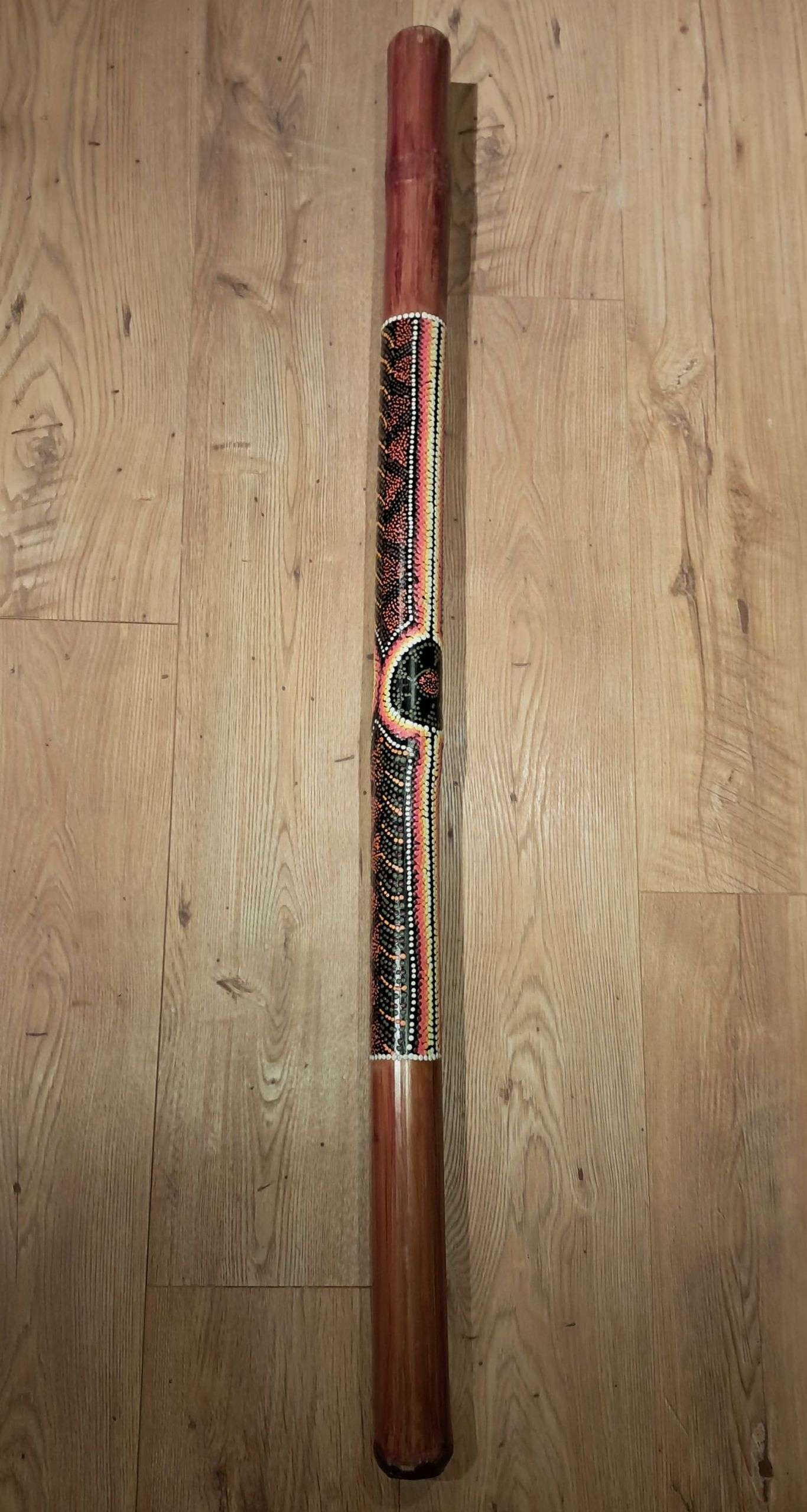
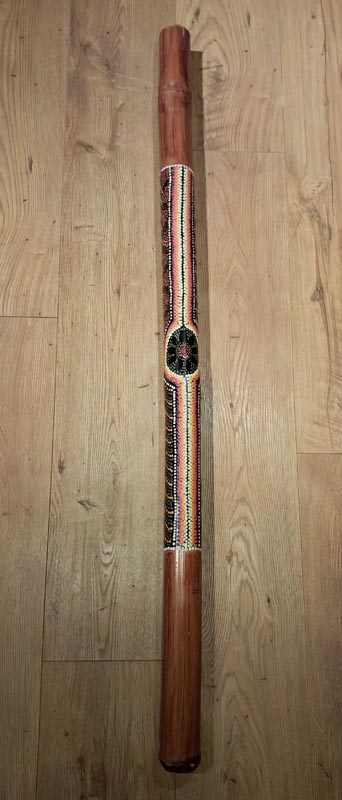
Didgeridoo
| Dimensions | 1195 × 55 × 55 mm |
|---|---|
| Name of musical instrument | |
| Type of musical instrument | |
| Typical place of occurrence | |
| Date of manufature of instrument | |
| Place of manufacture | |
| Made by | |
| Restored by | |
| Scale | |
| Number of strings | |
| How to play musical instrument | |
| Continent | |
| Country |
Didgeridoo is a wind instrument of the Indigenous people of northern Australia. Although it is most often made of wood, the way it is played makes it a member of the brass family of instruments.
Traditionally, the didgeridoo is made from the trunk or branch of a eucalyptus tree hollowed out by termites. Its hollow is usually conical, i.e. smaller at the blowing end than at the bottom end. Beeswax is often added to the edge of the infuser, which allows the player to adjust the gap to his own mouth. The surface is often decorated with paint.
More recently, the instrument is often made using the ‘sandwich’ method, i.e. glued together from two pieces of wood which have been properly hollowed out. It can also be made of reed or plastic. To meet the needs of contemporary western orchestral music-making, there is also a version that can be tuned while playing, in which case the length of the instrument can be varied by means of a telescopic extension.
no data

Reviews
There are no reviews yet.