



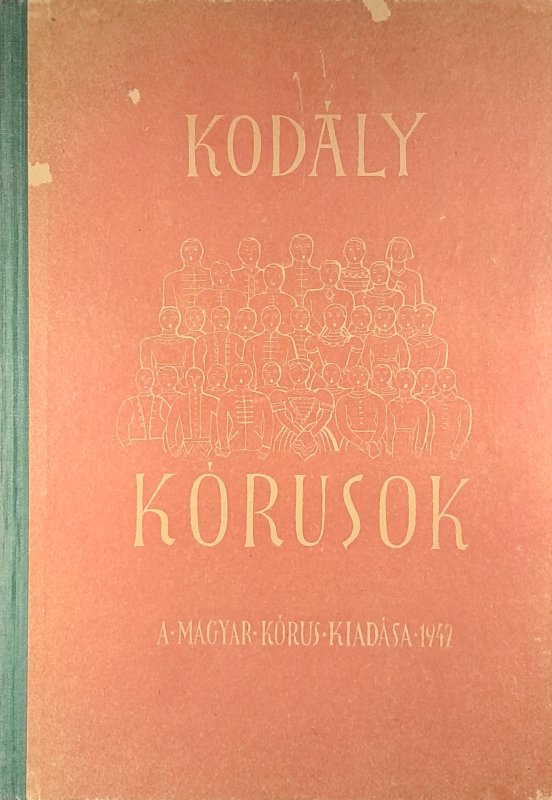
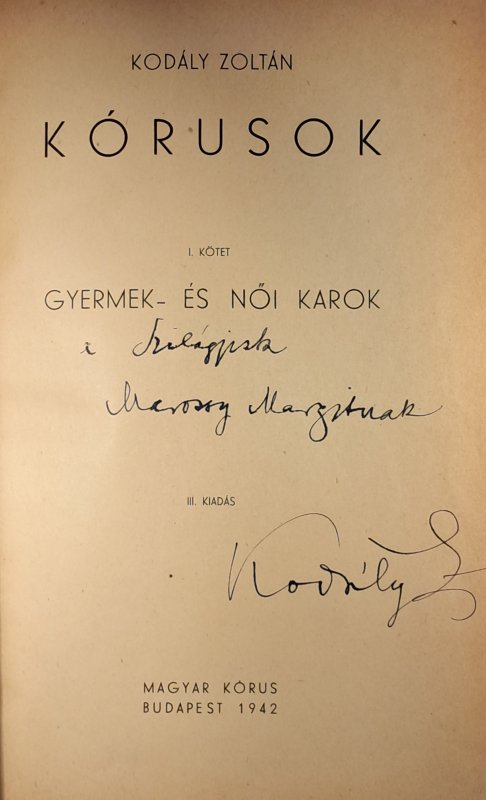


Book – Zoltán Kodály: Choirs – Dedicated – Margit Marossy – Szilágyi Erzsébet High School - Righteous Among the Nations
| Author and Title | |
|---|---|
| Published by | |
| Place of Edition | |
| Year of Edition | |
| Number of pages | 162 |
| Language | Hungarian |
| Country | |
| Size (length x width – mm) | 240×170 |
| Within other caregory | Book |
ZOLTÁN KODÁLY
Zoltán Kodály (Kecskemét, December 16, 1882 – Budapest, March 6, 1967) was a Hungarian composer, musicologist, music educator, and folk music researcher who was awarded the Kossuth Prize three times and honored with the title of “Outstanding Artist.” He was a member of the Hungarian Academy of Sciences (MTA) and served as its president from 1946 to 1949.
His Life
His father, Frigyes Kodály (1853–1926), who had Hungarian, Flemish, Czech, and Moravian ancestry, worked as a cashier at the freight yard of the Kecskemét railway station and later served as stationmaster in Szob, Galánta, and Nagyszombat. His mother was Paulina Jalovetzky (1857–1935), the daughter of a Polish-born innkeeper. His father played the violin, and his mother played the piano and sang.
He completed his elementary education at the public school in Galanta (1888–1892) and his secondary education at the Archiepiscopal High School in Trnava (1892–1900). He had already begun composing by this time, but he likely destroyed his early attempts. On June 13, 1900, he graduated with honors. In September, he moved to Budapest and enrolled in the Hungarian–German program at the Hungarian Royal University of Budapest, and was also admitted to Eötvös College, where Béla Balázs was his roommate. In addition to the university, he enrolled in the composition department of the Royal Hungarian Academy of Music. His music teacher was János Koessler. His Overture in C minor (1899) and his Trio in E-flat major (1899) were premiered at the school’s concerts. The very first (very favorable) review of these works later appeared in a Bratislava newspaper. In June 1904, he received his degree in composition. In September, he re-enrolled at the Academy of Music as a voluntary repeat student.
After studying previously published collections of folk songs and Béla Vikár’s early phonograph recordings, he set out in August 1905 to personally record authentic folk songs on site from the lips of peasant singers—the “nótafák.” He began his work in Galánta and continued in the surrounding villages. In the space of a month, he collected 150 melodies in this region between the Little Danube and the Vág. Thirteen of these were published under the title “Mátyusföldi Collection” in the journal Ethnographia. Then, based on the complete available material (about a thousand songs), he completed his dissertation: The Strophic Structure of Hungarian Folk Songs (1906). Early in his research, he met Béla Bartók, who was following a similar path, and this marked the beginning of their lifelong friendship. In 1906, they jointly published ten folk songs each under the title Hungarian Folk Songs, accompanied by piano. On October 22, he presented his diploma work, Summer Evening. He then embarked on a six-month study trip to Bonn and Paris. There he became acquainted with the music of Claude Debussy. In 1907, he was appointed professor of music theory at the Academy of Music, and in 1908, professor of composition.
On March 17, 1910, at his first recital, he presented instrumental compositions to the general public. On August 3, in Budapest’s Terézváros district, he married Emma Sándor (Schlesinger), the daughter of Móric Schlesinger and Sarolta Deutsch.
Between 1909 and 1920, he composed exclusively songs with piano and orchestral accompaniment, piano works, and chamber pieces. His Violin-Cello Sonata (1914) and his Solo Sonata for Cello (1915) date from this period. In his vocal works, he sought above all to establish a Hungarian song tradition. It is no coincidence that he titled one of his song cycles *Belated Melodies*. Kodály, in fact, sought to compensate for the lack of a song tradition – one that did not yet exist during the lifetimes of these poets – through his works set to the poems of Hungarian classical poets such as János Arany, Sándor Kisfaludy, Dániel Berzsenyi, Ferenc Kölcsey, Mihály Csokonai Vitéz, and Bálint Balassi. But contemporary literature also piqued his interest: he set the poems of Endre Ady to music just as he did the works of his friend Béla Balázs or Zsigmond Móricz. In addition to all this, we also owe the birth of prosody adapted to the tendencies of the language to his songs.
The outbreak of World War I not only hindered the spread of his works in Western Europe but also prevented him from continuing his fieldwork in the villages. For this reason, Kodály wrote popular science and scholarly articles for the journals *Ethnographia* and *Zenei szemle*. In 1919, during the Hungarian Soviet Republic, he was appointed deputy director of the Academy of Music, now known as the College of Music. Together with Bartók and Dohnányi, he was a member of the music directorate.
Between 1920 and 1923, he did not compose any new works, but then, in just two months, he completed the Psalmus Hungaricus, commissioned to mark the 50th anniversary of the unification of Pest, Buda, and Óbuda. Kodály quickly became Hungary’s leading composer. His work was recognized in 1930 with the Corvin Wreath award.
The Hungarian psalm composed to a text by Mihály Vég of Kecskemét not only won over the majority of public opinion to Kodály’s side, but also attracted a host of students. With Kodály’s intellectual support and in the spirit of his ideals of folk education and cultural enrichment, he founded the journals *Magyar Kórus* and *Énekszó* in the mid-1930s. Both were dedicated to reforming Catholic church music and raising the standard of music education. Kodály decided to compose works for children’s choirs from then on. The song cycle Háry János (1925-27), the Marosszék Dances (1930), and the Galánta Dances (1933). Through the Psalmus, his music had already reached concert halls across Europe and America. The Peacock Has Taken Flight (1938-39) and the Concerto (1934) were commissioned specifically for foreign audiences: the former by the Concertgebouw in Amsterdam, the latter for the 50th anniversary of the Chicago Philharmonic.
In the 1930s, alongside his large-scale orchestral works, Kodály’s dream also came true: folk songs were performed on concert stages and at the Opera House. At his song recitals, which began in 1925, numerous folk song arrangements were performed from the ten-volume series Hungarian Folk Music, with several outstanding Hungarian vocalists playing a significant role.
The major change came with the Transylvanian Spinning Room, whose musical repertoire was based exclusively on folk songs. In his later choral works, Kodály turned once again to Hungarian poetry. For the benefit of Hungarian ethnography, he wrote his summary of the history of folk music, *Hungarian Folk Music*, in 1937. Kodály also highlighted that, in the absence of historical musical records, the most important auxiliary discipline of Hungarian music history research is ethnomusicology, and with this, he established a new discipline in Hungary: comparative ethnomusicology.
A new theme in Kodály’s writings was music education, which he regarded as a “musical mission.” He spoke out on the issue of Hungarian choral singing (1937) and also proposed the idea of music education in kindergartens (Music in Kindergarten, 1941). In parallel with this work, he produced numerous pedagogical works for schoolchildren: first came Bicinia Hungarica (four volumes, 1937–1942), an introduction to two-part singing. At the turn of the 1930s and 1940s, Kodály’s plan to raise the standard of music education in elementary schools received support from both the government and the city of Budapest. In 1938, he protested against the anti-Jewish laws in the columns of the Pesti Napló, alongside thirty-two leading intellectuals. In 1940, shocked by the German occupation of Norway, he set Sándor Weöres’s poem “Norwegian Girls” to music. His revolutionary Petőfi choruses (Battle Song, Sons of Rabhaza, Miracle of God) proclaimed the ideals of Hungarian cultural and national independence in an era that was increasingly submitting to the oppressive German powers.
He retired in 1942 but continued to teach folk music at the Academy of Music; the government awarded him the Middle Cross of the Order of Merit of Hungary. The National Federation of Hungarian Song Associations declared 1942 the “Year of Kodály.” In 1943, the Hungarian Academy of Sciences elected him a corresponding member, and in 1945, a full member. In 1944 and 1945, he attempted to rescue Jews. During the siege of Budapest, he too was forced into the cellar of a Budapest convent. It was there that he composed his Mass for orchestra, organ, and choir, the Missa brevis, a work imploring for peace (an organ solo version of this, the Organoedia, had already been completed in 1942 during his stay in Galyatető; during the siege, he added organ-choir, and orchestra-choir textures), was finally premiered on February 11, 1945, in the cloakroom of the Opera House as the capital’s first performance following the February 1945 siege.
A year after the death of his first wife, Emma Sándor (November 22, 1958), on December 18, 1959—two days after his 77th birthday—he married Sarolta Péczely, a 19-year-old native of Dombóvár.
Following World War II, Kodály played a pivotal role in the country’s intellectual reconstruction. He was entrusted with numerous public duties: he was elected president of the Hungarian Arts Council and the Free Association of Musicians, and appointed chairman of the board of directors of the Academy of Music. Following the 1945 National Assembly elections, the newly formed National Assembly, recognizing him as a prominent public figure, invited him—along with nine others—to serve as a representative in Parliament under a special law, an invitation he accepted. From 1946 to 1949, he served as president of the Hungarian Academy of Sciences, and in 1956, he was elected president of the Revolutionary Council of the Hungarian Intelligentsia.
In 1947 he visited the Soviet Union, and in 1948 and 1949 he returned to Western Europe. In 1965 he spent two months in the United States, where he met with both long-time and recent émigrés, including composer Tibor Serly and harpist Arisztid Würtzler. During his trips abroad, he participated in folk music and music education conferences and received international awards. He was awarded the Kossuth Prize three times (1948, 1951, 1957) and the title of “Outstanding Artist” in 1952.
Starting in 1954, two rooms were reserved for him and his wife at the Galyatető Grand Hotel, which they visited several times a year, usually spending 10–10 days there.
At the time of the 1956 Revolution, he was Honorary President of the Hungarian Academy of Sciences. He died of a heart attack in Budapest on March 6, 1967, at 5:45 a.m.
His Academic Work
Kodály’s academic career was laid the foundation by his studies in the humanities, which he pursued concurrently with his studies at the Academy of Music. Although his dissertation officially fell within the field of linguistics, he chose a musical topic; according to his recollections, he had originally intended to write a comprehensive history of Hungarian folk music. He studied the folk song collections published up to that point, and from the fall of 1903, he regularly visited the Ethnographic Department of the National Museum, where he met Béla Vikár and became acquainted with his phonograph recordings of folk music. Partly as a result of this, he recognized the shortcomings of earlier collections and transcriptions and decided to go to the countryside to collect folk songs. In August 1905, he transcribed more than 100 melodies in the villages around Galánta. Thirteen of these were published under the title Mátyusföldi Collection in the journal of the Ethnographic Society, Ethnographia.
He ultimately wrote his dissertation on the stanzaic structure of Hungarian folk songs, since the structure of the melodies was the only aspect in which he found earlier transcriptions to be reliable. He began with the unity of melody and text, and considered the melody to be primary. In his dissertation, he drew on a wide range of up-to-date foreign literature, primarily in the field of rhythmology; his perspectives revealed key elements of his later interests, notably the question of Eastern affinities, as well as references to old Hungarian music and literature.
In 1905, he met Bartók, whom he introduced to his work as a collector of folk music. The first result of their collaboration was the publication in 1906 of the collection *Hungarian Folk Songs for Voice with Piano Accompaniment*. In the Preface, Kodály outlined a long-term goal: he articulated the need for a scholarly edition of folk music that aimed for completeness, as well as the publication of popularizing works.
During this period, his scholarly work focused on the collection of folk music using modern methods, which he carried out in coordination with Bartók and with a clear conceptual framework. He set out to explore the language border region, which preserved many traditional elements. He completed the bulk of his collecting by the time of World War I, but he did not cease this work later on. By 1952, he had collected and transcribed a total of approximately 5,100 melodies—overwhelmingly Hungarian—in 35 counties of historical Hungary and 235 settlements in Bukovina. His attention extended early on not only to peasant songs in the strictest sense but also to the traditions of old literary poetry, art music, and church singing, as well as to the influence of other folk musics related to the Hungarian tradition. He and Bartók divided the tasks related to folk music collection: while Kodály, in line with his interests, focused primarily on historical issues, Bartók’s task was to collect the folk music of neighboring peoples and compare it with the Hungarian collection.
From the very beginning, Kodály considered it important that Hungarian folk music collections be brought together into a central repository; at that time, the Ethnographic Department of the National Museum—the predecessor of the Museum of Ethnography—which housed Vikár’s phonograms, was the most suitable institution for this purpose. In preparation for the planned publication of folk songs, Kodály studied foreign folk song publications from the very beginning, examined their methods of presentation, and, together with Bartók, gradually developed the musical order of the material to be published, which he initially called a “dictionary-like order.” In addition to their own collection, they also incorporated older and newer collections by others, which had been verified for authenticity, into their work. Before World War I, they also planned to publish folk music collected in Hungary, that is, from Hungarians and other ethnic groups.
The plan for a comprehensive edition of Hungarian folk songs was not new, as the Hungarian Scientific Society had already decided in 1833 to collect and publish Hungarian folk songs. The collections received in response to their calls for submissions and the work of publication were soon entrusted to the Kisfaludy Society. When Bartók and Kodály deemed the collection, which they considered reliable, sufficient and sufficiently representative to begin publication, they submitted the draft of the “Universal Collection of Folk Songs” to the Kisfaludy Society in 1913, the title of which also referred to earlier attempts. Kodály outlined the folk song collection in accordance with the expectations of modern ethnomusicology, the essence of which, according to their calculations, was the publication of 5,000–6,000 melodies that were authentic, accurately documented, and organized according to musical criteria. Although the Society supported the proposal, it could not be carried out at that time – primarily due to the outbreak of World War I.
In 1916, however, folklorist Gyula Sebestyén asked Bartók and Kodály to contribute to the next volume of the series *Hungarian Folk Poetry Collection*. Kodály accepted the task. The publication was to be based on material collected by volunteer collectors in Nagyszalonta working within the Folklore Fellows movement; Kodály was asked to locate the melodies associated with the predominantly textual transcriptions and prepare them for publication. After assessing the material, which proved to be extremely problematic, Kodály began his own collection, transcribing some 450 melodies and making recordings on 77 phonograph cylinders. However, the originally curated collection had to be continually truncated due to financial constraints; moreover, in the volume that was finally published in 1924, a text-based arrangement was adopted instead of Kodály’s musical arrangement. Through all this, the project highlighted for Kodály the limitations of amateur collections, the acute questions arising regarding the methodology of folk song collection, and the differences between the perspectives of ethnography and ethnomusicology, thereby underscoring the necessity of an independent ethnomusicology. Kodály’s collection was finally published in a critical edition only in 2001.
Kodály published several selections from his early collections in *Ethnographia*. In his articles from the second half of the 1910s, the presentation of melodies and lyrics is often organized around specific questions of historical comparative analysis, in response to contemporary discourses in ethnography and literary history. This thematic focus culminates in his study titled “Árgirus’s Song” (1920), which, like many of Kodály’s other writings, serves as a methodological guide for research that extends beyond the specific topic: in this instance, Kodály emphasized the necessity of a shared understanding and joint research of historical sources – in this case, old Hungarian poetry – and folk tradition.
His study titled “The Five-Tone Scale in Hungarian Folk Music” is of fundamental importance. As early as 1907, he and Bartók had recognized the significance of the semitone-less pentatonic scale in both old and newer Hungarian folk music, but it was not until ten years later, having amassed a larger body of material, that Kodály presented the scale, its place in Hungarian folk music, and certain characteristic features of the folk music stratum later regarded as the “old style.”
Kelemen Kőmies’s ballad, completed as early as 1918 but published only in 1926 for technical reasons, is exemplary in terms of the precision of its musical notation. With its detailed musical notation of thirty-five stanzas from a version of the Transylvanian ballad text – which had by then become iconic – and its comparative presentation of these, he shed light not only on the significance of the variants but also on the inseparable unity of text and melody, presenting the folk ballad as a musical work of art.
In the 1920s, Kodály resumed his folk music collecting on a regular basis, though with decreasing frequency. Lamentations played a prominent role in his collections from 1922. Starting in 1915, Kodály turned his attention to this previously little-known genre, and by around 1920 he was already planning to publish them in a separate volume, for which he arranged the notation of 39 laments and prepared an introductory study. By the mid-1920s, however, he abandoned plans to publish the long-in-the-making volume, as he felt neither the collected material nor the international scholarly literature of the time was sufficient.
After World War I, Kodály and Bartók sought to make up for the stalled comprehensive publication of folk music by beginning to release the material in smaller installments, in a form accessible to a broad audience. This goal was served by the 1923 publication – in Hungarian, English, and French – of 150 folk songs selected from the older layers of Transylvanian folk music. The volume attracted attention as the first major publication of modern Hungarian folk song collection and as a document of the lost culture of Transylvania.
During this period, Kodály – in connection with his works based in part on folk songs and his author’s recitals featuring folk song compositions – sought to arouse the interest of a broad audience in folk music through numerous journalistic writings. He presented Hungarian folk music as a product of artistic value, in which the memory of the ancient art of the entire Hungarian people – scarcely found in written form – had been preserved, and which thus formed the foundation of Hungarian culture. He reached a similar conclusion later in his study *The Hungarian People in Music* (1939). In his ambitious work, written for Gyula Szekfű’s volume, Kodály examined the issues of Hungarian identity in music from the perspectives of monophonic art music, folk music, polyphony, and the performing arts; he reviewed the status of music in society and outlined the tasks at hand. He identified the synthesis of rural and urban culture, as well as Hungarian and European identity, as his primary goal.
As a composition teacher at the Academy of Music and later as a lecturer in the Faculty of Arts at the University of Budapest, Kodály also paved the way for Hungarian musicology and drew many young people into the collection and research of folk music. In 1927, he launched a musicology publication series titled Magyar Zenei Dolgozatok (Hungarian Music Essays), and until 1935, he published eleven volumes containing primarily music-historical studies by young scholars. In his lecture and study titled Folklore and Music History, he emphasized to the burgeoning field of modern Hungarian musicology the inseparability of the histories of folk music and art music, and that, in the absence of adequate written sources, the history of Hungarian music cannot be understood without examining folk traditions.
By the end of the 1920s, the prospect of a comprehensive edition of folk songs had once again become a realistic possibility. After Ferenc Vigyázó, fulfilling his father’s last will and testament, bequeathed his entire estate to the Hungarian Academy of Sciences in 1928, the institution gained the means to support scholarly research. From 1930, Kodály was a member of the Academy’s newly established Committee on Folklore and its Subcommittee on Folk Music, and he was asked to develop a work program for folk music. Based on his proposal, the publication of Hungarian folk music collections was set as a goal; funding was secured for young collectors’ fieldwork, and Kodály and Bartók were entrusted with editing the publication. While Bartók worked full-time on organizing the folk song material for publication starting in the fall of 1934, Kodály worked on the material alongside his other duties. During this period, with the help of his student copyists, he classified the melodies of numerous historical sources among the folk songs in order to uncover the influences that had shaped the folk tradition over the centuries.
In 1931, he wrote a brief historical overview of folk music for the *Zenei Lexikon* (Music Lexicon), edited by Bence Szabolcsi and Aladár Tóth; then, in 1934, he completed the chapter titled “Music” for the series *A magyarság néprajza* (The Ethnography of the Hungarian People), which stands as the most significant summary of the findings of Hungarian folk music research at that time. The study was soon published as a separate volume titled Hungarian Folk Music, which saw numerous editions in Hungarian, German, and English. Drawing on the available partial findings and writing with his characteristic caution, Kodály presented a picture of the Hungarian folk music tradition that, given the scope of the study, aimed for completeness. In this, the historical stratification of folk music and its role in folk life played a significant part. Kodály devoted a separate chapter to the characteristics of the musical folk tradition, the archaic layer of folk music, the new folk melody style, children’s songs and regös songs, as well as lamentations. He dealt in depth with folk interactions, traces of art music in folk music, instrumental music, and the relationship between folk tradition and musical culture. He published the detailed results of his comparative work exploring the eastern connections of Hungarian folk music in his paper “Characteristic Melodic Structure in Cheremis Folk Music” (1934).
After Bartók left for America in 1940, Kodály took over the editing of the Hungarian folk song publication. He handed over his own collection of folk music manuscripts to the Academy and carried out the editorial work there with his colleagues. He also continued to explore historical sources. In his study *Hungarian Musical Folklore 110 Years Ago* (1943), he presented the figures of folk music research during the Reform Era and the folk music discourses of the time through the publication of unpublished writings. He also came across a valuable source at an auction: he found Dániel Mindszenty’s collection of 88 folk songs, which the author had compiled in 1832 for the Hungarian Scientific Society.
In 1943 – after an unsuccessful nomination two years earlier – Kodály was elected a corresponding member of the Hungarian Academy of Sciences, and in 1945, a full member. In 1946, he became president and an honorary member of the Academy. He served as president for more than three years during a crisis-ridden period for the Academy, when it was grappling not only with the financial problems of an institution that had suffered war damage and subsequently deprived of its assets, but also had to contend with the financial problems of the institution, as well as disputes between the old academic departments and natural scientists demanding more space, and the steps taken by the increasingly Soviet-oriented state power to completely transform the Academy along Soviet lines.
After stepping down, he set himself the goal of ensuring the disciplinary independence of musicology. In 1951, Kodály and Bence Szabolcsi established the Musicology Committee of the Hungarian Academy of Sciences, which for a long time served as the main governing body for music historical research. In the same year, alongside the musicology program at the Academy of Music led first by Dénes Bartha and then by Bence Szabolcsi, training for folk music researchers also began under Kodály’s direction. As the first chair of the Musicology Committee, Kodály advocated for the publication of the most important works in Hungarian music history. He actively participated in organizing the burgeoning public life of musicology, primarily in the realization of international conferences and commemorative events related to the anniversaries of Bartók, Haydn, Erkel, and Liszt. From 1961, he also took on the editorship of the newly launched foreign-language journal, Studia Musicologica. As had been characteristic of him earlier, his scholarly writings continued to provide guidance by reflecting on current issues in research. In the early 1950s, in the publication of Hungarian music-historical sources – in contrast to ideological concerns – he emphasized the importance of authentic and enduring editions of folk music and music-historical sources. A significant work of his was the joint facsimile publication with Ágost Gyulai of János Arany’s collection of folk songs in 1952. In the notes accompanying the melodies – compiled through meticulous philological work – Kodály not only shed light on the origins and connections of the melodies but also characterized a period of Hungarian music history that had remained largely unexplored until then.
Work on the folk song publication, which had resumed after the war in 1946, intensified again in 1949. The small workshop operating under Kodály’s direction, edited by György Kerényi – who was already working alongside Bartók – published the first volume of the *Magyar Népzene Tára* (*Collection of Hungarian Folk Music*), *Gyermekjátékok* (*Children’s Games*), in 1951. In his preface, Kodály also wrote a summary of the 120-year history of Hungarian folk music collection and publication efforts. In 1953, the editorial board gained permanent status as the Folk Music Research Group of the Hungarian Academy of Sciences. Under Kodály’s leadership, the following volumes were prepared and published with his foreword: The Hungarian Folk Music Collection: Special Occasions (1953), Weddings (Part I 1955, Part II 1956), Matchmakers (1959), and Lamentations (1966); in addition, the researchers began systematizing and preparing for publication old-style melodies not tied to specific occasions. The tasks of the ever-expanding group now included not only the editing of folk song collections, but also the collection and central organization of folk songs, the management of its results, and all areas of scientific research. Kodály also considered the dissemination of scientific knowledge to be part of their mission. Thanks to the new tape recorder, a well-organized collection effort began, which not only made the Academy’s collection the most significant collection of Hungarian folk music and folk dance, but also opened up new horizons in the work of folk music publishing and folk music research.
As head of the Hungarian committee of the International Folk Music Council, founded in 1947, Kodály kept track of the research programs and findings in the field of international folk music research. In 1961, he was elected president of the organization, a position he held until his death. A total of five international conferences were held during his presidency; of these, the 1964 conference in Budapest was of particular significance for the Folk Music Research Group. Its main themes were the relationship between folk music and music history, as well as the arrangement of folk music. Kodály also advocated for the compilation of an international type collection, from which he hoped for discoveries that would shed light on the essence of folk music. As a pioneering initiative, the European Folk Song Catalog, established by the Folk Music Research Group for this purpose, incorporated IT tools into its work.
Kodály’s scholarly work centered primarily on the study of folk music. His research in other areas of Hungarian music history was closely intertwined with this. In addition to his relatively small number of scholarly writings, his work in organizing the field was of decisive importance. His activities in literary history, linguistics, and language cultivation were also linked to his work on folk music, and these manifested themselves in numerous writings and lectures on various other topics throughout his life. He was a member of the Hungarian Academy of Sciences’ Language Cultivation Committee and served as its president from 1951 onward. In addition to his scholarly publications and popular writings, he produced numerous statements, speeches, and reports, and for a time, following World War I, he also wrote music reviews. In his writings, published in three volumes by Ferenc Bónis, he shared his thoughts on contemporary and earlier composers, artists, and the musical life of Budapest, among other topics. Among these, his analyses of Bartók and other writings stand out, as they have significantly shaped our perspective on Bartók’s oeuvre and its reception.
His Work in Music Education
Zoltán Kodály’s concept of music education forms the foundation of Hungarian public music education today and plays a significant role in specialized music education as well. These principles gradually took shape, were formulated, and put into practice after the composer turned his attention to music education around 1925.
According to his conception, the qualities of a good musician can be summarized in four points: 1. a trained ear, 2. a trained mind, 3. a trained heart, 4. a trained hand. All four must develop in parallel, in constant balance. As soon as one lags behind or gets ahead, there is a problem. … The first two points are taught through solfège and the related, intertwined harmony and form. A necessary addition: without the most diverse practical musical activities—chamber music, choral singing—no one can become a good musician.
https://hu.wikipedia.org/wiki/Kod%C3%A1ly_Zolt%C3%A1n
MARGIT MAROSSY
Margit Marossy graduated from the Szilágyi Erzsébet High School in Budapest in 1938, as a member of Class A.
It was there that she formed a lifelong friendship with Eszter Tóth, the daughter of the poet Árpád Tóth.
Margit Marossy worked in the social services department at the Siemens factory in Budapest. After the German occupation of Hungary and the Arrow Cross Party’s rise to power, she used her position to save Jews. She removed documents from the personnel files she managed and handed them over to her Jewish friends and acquaintances, who were able to survive the Holocaust with the help of these papers. Éva Kardos was one of those who, in addition to her ID card, received a monthly certificate from Margit Marossy stating that she was on leave from work. She authenticated these certificates using a stamp stolen from the factory.
She gave her own birth certificate to her Jewish friend, Etel Takács. This is how Etel escaped persecution. By November 1944, she had already been conscripted as a forced laborer at the ELZETT factory. When the workers were sent on the death march, Etel escaped. She wandered the capital without documents, which would have led to her quick capture. It was then that Margit gave her documents to her friend, who was thus able to be taken in by her Christian relatives as a refugee from Transylvania.
The Makker family—the mother and her two daughters, Erzsébet and Éva—escaped from the ghetto. One of the girls was Margit’s childhood friend. She hid all three of them in the coal cellar of her house without her own family knowing. She provided them with food and water and ensured they could keep themselves clean until the day of liberation.
She gave the papers of a Transylvanian girl who worked at the factory to Ágnes Molnár, who was training to be a violinist; this allowed Ágnes to register as a Transylvanian refugee in an apartment in Óbuda, become eligible for food stamps, and even work. Margit visited Ágnes’s relatives in the “starred houses” on several occasions, bringing them food and medicine.
After the war, members of her circle of friends, including Eszter Tóth, the daughter of the poet Árpád Tóth, asked her how she had saved the Jews. Margit Marossy replied modestly: “I don’t remember anymore.” Margit Marossy died in 1998.
Yad Vashem honored Margit Marossy with the title Righteous Among the Nations in 2001.


