Skip to main content Scroll Top
Instruments from all over the world!

Tromba marina - Emil Kovács - Budapest

Add to favorites
Added to Cart View Cart Checkout
Added to Wishlist View Wishlist
Removed from Wishlist
Information
Dimensions 925 × 114 × 69 mm
Name of musical instrument

Type of musical instrument

Typical place of occurrence

Date of manufature of instrument

Place of manufacture

Made by

Restored by

Scale

Number of strings

How to play musical instrument

Continent

Country

Sharing:
Categories:

Tromba marina - Emil Kovács - Budapest

Information
Dimensions 925 × 114 × 69 mm
Name of musical instrument

Type of musical instrument

Typical place of occurrence

Date of manufature of instrument

Place of manufacture

Made by

Restored by

Scale

Number of strings

How to play musical instrument

Continent

Country

Sharing:
Categories:

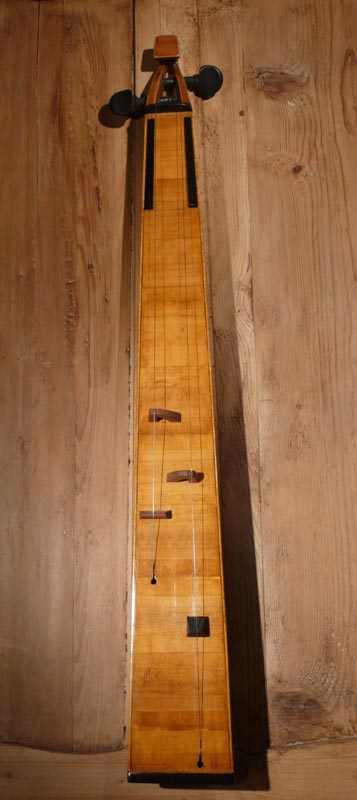
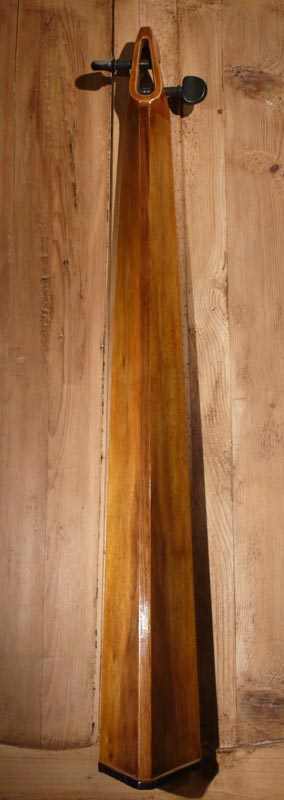
A tromba marina, marine trumpet or nuns’ fiddle, (Fr. trompette marine; Ger. Marientrompete, Trompetengeige, Nonnengeige or Trumscheit, Pol. tubmaryna) is a triangular bowed string instrument used in medieval and Renaissance Europe that was highly popular in the 15th century in England and survived into the 18th century. The tromba marina consists of a body and neck in the shape of a truncated cone resting on a triangular base. It is usually four to seven feet long, and is a monochord (although some versions have sympathetically-vibrating strings). It is played without stopping the string, but playing natural harmonics by lightly touching the string with the thumb at nodal points. Its name comes from its trumpet like sound due to the unusual construction of the bridge, and the resemblance of its contour to the marine speaking-trumpet of the Middle Ages.

Construction

The body of the marine trumpet is generally either three sides of wood joined in an elongated triangle shape with a pegbox at the apex; or a body of three to six ribs, a frontal soundboard, and a distinguishable neck. In most cases the bottom end of the instrument is open; some historical models use sound-holes. The single string, generally the D string of a cello, most often is tuned to the C three octaves below middle C. It attaches at the soundboard and passes over one foot of the bridge, leaving the other foot to vibrate freely on a plate of ivory or glass set into the soundboard, creating a brassy buzz. From its curiously irregular shape, the bridge was also known as the shoe; it was thick and high at the one side on which rested the string, and low and narrow at the other which was left loose so that it vibrated against the belly with every movement of the bow. A string called a guidon is tied around the playing string below the bridge and runs up to the pegbox where it is wrapped around a peg. The guidon adjusts the balance of the bridge by pulling the playing string.

The measurements of the tromba marina varied considerably, as did the shape of the body and the number of strings. An octave string, half the length of the melody string, and even two more, respectively the twelfth and the double octave, not resting on the bridge but acting as sympathetic strings, were sometimes added to improve the timbre by strengthening the pure harmonic tones without increasing the blare due to the action of the bridge.

History

In the days of Michael Praetorius (1618), the length of the Trumscheit was 7 feet 3 inches (2.21 m) and the three sides at the base measured 7 inches (180 mm), tapering to 2 inches (51 mm) at the neck. There was at first only one string, generally a D cello string. The heavy bow, similar to that of the cello, is used between the highest positions of the left hand at the nodal points and the nut of the head. In a Trumscheit in the collection of the Kgl. Hochschule, at Charlottenburg (No. 772 in catalogue) the frets are lettered A, D, F, A, D, F, G, A, B, C, D.

In Germany, at the time when the trumpet was extensively used in the churches, nuns often substituted the tromba marina because women were not allowed to play trumpets—hence the name Nonnengeige (literally, nuns’ violin). In France, the Grande Ecurie du Roi comprised five trumpets-marine and cromornes among the band in 1662, when the charge was mentioned for the first time in the accounts; and in 1666 the number was increased to six. The instrument fell into disuse during the first half of the 18th century (with the presence of tempered scales), and was only to be seen in the hands of itinerant and street musicians.

In modern times, the group Corvus Corax still regularly plays the tromba marina.

https://en.wikipedia.org/wiki/Tromba_marina


Emil Kovács

Born in 1948 in Budapest.

In 1966 he was taught by masters Bohák, Kürtös and Lehoczky at the Minőségi Hangszer K.T.Sz.

From 1968 to 1970 he worked as an apprentice.

In 1972 he retired from the army.

In 1972 Minőségi Hangszer K.T.SZ Musical Instrument K.T.SZ. changed its name and partly its profile.

He was offered a job at the Művészi Kézműves Vállalat, (there was also instrument production) “…new broom sweeps clean !” and was asked to take part in the training of apprentices.

At Művészi Kézműves Vállalat he was involved in training apprentices and preparing a curriculum for the apprenticeship school and a syllabus for the practical training.

In 1975, he wrote the textbook “Pengetős Szakmai Ismeretek”.

In 1976 he passed his master’s examination.

From 1978 he worked in the restauration workshops of the College of Music.

In 1982 he worked at the Lunacharsk Instrument Factory in Leningrad for a short period of professional training, at which time he began to work on historical instruments as a restorer.

From 1988 until its dissolution, he was a member of the National Association of Hungarian Artists. In 1992 the instrument repair workshops of the College of Music were closed down.

He then founded his own workshop. From then on, he designed and made all the details of his handicrafts independently.

Since 1978, he has made more than 200 new instruments. Most of them are Renaissance and Baroque bowed or plucked instruments, but he has also made folk instruments and modern bowed instruments, instruments of mandolin family, guitars and harps.

Since 1995, he has also been making acoustic jazz guitars with carved bodies exclusively for custom orders. His instruments are used in the USA, Japan, France, Italy, Germany, Switzerland, Austria and Israel.

In 2017 he was awarded a Gold String Master Award.

From 2020 he lives and works in Érd. 50% of his current work is as a restorer.


Reviews

There are no reviews yet.

Add a review

For security, use of CloudFlare's Turnstile service is required which is subject to the CloudFlare Privacy Policy and Terms of Use.

You might also be interested in this

Privacy Preferences
When you visit our website, it may store information through your browser from specific services, usually in form of cookies. Here you can change your privacy preferences. Please note that blocking some types of cookies may impact your experience on our website and the services we offer.