Skip to main content Scroll Top
Instruments from all over the world!

Domra - prima

Add to favorites
Added to Cart View Cart Checkout
Added to Wishlist View Wishlist
Removed from Wishlist
Information
Dimensions 590 × 253 × 130 mm
Name of musical instrument

Type of musical instrument

Typical place of occurrence

Date of manufature of instrument

Place of manufacture

Made by

Restored by

Scale

Number of strings

How to play musical instrument

Continent

Country

Sharing:
Categories:

Domra - prima

Information
Dimensions 590 × 253 × 130 mm
Name of musical instrument

Type of musical instrument

Typical place of occurrence

Date of manufature of instrument

Place of manufacture

Made by

Restored by

Scale

Number of strings

How to play musical instrument

Continent

Country

Sharing:
Categories:

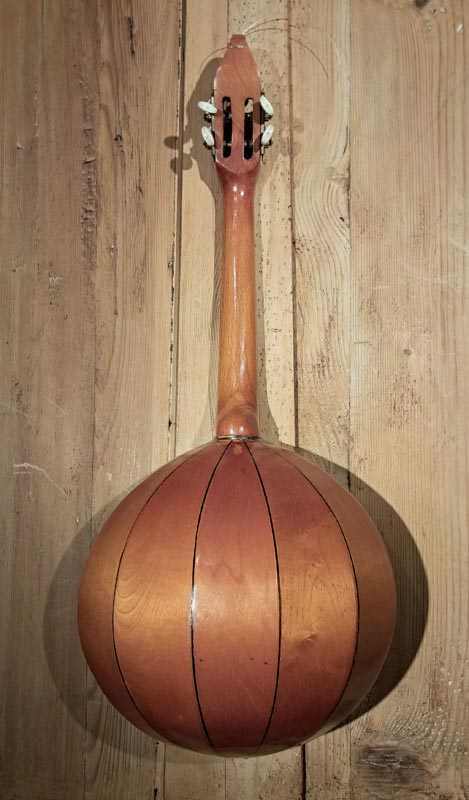
The domra (Cyrillic: до́мра, [ˈdɔmrɑ]) is a long-necked Belarusian, Russian, and Ukrainian folk string instrument of the lute family with a round body and three or four metal strings.

History

The first known mention of domra is in Admonitions of Metropolitan Daniel (1530). This musical instrument gained great popularity in the 16th–17th centuries, replacing gusli. There are numerous mentions of domra in historic documents of this period. In addition, medieval Russian illuminated manuscripts of the Psalter contain images of musicians with necked plucked-string instruments, and some of those miniatures are clearly captioned «depiction of domras». Judging by those images, late medieval Russian domras can be divided into two types: lute-shaped, which had five to six strings, a large body and а pegbox angled back, and tanbur-shaped, which had three to four strings, a small body and a straight pegbox.

After the pious Tsar Alexis of Russia issued an edict ordering the persecution of Russian folk musicians and destruction of their instruments (1648), domra gradually came into disuse and was replaced by balalaika, which was much easier to make and play.

In 1896, a student of Vasily Vasilievich Andreyev found a broken instrument in a stable in rural Russia. It was thought that this instrument may have been an example of a domra, although at that time no illustrations or examples of the traditional domra were known to exist (the traditional domra was only known through numerous mentions in folklore, though examples existed of the dombra, a related Turkic instrument). A three-stringed version of this instrument was later redesigned in 1896, patented, and introduced into the orchestra of Russian folk instruments.

Orchestral Instruments

The basic domra is tuned as follows:

Three strings: EAD tuning.

Four strings: GDAE tuning (like the mandolin or the violin)

Instruments are made in various sizes including piccolo, prima, alto, tenor, bass, and contrabass.

Piccolo: b1 e2 a2

Prima: e1 a1 d2

Mezzo-Soprano: b e1 a1

Alto: e a d1

Tenor: B e a

Bass: E A d

Contrabass (minor): 1E 1A D

Contrabass (major): 1A D G

Performers

Tamara Volskaya is considered to be one of the leading contemporary performers on the 4 string domra. She is a Merited Artist of Russia, a Laureate of the USSR competition, and a professor at the Mussorgsky Ural State Conservatory in Yekaterinburg, Russia. She now lives in New York City. [citation needed] Aleksandr Tsygankov is considered to be one of the leading contemporary performers, teachers, and composers of the 3-string domra. He lives in Moscow.

https://en.wikipedia.org/wiki/Domra


no data

Reviews

There are no reviews yet.

Add a review

For security, use of CloudFlare's Turnstile service is required which is subject to the CloudFlare Privacy Policy and Terms of Use.

You might also be interested in this

Privacy Preferences
When you visit our website, it may store information through your browser from specific services, usually in form of cookies. Here you can change your privacy preferences. Please note that blocking some types of cookies may impact your experience on our website and the services we offer.