Skip to main content Scroll Top
Instruments from all over the world!

Setar

Add to favorites
Added to Cart View Cart Checkout
Added to Wishlist View Wishlist
Removed from Wishlist
Information
Dimensions 865 × 150 × 138 mm
Name of musical instrument

Type of musical instrument

Typical place of occurrence

Date of manufature of instrument

Place of manufacture

Made by

Restored by

Scale

Number of strings

How to play musical instrument

Continent

Country

Sharing:
Categories:

Setar

Information
Dimensions 865 × 150 × 138 mm
Name of musical instrument

Type of musical instrument

Typical place of occurrence

Date of manufature of instrument

Place of manufacture

Made by

Restored by

Scale

Number of strings

How to play musical instrument

Continent

Country

Sharing:
Categories:

Setar is a stringed instrument, a type of lute used in Persian traditional music, played solo or accompanying voice. It is a member of the tanbur family of long-necked lutes with a range of more than two and a half octaves. Originally a three stringed instrument, a fourth string was added by Mushtaq Ali Shah by the mid 19th century. It is played with the index finger of the right hand.

It has been speculated that the setar originated in Persia by the 9th century C.E. A more conservative estimate says “it originated in the 15th century, or even earlier.”

Although related to the tanbur, in recent centuries, the setar has evolved so that, musically, it more closely resembles the tar, both in tuning and playing style.

Etimology

According to Curt Sachs, Persians chose to name their lutes around the word tar, meaning string, combined with a word for the number of strings. Du + tar is the 2-stringed dutār, se + tar is the 3-stringed setār, čartar (4 strings), pančtār (5 strings).

The modern Iranian instrument’s name setâr is a combination of se—meaning “three”—and târ—meaning “string”, therefore the word gives the meaning of “three-stringed” or “tri-stringed”.

In spite of the instrument’s name implying it should have three strings, the modern instrument actually has four strings. One was added in the 19th century. Strings however are grouped so that musicians are still dealing with three groups or courses of strings, instead of four separately played strings.

Sharing a name

Other tanbur-family instruments share the setar name. Sharing the name may not mean a direct connection between the musical traditions.

In Tajikistan, the Pamiri Setor is larger than the Iranian setar. It has 3 playing strings and sympathetic strings (as many as 8–12). It is played with a “thimble-like metal plectrum” worn on a finger.

In Baluchistan, the setar is larger than the Iranian setar, and is a “rhythmic drone” instrument to accompany singing. Its three strings are set up to resemble the dutar’s two strings: one bass string and a pair of strings tune a 4th higher.

In Pakistan, there exists the Chitrali sitar with 5 strings in 3 courses, with melody played on the top two strings.

In Xinjiang, China, Satar is an important instrument in 12 muqam. It is a bowed lute with 13 strings, one raised bowing string and 12 sympathetic strings, tuned to the mode of the muqam or piece being played.

In India, the Sitar is an instrument with many forms. Its name is “an Urdu transcription of the Persian sihtār”. The Indian instrument was likely adapted from instruments brought by Muslim empires and then developed locally.

Construction

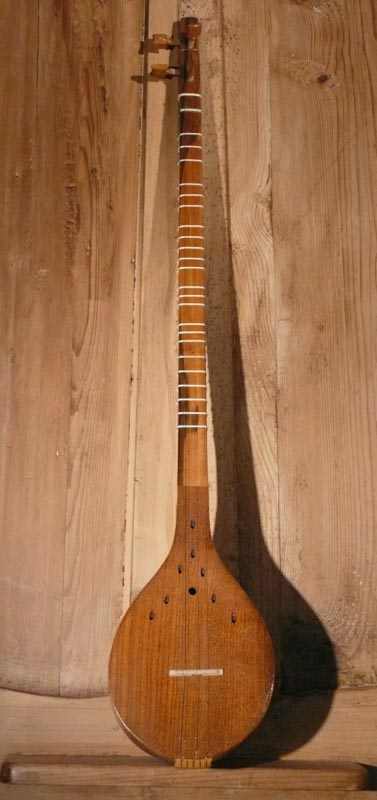
The instrument can be categorized as a neck-bowl instrument. Strings run from the pegs at the top of the neck, across a bone or plastic nut that has grooves to separate them, down the neck, across the bowl, over the bridge and are secured to a string holder at the end of the bowl. The pegs are inserted directly into the end of the instrument’s neck, similar to a headstock.

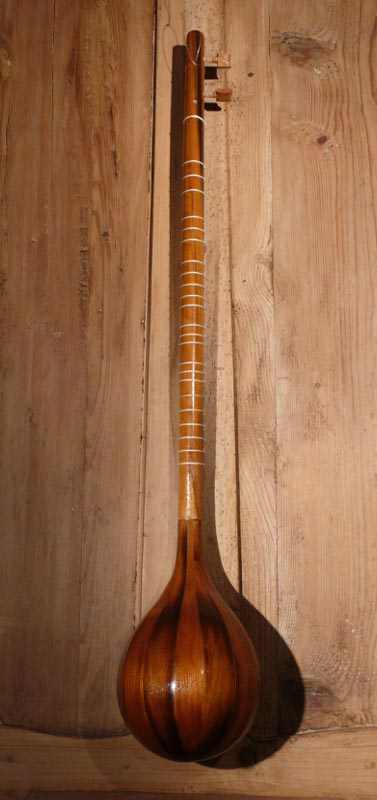
The bowl is structurally similar to the bowl of the tanbur, but smaller and pear-shaped. The length of the bowl is from 26 to 30 cm, its width is between 12 and 16 cm and its depth is about 13 cm. It is usually made of mulberry or walnut wood. The structure of the bowl can be either a single piece of wood or made of separate and glued pieces. The soundboard of the bowl is made of thin sheets of wood. It has sound holes to let the sound escape the bowl. The musician’s hand may be placed on it while playing.

The length of the neck is 40 to 48 cm long and 3 cm wide. A 12 cm section at the top is set aside for the pegs. The neck may be decorated with camel bone, covering the neck to make it more beautiful and to extend its useful life.

The wooden bridge is between 5 and 6 cm long and its height is less than 1 cm. It has shallow grooves for the strings to rest in. The strings, after passing over the bridge from the neck, are secured on the wire holder. The neck has frets made from thin threads made of animal intestines or silk. They are tied in 3 or 4 strands across the neck. There may be 26 frets, one of which is at the nut and not used to create a note.

The instrument is strung with four strings. From top to bottom the strings are (4) bam or bass string, (3) drone string, (2) yellow string, and (1) silver string.

The top-two strings, referred to together by the one-string’s name —bam — function together as a pair and are played together. The other two strings are known as the yellow string and the silver string. The silver string is the melody string. Historically, only the (4) bam string, the (2) yellow string and the (1) silver string existed. The need for the additional fourth string was recognized centuries ago, by intellectual thinkers such as Abu Nasr al-Farabi (ca. 872-950 C.E.), Abu Ali Sina (980-1037 C.E.), Safi al-Din Ermavi (ca. 1216-1294 C.E.), and (in the 20th century) the late Abul Hassan Khan Saba.

The new string is sometimes referred to as the “fourth string” because it is the last of the four strings to be added to the instrument. However, it was inserted between the yellow string and bass string; today when looking at the modern instrument being played, it is the (3) drone string, the third string from the bottom. The newest string is also known as the Mushtaq string, because it was first used by Mushtaq Ali Shah, according to a narration of Abolhassan Saba.

Playing the setar

The setar is played with the musician sitting, held at a 45-degree angle on the right thigh. Normally, the musician uses the fingers of the left hand on the frets to choose notes on the white string (bottom-most string). The right hand plays the setar, usually using only the index finger. The instrument is played using the index finger of the right hand, using an “oscillating motion”. This differentiates it from the tanburs, which are plucked with multiple fingers or with a homemade plectrum, made from plastic, quills or razor blades.

In more complicated works the musician may use the index, middle, ring and sometimes the little finger of the left hand to fret notes, and may use the thumb to pick notes on the bass strings.

Players not only tune the strings of the setar, but also move the gut or nylon frets that are tied around the neck, between the neck and the strings. Since these frets are moveable, players can move them to set notes closer or farther apart. The instrument is designed to play microtones, pitches between the standard western pitches on the piano keyboard. On music sheets a Koron lowers and a Sori raises the pitches by quarter steps (flats and sharps are half-steps).

Strings are tuned to meet the tonal requirements of Dastgâh (standard musical system in Persian art music).

The instrument’s four strings are not always set the same. Tones are not absolutes (unless playing with instruments that are set, such as a western-instruments with standardized and unchangeable pitches). Rather, the strings are intervals, what one string sounds like when compared to the first string.

https://en.wikipedia.org/wiki/Setar

no data

You might also be interested in this

Privacy Preferences
When you visit our website, it may store information through your browser from specific services, usually in form of cookies. Here you can change your privacy preferences. Please note that blocking some types of cookies may impact your experience on our website and the services we offer.