Rebec - András Romanek - Budapest
| Dimensions | 505 × 157 × 63 mm |
|---|---|
| Name of musical instrument | |
| Type of musical instrument | |
| Typical place of occurrence | |
| Date of manufature of instrument | |
| Place of manufacture | |
| Made by | |
| Restored by | |
| Scale | |
| Number of strings | |
| How to play musical instrument | |
| Continent | |
| Country |
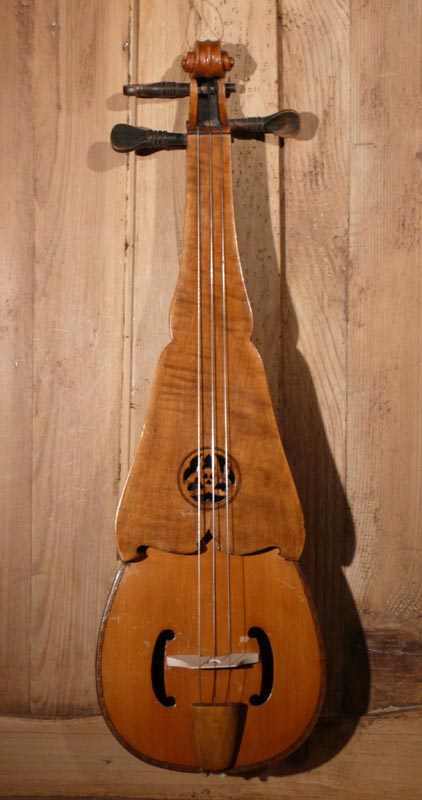
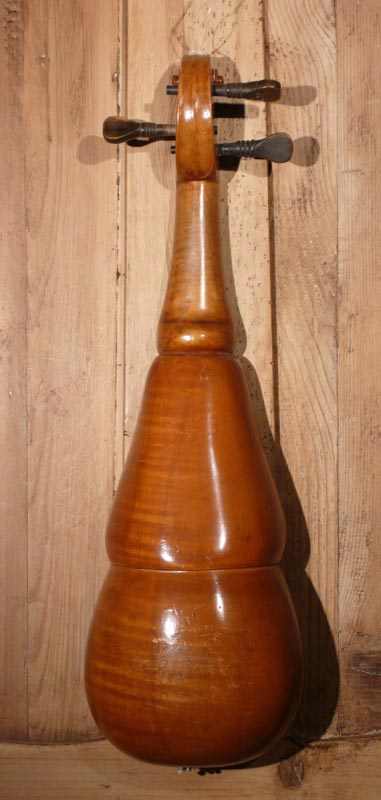
The rebec is a stringed bowed instrument with a small, elongated, pear-shaped body, a neck that fits organically into the body, and a typical sickle-shaped pegbox with laterally positioned tuning pegs. It usually has two or three strings tuned in fifths and a fretless fingerboard.
In a broader sense, all pear- and almond-shaped bowed stringed instruments, or small, high-pitched fidulas, whatever their shape, are called rebecs. In Europe, from the beginning of the 11th century to the present day, a wide variety of these types of instruments are known, and they were used in art music mainly in the Middle Ages and then in the Renaissance.
The hollow body, neck and sometimes the pegbox are carved from a single piece of wood. The fingerboard is either a raised part of the neck or a separate piece of wood, as is the resonator.
The pegbox, tuning pegs, string holders, sound holes and bow shapes of rebec-like stringed instruments have changed a lot over time. Sometimes the bridge is straight to allow the strings to be played together with the bow, but it can also be curved to allow each string to be played separately. The old rebecs do not have a sound post inserted, but their late post-Renaissance descendants usually do. The number of strings is usually three, but can vary from one to five, usually tuned to fifth intervals.
Stringed lutes, like the rebec, were initially played in North Africa and southern Europe with the bow held from below in an upright position, but the reverse position became common in Europe early on, and even common in the north, when the instrument was used with the upper bow held against the shoulder, as in modern violin playing.
History
Stringed instruments appeared in Europe at the turn of the 10th and 11th centuries, spreading mainly through Byzantium and the Balkans. One of the shapes of these early fidulas is similar to a rebec: pear or almond-shaped with a convex back. Unlike the later fiddles, they have a flat pegbox and front or back tuning pegs, suggesting a Central Asian origin. Most have three strings, the middle one a burdon, the ends are detachable strings. As a folk instrument, this type is nowadays known as the kamanja rumi in Anatolia, the gadulka in Bulgaria and the Cretan lyre in Greece. The instrument name ‘rebec’ does not appear in literature before about 1300, the name of these instruments being lyre in Byzantium and perhaps gigue in the West. Nevertheless, musicology uses the instrument name ‘rebec’ for these instruments, in addition to the Byzantine lyre.
From the end of the 13th century onwards, the Arabic rebab and its derivatives, such as the French rebbe, reberbe, rebesbe, the English rubube, rubebe, rybybe, ribible, began to appear in European literature. The Northwest African rebab is a stringed lute with a narrow boat or pear-shaped body, a neck that is not separated, no frets, a backed pegbox, two strings and side-positioned tuning pegs. The body is covered with a leather resonator and the hollow neck with a brass plate. Illustrations of this instrument include the Cantigas de Santa Maria, a manuscript from around 1270 in Castile.
A variant of the rebab may have reached Europe via Spanish soil, where it was given the names rebec, rabec, rebequin, rabecca, rebicchino, rebekke, etc. Juan Ruiz de Híta, in his 14th century El Libro de buen Amor, mentions an instrument called ‘rabé morisco’ (‘Moorish rebec’), which may be identical to the rebec, but also mentions another type of ‘rebec’, which he does not specify: it is certainly none other than the European rebec. The contemporary rebec also has an elongated pear shape, but its resonance is no longer leather but sheet metal with one or more sound holes and rosettes, the neck is raised or has a separate fingerboard attached, and the pegbox head is now sickle-shaped like that of the guiterne.
The rebec was at the height of its popularity around 1480, but was also popular in the first half of the 16th century; Martin Agricola describes it as a family of instruments in his Musica instrumentalis deudsch in 1529. It was in use until the first third of the 17th century, and its late descendant is the pochette or dance violin, which in its early form followed the structure of the rebec.
András Romanek, self-taught instrument maker from Budapest. He is also considered to be the first Hungarian lute maker. His son, Tihamér Romanek, who lives in Velence, Fejér County, is also an instrument maker.
https://global.museum-digital.org/objects?&s=persinst%3A84657#infoBoxthesInfoOverview

Reviews
There are no reviews yet.