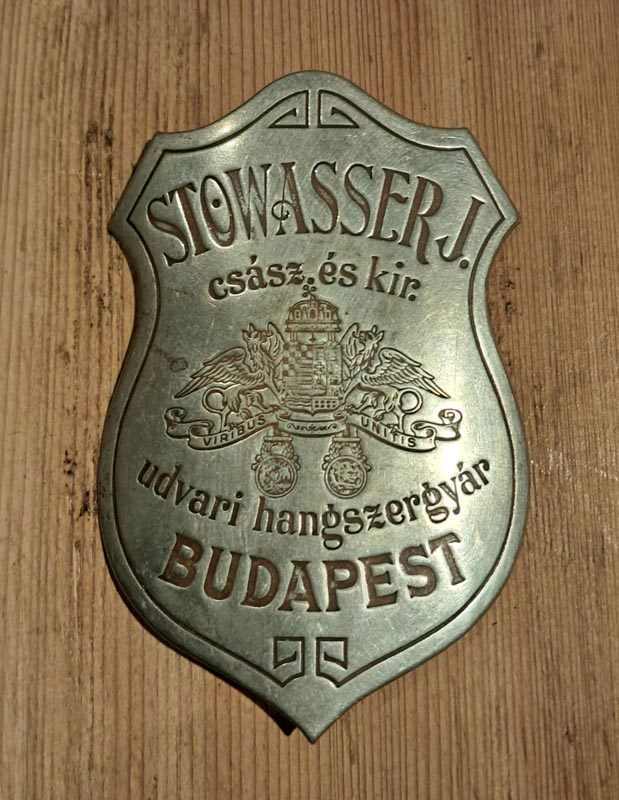
Musical instrument plate - János Stowasser – 1st District - Budapest 2.
| Dimensions | 78 × 50 × 4 mm |
|---|---|
| Name of musical instrument | Musical instrument plate – János Stowasser – 1st District – Budapest 2. |
| Within other caregory | Musical instrument plate |
| Typical place of occurrence | |
| Date of manufature of instrument | |
| Place of manufacture | |
| Made by | |
| Restored by | |
| Scale | |
| Number of strings | |
| How to play musical instrument | |
| Continent | |
| Country |
no data
JÁNOS STOWASSER
Stowasser János (Graslitz, Czech Republic, 21 May 1846 – Budapest, 9 February 1923) was an instrument maker, emperor and royal court supplier, founder of the “First Hungarian Instrument Factory Stowasser”. He was the inventor of the improved Ócskái and Rákóczi tárogatos.
Biography
Scion of the Stowasser family, a bourgeois family of Roman Catholic origin in the Czech Republic. From a very young age, he trained himself in various technical aspects of the instrument industry in his father’s shop in Graslitz. The instrument factory was originally founded in the Czech Republic in 1770 by Henrik and Paul Stowasser. They were followed by Vencel Stowasser and János Stowasser the Elder, who later set up his own factory in Hungary.
After a long period of wandering, he settled in Buda in 1867, aged just 21, at the invitation of a relative, Ferenc Stowasser. In his new home, he used his wealth of expertise to build his relative’s instrument-making business to a very respectable standard, and in 1873 he took over. Within a short time, the workshop was expanded into an instrument factory at 5 Lánchíd utca, located at the Buda Castle, next to the Chain Bridge; it was Hungary’s first instrument factory. The talented János Stowasser took the business to a very high level by becoming the most sought-after supplier to military bands and was later awarded the title of Imperial and Royal Court Instrument Manufacturer.
His business has made a name for itself mainly in the manufacture of brass and woodwind instruments. His invention is the “echo trumpet”, which plays a major role in all military bands. The Stowasser company also made its presence felt at the last millennial national exhibition with a non-competitive exhibition, where it was awarded the state gold medal. In his old age, János Stowasser always managed his business personally, so that only the instruments that met his expert judgement would find their way into the hands of the customer. In 1910, János Stowasser jr. took over the management of the long-established company.
After his death in 1923, the ownership of the factory passed to his eldest son, János Stowasser jr. (1874-1937), instrument maker. The factory closed during the Second World War.
Marriage and children
His wife, Jozefa Klauber (*Buda, 23 March 1853 -†Budapest, 29 September 1911), was the daughter of János Klauber, a master miller, and Anna Lenz, who had several children in Budapest, but only one reached adulthood and took over her father’s instrument factory:
-János Vencel Stowasser jr. (*Budapest, 17 November 1874 -†Budapest, 6 April 1937), instrument maker. Wife Frida Zaratin (*Budapest, 20 June 1875 -†Budapest, 1 November 1929).
-Hugo Stowasser (*Budapest, 22 October 1876 -†Alsóvíziváros, Budapest, 18 April 1892)
-Ernő Ferenc Stowasser (*Budapest, 2 April 1882 -† Budapest, 17 January 1901).

Reviews
There are no reviews yet.