Skip to main content Scroll Top
Instruments from all over the world!
  • Home
  • Europe
  • Hungary
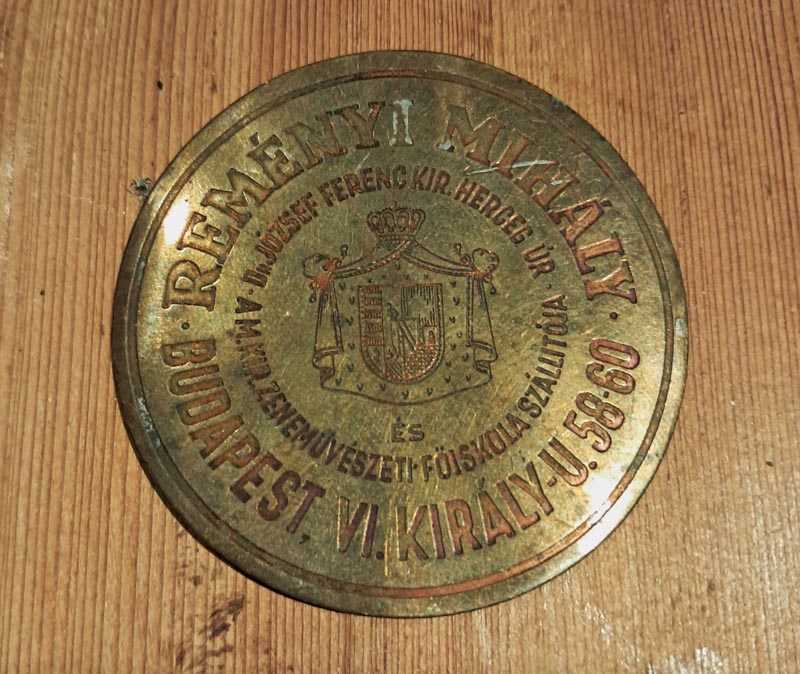
  • Musical instrument plate – Mihály Reményi – Terézváros – Budapest

Musical instrument plate - Mihály Reményi – Terézváros - Budapest

Add to favorites
Added to Cart View Cart Checkout
Added to Wishlist View Wishlist
Removed from Wishlist
Information
Dimensions 50 × 50 × 1 mm
Name of musical instrument

Within other caregory

Musical instrument plate

Typical place of occurrence

Date of manufature of instrument

Place of manufacture

Made by

Restored by

Scale

Number of strings

How to play musical instrument

Continent

Country

Sharing:
Categories:

Musical instrument plate - Mihály Reményi – Terézváros - Budapest

Information
Dimensions 50 × 50 × 1 mm
Name of musical instrument

Within other caregory

Musical instrument plate

Typical place of occurrence

Date of manufature of instrument

Place of manufacture

Made by

Restored by

Scale

Number of strings

How to play musical instrument

Continent

Country

Sharing:
Categories:

no data

Mihály Reményi

In contrast to the Schunda factory and Bohák workshop, which were oriented towards cimbalom making, the Reményi instrument factory focused its activities specifically on strings. Its founder, MIHÁLY REMÉNYI (*15.IX.IX.1867, Pest +1939, Budapest) started to learn violin making at the age of 14 – in 1881 – with Ede Bartek. He continued and completed his studies with György Tanczer. He was released on 2.IX.1885.

Before that he had also studied the violin.

He worked as an assistant for Sándor Ferenczy (1886-1887) and Pál Pilát (1887-1889). At the same time as he got married – on 22.VII.1890 – he founded his firm at 7, Koronaherceg u., IV. Later he moved to No. 44, Király u. VI, and then to his final location at No. 58/60, Király u. VI.

In 1902, he founded the Reményi Prize, through which the winners of the biannual prize competition at the College of Music received an excellent master instrument made by the company. The first such prize competition was held in 1902/1903, and the winner was Nándor Kőszegi (the last time it was held in Hungary was in 1949/1950, when Albert Kocsis won). His good business acumen helped him spectacularly to advance in the profession, but also made him plenty of enemies. He was a great connoisseur of fine master instruments.

Unfortunately, his public and commercial engagements later distracted him almost entirely from his own manual work, although he was himself a dedicated and excellent craftsman, who worked with great care and cleanliness both as a repairer and as a maker of new instruments.

His instruments followed the Guarneri pattern first and Stradivari second. He used spirit varnish for old violins and oil varnish for new ones. His oil varnish, according to Henley, was supplied in part by the ‘Harris Gateshead’ firm. His colouring is sometimes quite garish, though always uniformly nuanced and warmly bright. Shades of reddish brown or yellowish brown are the most common.

He researched the acoustic properties of wood. He chose his material with insight and understood how to thin it to the required degree. In this way he achieved a lively, clear sound worthy of a concert podium.

After years of experimenting with the beam, he finally arrived at a design (‘sound-enhancing beam’) that was significantly different in shape and position, designed to increase the flexibility of the roof and prevent the sound from becoming loose. These efforts have been successful for his most careful works.

He printed some of his labels on parchment.

As an innovation, he initiated the production of aluminium cases (Geigenkasten).

He participated in both the Millennium Exhibition and the Paris World Exhibition. He won several prizes (1894, Milan; 1895, Paris; 1896, Budapest; 1900, Paris; 1910, Budapest).

[From the book “History of Hungarian Violin Making” by Dr. András Tímár, 1983]

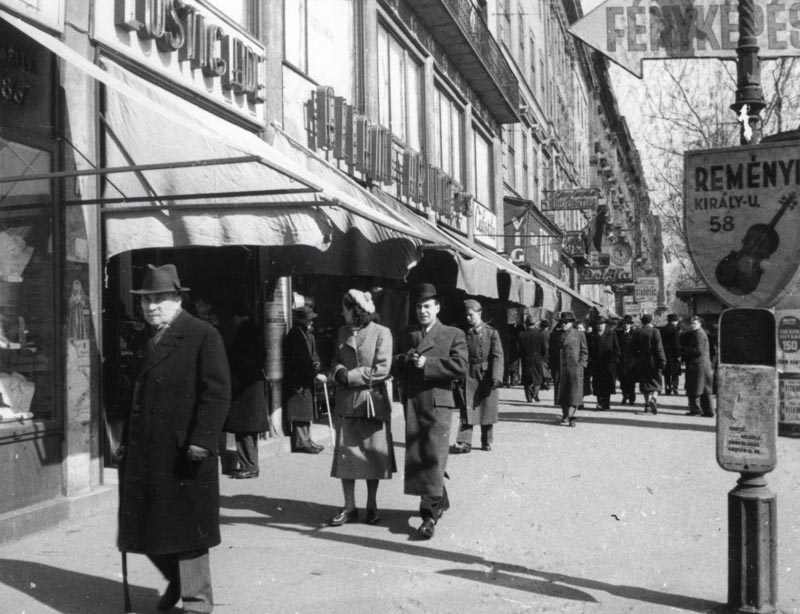
Photo: Rákóczi út seen from Astoria towards Blaha Lujza Square – 1949 [Fortepan 128473]

Reviews

There are no reviews yet.

Add a review

For security, use of CloudFlare's Turnstile service is required which is subject to the CloudFlare Privacy Policy and Terms of Use.

Privacy Preferences
When you visit our website, it may store information through your browser from specific services, usually in form of cookies. Here you can change your privacy preferences. Please note that blocking some types of cookies may impact your experience on our website and the services we offer.