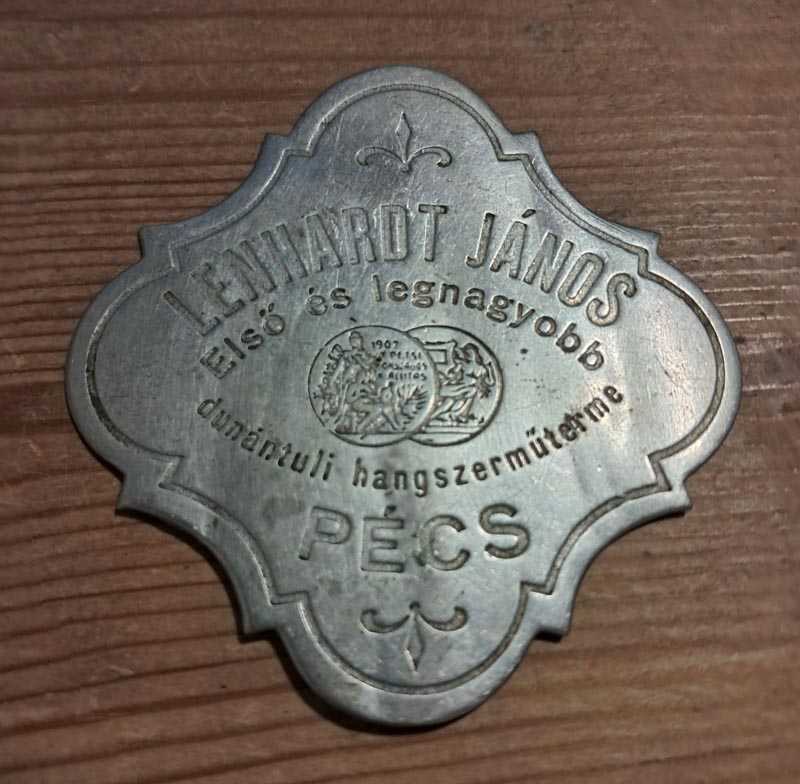
Musical instrument plate - János Lenhardt - Pécs
| Dimensions | 54 × 53 × 1 mm |
|---|---|
| Name of musical instrument | |
| Within other caregory | Musical instrument plate |
| Typical place of occurrence | |
| Date of manufature of instrument | |
| Place of manufacture | |
| Made by | |
| Restored by | |
| Scale | |
| Number of strings | |
| How to play musical instrument | |
| Continent | |
| Country |
no data
János Lenhardt (Mollyfalva, 23 December 1880 – Pécs, 24 September 1931) was a master violin and harp instrument maker, the first and still the only Hungarian pedal harp maker.
His life
Born in Torontál county, near Nagykikinda. From the age of eight he played several instruments in a children’s orchestra. In 1893, he joined the workshop of János Braun in Szeged, who employed nearly fifty assistants and whose descendants today make the world-famous Braun flute and piccolo. Under his master he learned to make and repair stringed instruments.
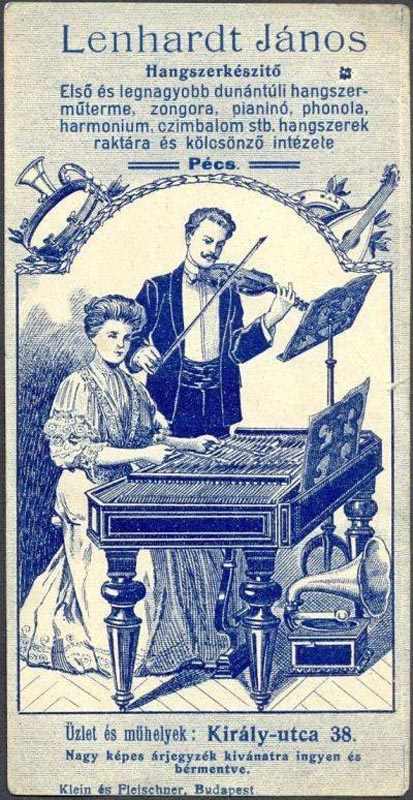
He opened his own shop in 1903 in Király Street in Pécs. Following his master’s example, he sought to make his workshop as versatile as possible. In addition to making musical instruments, he also made strings, repaired instruments, rented and sold instruments, and made dozens of cheap instruments in addition to the master instruments. His master violins won a silver medal at the 1907 national exhibition in Pécs. In 1909 he became the representative of the pianos of the Stingl Brothers from Vienna in the Pécs area. From 1910 he also sold gramophones and recorders together with records. In the 1920s he had extensive international connections, with Anton Hamm, Matthias Hohner, A. Gläsel & Co. and Lippold Hammig as his most important partners.
He started working with harpoons in 1923. His separate and equipped harp workshop started in 1924, and in 1926 he won a gold medal with them at the exhibition in Mohács. His choice of instrument may have been influenced by the fact that in his native southern Hungary there was a long tradition of harp playing and harp making among the German nationality and the Sinto gypsies. He developed several harp models, while at the same time building up national and international contacts with artists, as well as with business and political figures. Ottó Mosshammer, harp teacher at the Academy of Music, visited his workshop twice, ordered three instruments from him and had the instruments of the Opera House repaired. In 1926, harpist Robert Payr, soloist with the Vienna Opera and Philharmonic Orchestra, came to visit him. In 1929 he was visited and played by Alfred Holy, an American living in Vienna who had previously taught at the Boston Music Academy. Among his supporters were Members of Parliament György Perlaky and Antal Oberhammer, Mayor Antal Nendtvich, Count Móric Benyovszky, and many members of local musical and public life.
Between 1924 and 1929, his workshop produced dozens of harps, including 3-4 master instruments a year, so that he was able to produce for export. In Germany he was represented by the Leipzig firm Julius Heinrich Zimmermann. Interest in his instruments came from Italy, Switzerland, Austria, Yugoslavia and Romania. In 1927 he was invited to the Geneva Instrument Exhibition, but was unable to attend.
To promote the harp, he founded a harp school, where he took forty students in 1927. Although he was not a qualified harp teacher, he sought advice from music academy teachers and planned to invite harp teachers to Pécs.
After starting harp making, he increasingly neglected precise business management, suffered from a lack of capital and financial embarrassment. One reason for this may have been that harp making kept him too busy. Not only did he seek to improve the mechanics and overall construction of the instrument, but he also worked on developing machinery to make harp making more efficient. In 1927, he applied to the Minister of Commerce for a loan of 100,000 pengő, which was refused. In 1928, he applied again for a government loan of 10 000 pengő for 5 years at 5% interest. He invested the money in harp making, but it soon became clear to him that he was close to bankruptcy. He sought help from local investors and businessmen, who tried to help his situation by providing capital and revising the business, but to no avail.
As a result of an old illness, he became paralysed in 1930 and died less than a year later of tuberculosis.
In memory of
In 1913, he had a semi-relief depicting the “anthropomorphic image of the primordial God” erected above the Istenkút spring on the Magyarürögi road. Its inscription (“Erected to the glory of God by János Lenhardt and his wife”) is no longer visible due to concrete covering. His memorial is no longer there either. As president in 1926, he founded the “Hárfa” singing group, which continued to function until its dissolution in 1948.
Although he married four times, he had no children of his own. He raised an adopted son, who later took back his original name. His 24-year-old widow and one of her assistants continued his business for a short time, but they did not continue harp making.
After the Second World War his person and work were forgotten. Since 2008, his memory has begun to return to the public consciousness thanks to Andrea Pásztor’s research. In collaboration with the researcher, the HarpPost blog has published a series of articles on Lenhardt’s life and harps.
In 2013, harpist Erzsébet Devescovi donated a concert harp of him to the Kodály Centre in Pécs.
His harps
Little is known about his instruments, as few Lenhardt harps have survived. He made single and double pedal harps, and presumably also harps with hooks (folk harps).
https://hu.wikipedia.org/wiki/Lenhardt_J%C3%A1nos
Source of 2. image: Facebook Régi Pécs

Reviews
There are no reviews yet.