



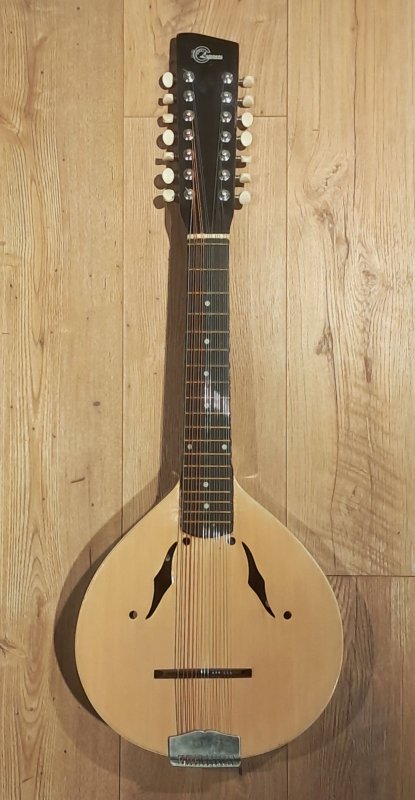
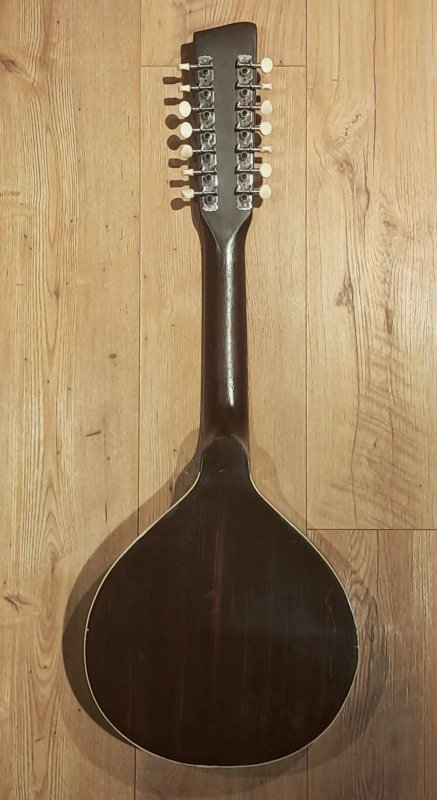
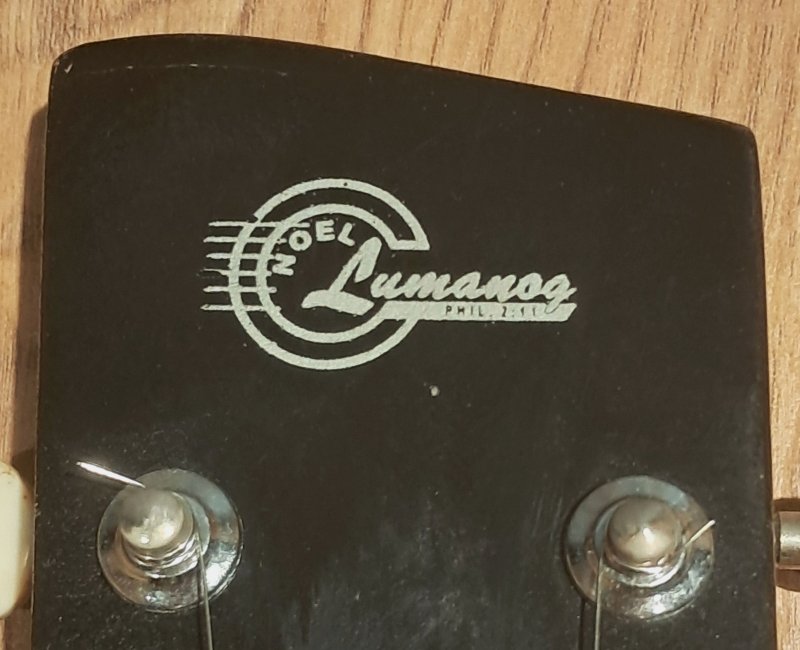


Laúd 2.
| Dimensions | 830 × 295 × 81 mm |
|---|---|
| Name of musical instrument | |
| Type of musical instrument | |
| Typical place of occurrence | |
| Date of manufature of instrument | |
| Place of manufacture | |
| Made by | |
| Scale | |
| Number of strings | |
| How to play musical instrument | |
| Donor | |
| Continent | |
| Country |
Laúd
Laúd (Spanish: “lute”) is a plectrum-plucked chordophone from Spain, played also in diaspora countries such as Cuba and the Philippines.
The laúd belongs to the cittern family of instruments. The Spanish and Cuban instruments have six double courses in unison (i.e. twelve strings in pairs); the Philippine instrument has 14 strings with some courses singled or tripled. A similar, but smaller instrument, with a shorter neck, is the bandurria, which also exists in 12- and 14-string versions.
Traditionally the laúd is used by folk string musical groups, such as Spanish or Filipino rondalla string ensembles, together with the guitar and the bandurria. Like the bandurria, it is tuned in fourths, but its range is one octave lower.
Tuning
For the Spanish laud the tuning is:
1st: A4 A4
2nd: E4 E4
3rd: B3 B3
4th: F#3 F#3
5th: C#3 C#3
6th: G#2 G#2
The Filipino version, has (from bass to treble) one single course, two double courses and three triple courses (i.e. fourteen strings), and is tuned a step lower than the Spanish instrument.:
1st: G4 G4 G4
2nd: D4 D4 D4
3rd: A3 A3 A3
4th: E3 E3
5th: B2 B2
6th: F#2
Steve Howe plays a laúd in both Yes (band) and as a solo artist, but he incorrectly refers to it in his guitar book as a Portuguese guitar. His tuning is:
1st: A-flat E
2nd: B E
3rd: B E
4th: A-flat A-flat
5th: E E
6th: B B
Cuban laúd
There is also a Cuban variety of laud—called the “Cuban laud” — (such as played by Barbarito Torres of the Buena Vista Social Club). It has the same appearance and use as the Spanish version, six sets of doubled strings, but a shorter scale length and higher tuning. Sometimes the Cuban variety has a different body shape, with two points instead of the lute-style or wavy shapes used for the traditional Spanish variety. The tuning is:
1st: D5 D5
2nd: A4 A4
3rd: E4 E4
4th: B3 B3
5th: F#3 F#3
6th: D3 D3
https://en.wikipedia.org/wiki/La%C3%BAd
Donator: Sándor Szabó
Sándor Szabó (Törökszentmiklós, 1956 –) is a Hungarian guitarist, composer, musicologist, and sound engineer. Instruments: 6-, 8-, 10-, 12-, and 16-string guitars, koboz, and guzheng.
Overview
He was born in Törökszentmiklós in 1956. He began his studies in classical guitar with a private teacher. From the mid-1970s, his focus shifted toward jazz and improvisation. In the early 1980s, he studied as a visiting student at the Jazz Department of the Béla Bartók Conservatory of Music in Budapest. Even then, he felt that he should not learn improvisation tied to a single style, but rather synthesize within himself all the musical influences to which his receptivity and sensitivity allowed him access, and build upon this to develop his improvisational skills. From the very beginning, he was almost instinctively drawn to the music of the Eastern world, so immersing himself in it provided the best foundation for him.
We have been able to follow the artist’s career since 1980. He was the first in Hungary to perform modern acoustic guitar music as a soloist. Since the acoustic guitar, as an instrument, has no notable tradition in Hungarian musical culture, guitar playing and composition have not become recognized and respected art forms in Hungary. His rural background also posed an obstacle to his integration into the Budapest milieu. Recognizing this, he focused all his energy on establishing a presence abroad, and as a result, he drew attention to himself internationally with his guitar playing—which blends the techniques of stringed instruments from various cultures—his modern compositions, and his profound spirituality. His albums have been released in England, the United States, and Germany. His playing can be heard on the SzaMaBa Trio’s series, which now consists of four albums, as well as on numerous solo recordings.
1980–1996
In 1980, Balázs Major formed the Szabó-Major duo with a percussionist. Within a few years, they had performed at virtually every music club in Hungary. Their first album was released in 1988 by the British label LEO Records. In the 1980s, Sándor Szabó frequently invited foreign musicians to Hungary. As a result, they took part in numerous national concert tours and left behind a number of recordings. His first major collaboration was with Belgian guitarist Gilbert Isbin. This period is also marked by an album released by the British label HWYL Records. A trio album was recorded with Balázs Major at the BRT studio in Brussels, which was released 14 years later under the title Constellation. Following this, they performed as a duo with Andreas Georgiou, a Greek guitarist of Cypriot origin, as part of a concert tour; however, no recording was released from this collaboration. In the early 1990s, he came into contact with Italian flutist Massimo De Mattia. Their collaboration can be heard on the SzaMaBa Trio’s CD titled Hypnos.
One of the most significant periods of his career was the SzaMaBa Trio, which operated for about ten years starting in the mid-1980s and of which he was a founding member. Initially, the trio gave only a few concerts as an occasional ensemble. The original lineup featured bandleader Sándor Szabó, guitarist László Bagi, and Balázs Major on percussion. At the same time, they formed a guitar trio called the Alföldi Szabadzene Alkotóműhely, with guitarist András Bakondi joining Szabó and Bagi in the group. A year later, with the addition of Balázs Major, the two projects—which had been heading in slightly different directions—merged. The music of the Alföldi Szabadzene Alkotóműhely is preserved in several compositions on the albums *Sanctified Land* and *Anima*.
After about two years, András Bakondi left the band, but the trio remained together in its original lineup and adopted the name SzaMaBa, derived from the initials of their names. By 1993, they had become one of the most successful touring bands, performing at virtually every domestic festival. With guest musicians joining them, the trio recorded three albums released by Tandem Records. A live concert recording of the band was also made at the Tata Jazz Camp, which Pannon Jazz released in 2005. Due to the decline of the cultural scene in Hungary, the band received fewer and fewer invitations, so they disbanded in 1996. Since then, Sándor Szabó has been pursuing his own solo career.
1996–2010
His music has matured since the breakup of SzaMaBa. It has become more complex and profound, yet with a greater sense of internal coherence. He strives to realize the full potential of solo guitar playing. His music incorporates classical compositional methods, the Eastern maqam principle and performance style, and improvisation drawn from modern jazz. Over the years, he has developed a distinctive, at times meditative, delicately detailed melodic world, with harmonies that hover between the diatonic and atonal realms, interweaving them.
His music is difficult to categorize. He has combined the polyphony of classical guitar, the techniques of modern acoustic guitar playing, and the ornamentation of Eastern music. All of this is paired with his improvisational skills inherited from jazz. This is evident in his three solo albums released by the German label Acoustic Music Records: *Alexandria*, *Gaia and Aries*, and *Dreams Within Dreams*. Thanks to this, Sándor Szabó has become a recognized, internationally renowned performer on the acoustic guitar. Since 1998, he has traveled the world, performing in Japan, Korea, India, Canada, Central Asia, the United States, and, of course, almost everywhere in Europe. In addition to his solo concerts, he increasingly performs in various duos, trios, and quartets.
In the 1990s, he thoroughly explored the previously untapped potential of digital effects processors and the electric guitar, and by reshaping the clean sound of the electric guitar, he developed a new sound he called AmbiMorph. This sound can be heard on his album *Echolocation I*. Building on his explorations and discoveries in psychokinetic sound perception, in the spring of 1998 he presented forward-looking and exciting musical experiments at the British Contemporary Music Festival using the AmbiMorph sound he had created. Since then, he has presented this music at several international festivals.
Almost at the same time, he composed a six-movement electronic music piece for Sándor Krizbai’s six-part musical painting (1998 Hangrelief, Merlin Theater, Budapest). At the Vácz Voczem Video Laboratory /3vLab/ exhibition in October 1998, he presented his compositions titled Lélektakarók (Soul Shrouds) featuring sounds never heard before. The pieces were created using an electric guitar and complex algorithms he developed using digital effects processors.
In 2002, he joined the American contemporary music ensemble Georgian Contemporary Unit, whose members were contemporary musicians from Athens and Atlanta, Georgia. In 2009, he founded the ensemble Fractal Strings (Michael Manring (USA)…bass guitar, Claus Boesser Ferrari (Germany)… guitar, Balázs Major…drums and percussion, Sándor Szabó…electric and acoustic guitar, guzheng, 24-string koboz). In this ensemble, he synthesized all his musical influences to date: East with West, acoustic with electric.
One of the most significant musical ventures of recent years was the Fractal Strings project. A multimedia production whose visuals are based on fractal-based visualizations and whose sound is based on a 6-channel surround sound system. The visualizations were created by László Megyeri.
2010–
In recent years, Sándor Szabó’s music has flourished in a very productive way. He performs and records in numerous duos and trios. As a result, several new albums have been released, featuring collaborations with well-known guitarists. His series of duo albums began with a joint release with Belgian guitarist/composer Veronique Gillet on the German label Wonderland.
This was followed by five albums released with American guitarist/composer Kevin Kastning, and then a new album with Michael Manring, released by the German label Acoustic Music Records. Another new duo album was released in Italy with Edoardo Bignozzi. A domestically released CD was also produced with Roland Heidrich, half of which consists of solo recordings and the other half of duo recordings. Additional duo albums have been released with German acoustic bassist Ralf Gauck, American guitarist Dean Magraw, and Norwegian guitarist Alf Wilhelm Kundberg. Duo recordings were also made with Claus Boesser-Ferrari and Fernando Freitez; these are currently awaiting release.
His 2010 album *Modern Magyar Makám* is considered a milestone in his musical career, as it synthesized all his research on Eastern music and his new ideas, and, as is typical, once again brought him recognition and success abroad.
It is worth mentioning his friendship and artistic collaboration with Kevin Kastning of Massachusetts, which has been ongoing since 2006. To date, they have released seven albums together, which the American trade magazine Acoustic Guitar describes as some of the deepest and most forward-thinking acoustic guitar music of our time. They complement each other well in many ways: both are passionate devotees of multi-stringed guitars, play with great ease, improvise together, and share a similar philosophy about music. They are currently working on an album that will undoubtedly be a milestone in terms of both music and sound, featuring the lute and 16- to 36-string guitars as the main instruments.
An important milestone in his musical career is the Hungarian Guitar Rhapsody. The origins of the piece date back several years, when he was invited to a Spanish guitar festival, where he performed modern arrangements of Hungarian folk songs. It was a huge success, and this encouraged him to write a guitar piece composed entirely of Hungarian music, playable on a classical guitar. By early 2010, the Hungarian Guitar Rhapsody—a long, four-movement work composed of 24 well-known Hungarian folk songs—was completed, marking the first guitar music based entirely on Hungarian folk music. Recordings of this work were released in 2011.
The Music Researcher
Over the past decades, he has regularly collected music and music-related materials from Central Asia and the Far East with the aim of comparing the similarities and historical and geographical connections between Hungarian folk music and Eastern instrumental music. As a result of this decades-long research, he launched his website dedicated to reviving ancient Hungarian music, the Modern Hungarian Makám site. In parallel with the website, he recorded an album capturing a recreated, revived possible form of ancient Hungarian instrumental pieces. On the website, visitors can read about the presumed history and structure of the makám, and there are also musical pieces available to listen to. His efforts as a musicologist and his research findings have been met with acclaim by music experts in Asia and the Far East, which led to his invitation in 2013 to to the international conference on Eastern music held at the Sharq Taronalari Festival in Samarkand, where he presented the results of his research, illustrated with live music. In 2010, his book titled “The Metaphysics of Music” was published by Püski Publishing.
The Master of Unique Multi-String Guitars
In 1982, he commissioned two guitars—a 10-string and a 16-string—from luthier Ödön Bittermann, which completely changed his previous ideas about guitars and, of course, his music as well. He recognized the compromise inherent in the 6-string guitar—the trade-offs between comfort, playability, and the limitations of tuning. From that point on, he began to explore the possibilities inherent in tuning multi-string guitars and to push the boundaries of the music that could be played on them. His 16-string guitars proved to be the perfect instrument for his music, and this also made him stand out. Several 16-string guitars were made for him by Tibor Turcsák and Tihamér Romanek. As a result of his collaboration with instrument maker Tihamér Romanek, in addition to numerous 8- and 16-string guitars, a double-necked 24-string koboz was created for the Modern Magyar Makám CD. The instrument can also be heard on the Modern Magyar Makám website. Among his unique guitars are an 8-string fretless guitar and 6- and 12-string baritone guitars with longer string spacing. Tihamér also crafted a uniquely designed 16-string lute for him. In recent years, he has also learned to play the guzheng, a 21-string Chinese zither, which appears more and more frequently on his recordings and in his concerts.
The Composer-Guitarist
By his own admission, he has always been more interested in music than in playing the guitar or the instrument itself; consequently, the major figures who have shaped his art come not so much from the world of the guitar as from the ranks of the great composers. He strove to familiarize himself with as many different kinds of music as possible, and his openness extended to the music of other cultures as well. He began writing pieces for novel, multi-stringed (12–16-string) guitars, which differ from the conventional guitar style and are thus radically distinct from the music typically associated with the guitar. As a result of his interest in and affinity for Eastern music, some of his compositions are closer to Western contemporary music, while others show an affinity for Asian maqams and Far Eastern music. The life’s work and intellectual legacy of Béla Hamvas had a profound influence on his thinking.
He is particularly fascinated by the idea of mystical intuition, in which one level of understanding the world lies in creation through intuition and meditation. For this reason, he regards improvisation as the most profound form of creation. All of his compositions are based on improvisation. For him, composing is synonymous with improvising. Through inspiration, the hidden depths of the world are revealed. His music is a projection of an invisible yet perceptible dimension of the world. In his musical textures, the ancient and the modern appear simultaneously. His ideal is a complex musicality drawing from ancient sources beyond time, a world inherent in the shared nature of sound and silence. The relevance of his music has been reignited by the expansion of Far Eastern cultures, people’s weariness of endlessly repeated consumer products, and their simultaneous flight into mysticism and esotericism. Wherever he performs, his concerts unfold almost like rituals; his music, exuding a peculiar sacred atmosphere and offering a kind of spiritual initiation, truly lifts the listener out of the real world for an hour.
His career is a quest for eternal bridges across the chasms between different cultures and ways of thinking, somewhere here in Central Europe, right here and now, at the end of a declining material culture and the dawn of a new spiritual culture. Sándor Szabó is an exploratory musician, a ceaseless researcher of the sonic possibilities of his instrument and the boundaries of the music that can be played on it. In the 1990s, he thoroughly studied the previously untapped potential of digital effects processors and the electric guitar, and by reshaping the pure sound of the electric guitar, he developed a new sound he called AmbiMorph. This sound can be heard on his album Echolocation I. Building on his explorations and discoveries in psychokinetic sound perception, in the spring of 1998 he presented forward-thinking and exciting musical experiments at the British Contemporary Music Festival using the AmbiMorph sound he had created. Since then, he has presented this music at several international festivals.
Almost at the same time, he composed a six-movement electronic music piece to accompany Sándor Krizbai’s six-part musical painting. He presented his composition *Lélektakarók* (Soul Veils) at the Vácz Voczem Video Laboratory/3vLab exhibition in October 1998, featuring sounds never heard before. The pieces were created using an electric guitar and complex algorithms he developed in digital effects processors.
In 2002, he became a member of the American contemporary music ensemble Georgian Contemporary Unit, with which he performs annually. In 2009, he founded the group Fractal Strings with American bassist Michael Manring, German guitarist Claus Boesser Ferrari, and drummer and percussionist Balázs Major. In this ensemble, he synthesized all his musical influences to date, blending East with West, and acoustic with electric.
The Fractal Strings project was one of the most unique musical ventures of recent years. It was a multimedia production based on fractal-based visualizations and 6-channel surround sound. The concert was held at Millenáris to great acclaim, featuring renowned musicians. (Michael Manring…bass guitar, Claus Boesser Ferrari…guitar, Balázs Major…drums and percussion, Sándor Szabó…electric and acoustic guitar, guzheng, 24-string koboz). The visuals were created by László Megyeri.
As a result of their collaboration with instrument maker Tihamér Romanek, in addition to numerous 8- and 16-string guitars, a special 24-string koboz with two necks was also crafted for him for the Modern Magyar Makám project. The instrument can be heard on the Modern Magyar Makám website.
The Sound Engineer
In addition to music production and composition, he runs a state-of-the-art recording studio, where he produces recordings using the highest-quality equipment. His work for the German label Acoustic Music Records and the American label GreyDisc, as well as his self-released solo and duo recordings, are considered benchmarks in the field. A testament to his skill as a sound engineer is the fact that musicians from abroad seek out his studio for recording and mastering. However, his studio produces not only new recordings but also audio restorations.
The Organizer
Since 2002, he has been one of the organizers of the annual International Acoustic Guitar Festivals held in Hungary. The Hungarian concert series, consisting of 10–12 concerts, is held every May, featuring three foreign acoustic guitarists each year.
https://hu.wikipedia.org/wiki/Szab%C3%B3_S%C3%A1ndor_(muzsikus)
No data


Reviews
There are no reviews yet.