Dombra 2.
| Dimensions | 988 × 233 × 130 mm |
|---|---|
| Name of musical instrument | |
| Type of musical instrument | |
| Typical place of occurrence | |
| Date of manufature of instrument | |
| Place of manufacture | |
| Made by | |
| Restored by | |
| Scale | |
| Number of strings | |
| How to play musical instrument | |
| Continent | |
| Country |
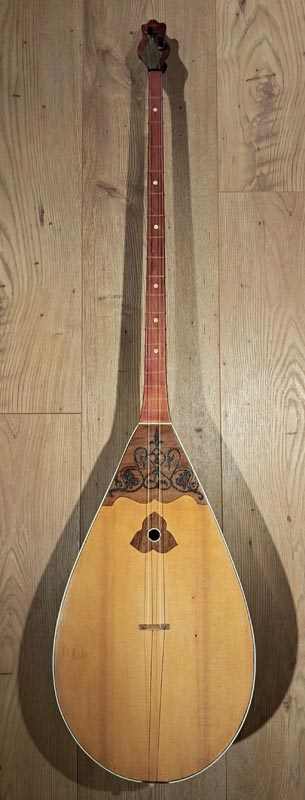
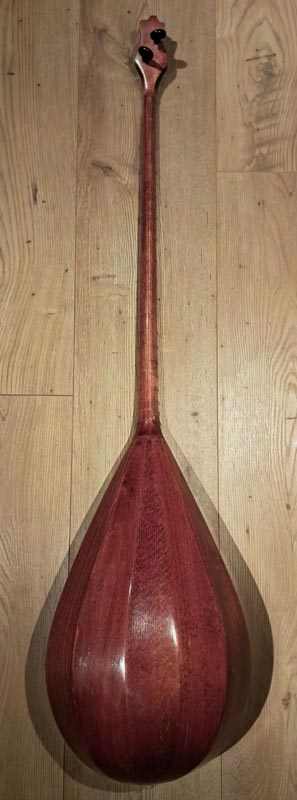
The dombra or dombıra (nogaj: домбра, dombra, kazakul: домбыра) is a long-necked, pear-shaped, two- or multi-stringed instrument of the shanked lute family, widely used by Turkic peoples in many Central Asian countries. The dombra is considered by the Kazakhs, Nogays and Kalmyks to be their folk instrument, and is one of the earliest and most popular instruments of the Kazakh people. This instrument has its own musical character, which plays an important role in the life of the Kazakhs. As part of the early epic traditions, the dombra is performed by men as an accompaniment to heroic songs (jyr/жыр [zsör]), didactic and educational meditations (tolǵaý/толғау [tolhrau]), recitative melodies, which led to the development of the küj (kúı/күй) as an independent instrumental musical genre.
History
In 1986, in Kazakhstan, in the Almati region, high in the mountains, at the Maıtóbe jaılıaý summer lodge (жайляу Майтөбе), with the help of Jaǵda Babalyquly (Жағда Бабалықұлы), an ethnographer, professor Sábetqazy Aqataev (Сəбетқазы Ақатаев) discovered a rock painting depicting an instrument and four dancing people in different poses. According to the research of the famous archaeologist Kemel Aqyshev (Кемел Ақышев), this figure dates back to the Neolithic (around 4000 BC). The rock fragment depicting this drawing is currently on display at the Kazakh Museum of Folk Instruments (Қазақтың Халық Музыка Аспаптары Мұражайы есімі Ықылас Дүкенұлы) in the city of Almati, Kazakhstan. In the picture, the instrument depicted on the rock by the artist of the time is visibly very similar to the shape of dombra. All this suggests that the prototype of the current dombra dates back to about 6000 years ago and is one of the first plucked musical instruments – a forerunner of the instruments we know today.
Archaeological studies have shown that Saka nomadic tribes used two-stringed instruments similar to the Kazakh dombra and may have been prototypes of it more than 2,000 years ago.
At the same time, terracotta figures of musicians playing plucked instruments from the same period have been found in excavations at the ancient Hvarezm. Scientists note that the two-stringed instrument of Hvarezm, which existed at least 2,000 years ago, bears typological similarities to the Kazakh dombra and was one of the most common instruments of the early nomads living in what is now Kazakhstan.
The written records of the Eurasian continent lead us to conclude that the dombra and similar instruments have been known since ancient times. The presence of this plucked instrument can be found in monuments from various periods of the Eurasian region, particularly those of Hun and Saka origin. This instrument is also found among the Kuns (kumans).
During the long influence of the Ottoman peoples (Huns, Avars, Bulgars, Khazars, Polovtsians, Horde peoples), the Eastern Slavs also adopted the instrument called dombra.
The first written records of the dombra date back to the Middle Ages. In the works of Abu Nasr al-Farabi we read of a tambura-like instrument similar to the dombra. The Uzbek double-stringed duet, which is very similar to the dombra, is first mentioned in al-Hussein’s ‘Musical Canon’. The Kazakh folk instrument, the dombra, is mentioned in the 14th century. Its main form and construction are unrelated to the Kazakh dombra, but the similarity of these instrument names seems to suggest that they share a common origin.
Marco Polo noted in his writings that this instrument was present among the warriors of the nomadic Turks, who at that time were called Tartars by the Russians. They sang and played before battle to get into the right mood.
In 2012, the electric dombra was developed.
Dombra – the instrument of kúı
For the Kazakhs, the kúı is more than just a piece of art; it is the sounding board of their people’s history, customs and culture. For this reason, the Kazakhs held the kúı performers, the kúıshis (күйші [küjsi]), among whom dombra players represente the vast majority. The Kazakh people say, “Нағыз қазақ – қазақ емес, нағыз қазақ – домбыра!”, which means “the real Kazakhs are not Kazakhs, the real Kazakhs are dombra!” This expresses the importance of playing the dombra for all Kazakhs, as well as the special love Kazakhs have for this instrument.
Dombra in the Kazakh culture
The dombra (Kazakh: домбыра) is the most popular two-stringed folk instrument. It has a pear-shaped body and a long neck with frets. The strings are usually tuned in fourths or fifths.
Used as an accompanying, solo and orchestral instrument, it is the main instrument of Kazakh folk music. It is also used by modern performers. So much so that it is even used to accompany rap.
In 1934, with the establishment of the Kazakh National Folk Instrument Orchestra, the types of dombra were born, such as the prima, alto, tenor, bass and double bass.
It is worth noting that there is a unique tradition of playing the dombra in the western regions of Kazakhstan.
One of the greatest dombra players is the Kazakh folk musician and composer Qurmanǵazy Saǵyrbaıuly (Құрманғазы Сағырбайұлы), who has had a great influence on the development of Kazakh musical culture, including hill music: his composition “Adai” is popular in Kazakhstan and abroad.
The Kazakh poet Abaı Qunanbaıuly (Абай ҚҚұнанбайұлы) is often depicted with a dombra in his hand, and is regarded with great respect as a symbol of Kazakh nationality in many post-Soviet nations of the Commonwealth of Independent States.
As an indication of the importance of the dombra in Kazakh culture, the first Sunday in July has been declared the day of the national instrument, the dombra. It was first celebrated on 1 July 2018.
On 24 May 2022, the elite Nazarabiev School of Physics and Mathematics in Nur Sultanate set a Guinness record by holding the most attended dombra class with 1001 students.
Construction
The length of the hill is 80-130 cm. The frets may be fixed, notched or, as in Uzbek dombras, completely absent.
The tones of the empty strings of the dombra form a perfect forth interval. It can also be a perfect fifth.
There are many folk and local tunings.
Types
The Kazakhs are not the only people to have an instrument like the dombra; this instrument has relatives in many countries. Similar instrument in other cultures: in Russian – domra, in Tajik – dumrak, in Uzbek – dumbyra, dumbrak. In Turkmen – dutar, in Bashkir – dumbyra, in Azov – nogaj – dombyra, in Azerbaijani and Turkish – saz, in Yakut – taҥsyr. These instruments sometimes differ in the number of strings (up to 3 strings) and the material of the strings (nylon, metal).
no data

Reviews
There are no reviews yet.