Skip to main content Scroll Top
Instruments from all over the world!

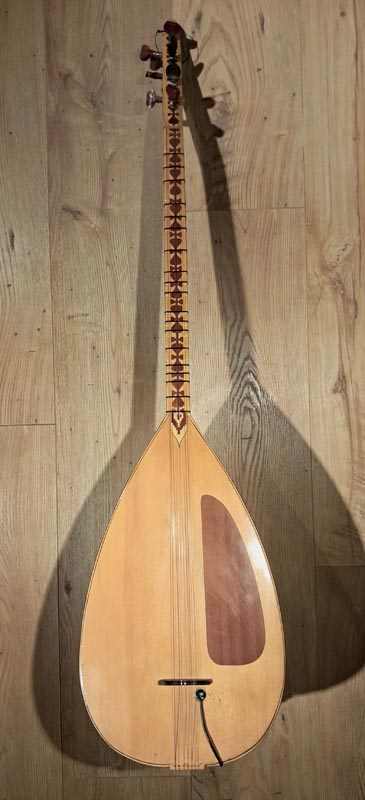
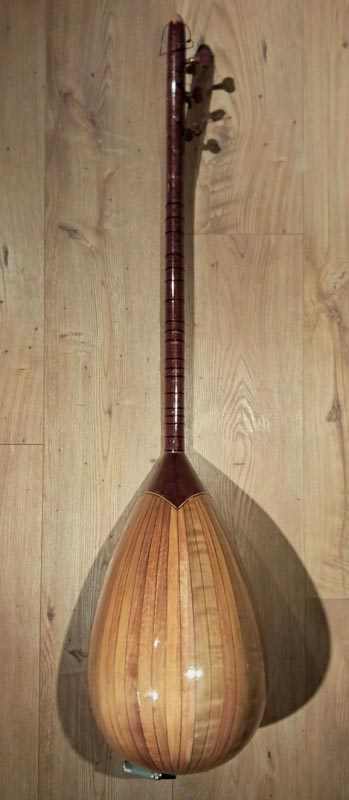
Baglama – Saz – Short neck

Add to favorites
Added to Cart View Cart Checkout
Added to Wishlist View Wishlist
Removed from Wishlist
Information
Dimensions 1005 × 248 × 240 mm
Name of musical instrument

Type of musical instrument

Typical place of occurrence

Date of manufature of instrument

Place of manufacture

Made by

Restored by

Scale

Number of strings

How to play musical instrument

Continent

Country

Sharing:
Categories:
Labels:

Baglama – Saz – Short neck

Information
Dimensions 1005 × 248 × 240 mm
Name of musical instrument

Type of musical instrument

Typical place of occurrence

Date of manufature of instrument

Place of manufacture

Made by

Restored by

Scale

Number of strings

How to play musical instrument

Continent

Country

Sharing:
Categories:
Labels:

The baglama or saz is a family of plucked string instruments and long-necked lutes used in Ottoman classical music, Turkish folk music, Turkish Arabesque music, Azerbaijani music, Bosnian music (Sevdalinka), Kurdish music, and Armenian music. It is played in several regions in the world such as Europe, Asia, Black Sea, Caucasus regions and many countries including Syria, Iraq, Iran and Bosnia and Herzegovina. It is commonly used by the ashiks.

Baglama (pronounced [baːɫaˈma]) is derived from the Turkish word baglamak meaning “to tie”. Used notably in Azerbaijan, the alternative name, Saz (Persian: ساز, romanized: sāz) means “musical instrument”, derived from a Persian verb that means “to make, to compose”.

According to The New Grove Dictionary of Music and Musicians, “the terms ‘baglama’ and ‘saz’ are used somewhat interchangeably in Turkey. ‘Saz’ is generally used interchangeably with ‘enstrüman’ (instrument) and it is used to refer single or group of musical instruments like ‘üflemeli sazlar’ (wind instruments).

Like the Western lute and the Middle-Eastern oud, baglama has a deep round back, with a much longer neck. It can be played with a plectrum or with a fingerpicking style known as şelpe.

In the music of Greece the name baglamas (Greek: μπαγλαμάς) is given to a treble bouzouki, a related instrument. The Turkish settlement of Anatolia from the late eleventh century onward saw the introduction of a two-string Iranian dutar that Turkmen people adopted which in turn was played in some areas of Turkey until recent times.


Turkish baglama

The most commonly used string folk instrument in Turkey, the baglama has seven strings divided into courses of two, two and three. It can be tuned in various ways and takes different names according to region and size: Baglama, Divan Sazı, Bozuk, Çögür, Kopuz Irızva, Cura, Tambura, etc. The cura is the smallest member of the baglama family: larger than the cura is the tambura, tuned an octave lower. The Divan sazı, the largest instrument in the family, is tuned one octave lower still.

A baglama has three main parts, the bowl (called tekne), made from mulberry wood or juniper, beech, spruce or walnut, the spruce sound board (göğüs) and a neck of beech or juniper (sap). The tuning pegs are known as burgu (literally screw). Frets are tied to the sap with fishing line, which allows them to be adjusted. The baglama is usually played with a mızrap or tezene (similar to a guitar pick) made from cherrywood bark or plastic. In some regions, it is played with the fingers in a style known as Şelpe or Şerpe.


There are also electric baglamas, which can be connected to an amplifier. These can have either single or double pickups.

Azerbaijani saz

Traditionally the Azerbaijani saz has been a mainstay of ashiqs, minstrels who combine poetry, storytelling, dance and vocal/instrumental music into a performance art that’s considered one of the symbols of Azerbaijani cultural, literary and musical identity.

Since 2009 the art of Azerbaijani Ashiqs has been inscribed on Unesco’s Representative List of the Intangible Cultural Heritage of Humanity.

Kopuz and the baglama

The baglama is a synthesis of historical musical instruments in Central Asia and pre-Turkish Anatolia. It is partly descended from the Turkic komuz. The kopuz, or komuz, differs from the baglama in that it has a leather-covered body and two or three strings made of sheep gut, wolf gut, or horsehair. It is played with the fingers rather than a plectrum and has a fingerboard without frets. Baglama literally translates as “something that is tied up”, probably a reference to the tied-on frets of the instrument. The word baglama is first used in 18th-century texts. The French traveller Jean Benjamin de Laborde, who visited Turkey during that century, recorded that “the baglama or tambura is in form exactly like the cogur, but smaller.” The Çoğur/Çöğur was in many ways a transitional Instrument between old Komuz and new Baglama style and has a body shape similar to the Instrument called panduri in Georgia.

According to the historian Hammer, metal strings were first used on a type of komuz with a long fingerboard known as the kolca kopuz in 15th-century Anatolia.[citation needed] This was the first step in the emergence of the çöğür (cogur), a transitional instrument between the kopuz and the baglama. According to 17th-century writer Evliya Çelebi, the çöğür was first made in the city of Kütahya in western Turkey. To take the strain of the metal strings the leather body was replaced with wood, the fingerboard was lengthened and frets were introduced. Instead of five hair strings there were now twelve metal strings arranged in four groups of three. Today, the çöğür is smaller than a medium-size baglama. Çöğür is also used to refer medium sized short necked baglama (kısa sap baglama).

Baglama (Saz) family


Baglama tunings

There are three string groups, or courses, on the baglama, with strings double or tripled. These string groups can be tuned in a variety of ways, known as düzen (literally, “order”). For the baglama düzeni, the most common tuning, the courses are tuned from top downward, A-G-D. Some other düzens are Kara Düzen (C-G-D), Misket Düzeni (A-D-F#), Müstezat (A-D-F), Abdal Düzeni, and Rast Düzeni.

Baglama düzeni (La, Sol, Re) (A, G, D)

Bozuk düzen, kara düzen (Sol, Re, La) (G, D, A)

Misket düzeni (Fa#, Re, La) (F#, D, A)

Fa müstezat düzeni (Fa, Re, La) (F, D, A)

Abdal düzeni (La, La, Sol) (A, A, G)

Zurna düzeni (Re, Re, La) (D, D, A)

Do müstezat düzeni (Sol, Do, La) (G, C, A)

Aşık düzeni (La (bottom string set), Re (middle string set), Mi (Top string set) (A, D, E)

Baglama Scale

The musical scale of the baglama differs from that of many western instruments – such as the guitar – in that it features ratios that are close to quarter tones. The traditional ratios for baglama frets are listed by Yalçın Tura:[3]


Fret 1: 18/17

Fret 2: 12/11

Fret 3: 9/8

Fret 4: 81/68

Fret 5: 27/22

Fret 6: 81/64

Fret 7: 4/3

Fret 8: 24/17

Fret 9: 16/11

Fret 10: 3/2

Fret 11: 27/17

Fret 12: 18/11

Fret 13: 27/16

Fret 14: 16/9

Fret 15: 32/17

Fret 16: 64/33

Fret 17: 2/1

However, as confirmed by Okan Öztürk, instrument makers now often set frets on the baglama with the aid of fret calculators and tuners based on the 24-tone equal temperament.

https://en.wikipedia.org/wiki/Ba%C4%9Flama

no data

Reviews

There are no reviews yet.

Add a review

For security, use of CloudFlare's Turnstile service is required which is subject to the CloudFlare Privacy Policy and Terms of Use.

You might also be interested in this

Privacy Preferences
When you visit our website, it may store information through your browser from specific services, usually in form of cookies. Here you can change your privacy preferences. Please note that blocking some types of cookies may impact your experience on our website and the services we offer.