Skip to main content Scroll Top
Instruments from all over the world!
  • Home
  • Europe
  • Hungary
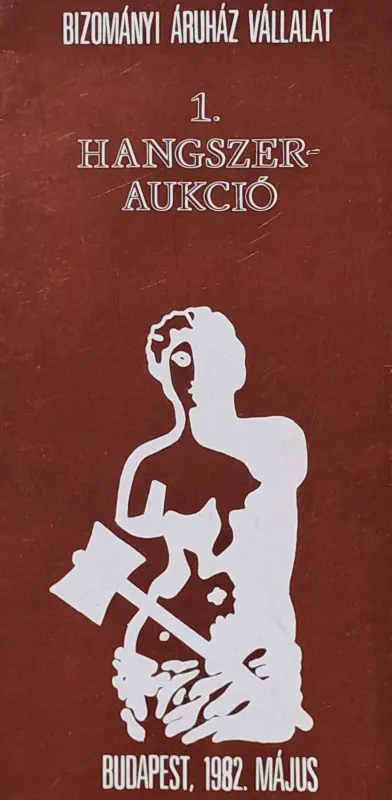
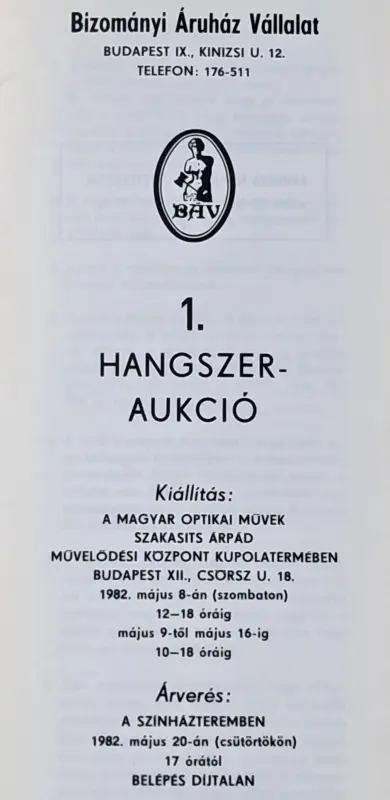
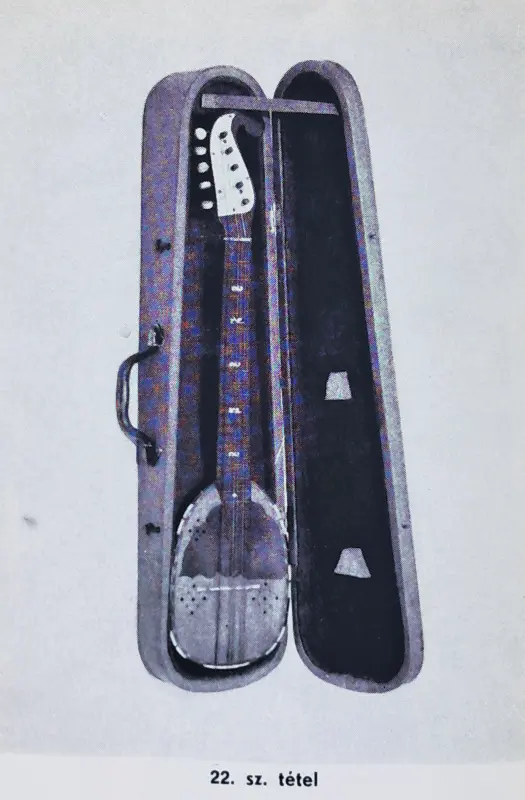
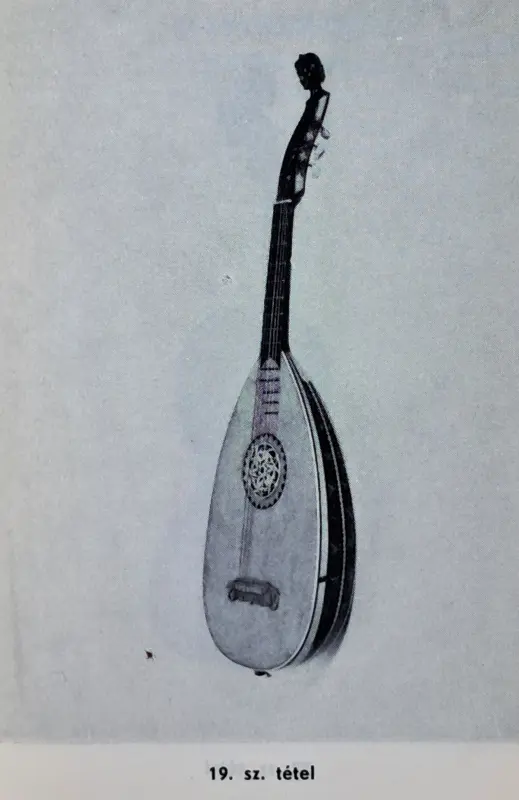
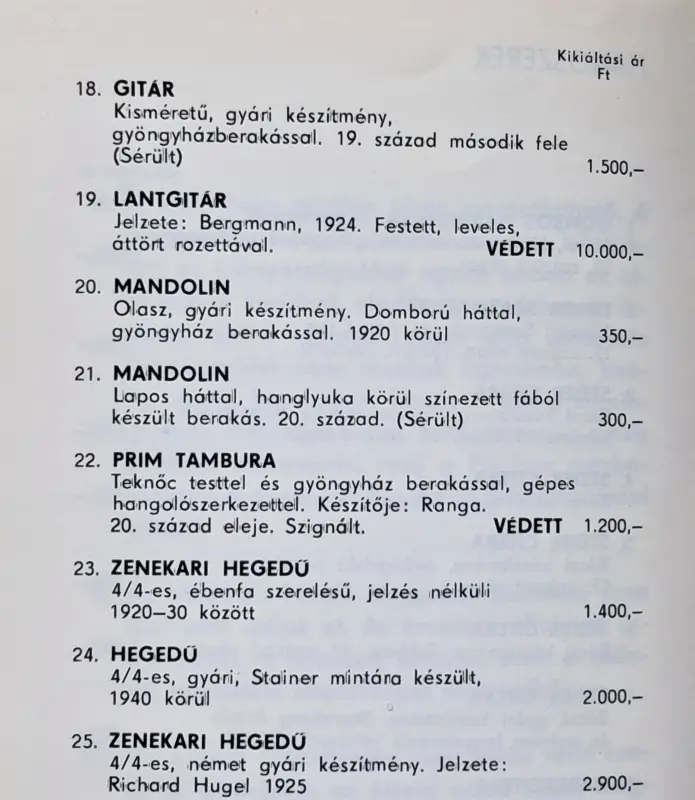
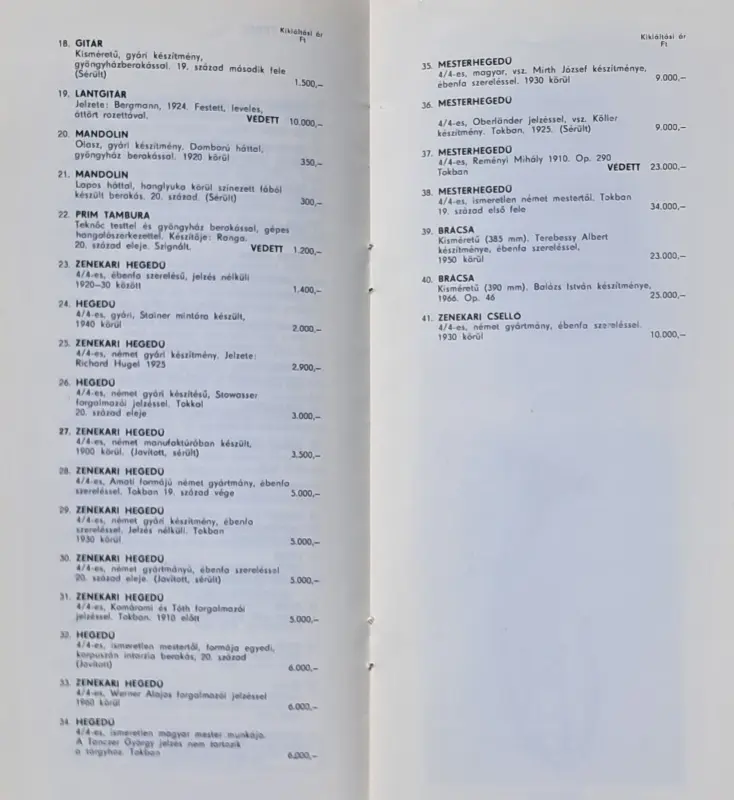
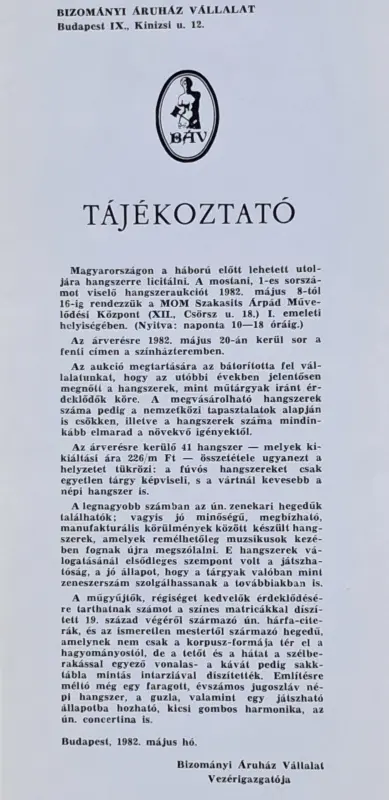
  • Book – Consignment Store Company – 1st Musical Instrument Auction – Budapest, May 1982

Book – Consignment Store Company – 1st Musical Instrument Auction – Budapest, May 1982

Add to favorites
Added to Cart View Cart Checkout
Added to Wishlist View Wishlist
Removed from Wishlist
Information:
Author and Title

Published by

Place of Edition

Year of Edition

Number of pages

16

Language

Hungarian

Size (length x width – mm)

189 x 120

Within other caregory

Book, Paper collectible

Sharing:
Categories:
Labels:

Book – Consignment Store Company – 1st Musical Instrument Auction – Budapest, May 1982

Add to favorites
Added to Cart View Cart Checkout
Added to Wishlist View Wishlist
Removed from Wishlist
Information:
Author and Title

Published by

Place of Edition

Year of Edition

Number of pages

16

Language

Hungarian

Size (length x width – mm)

189 x 120

Within other caregory

Book, Paper collectible

Sharing:
Labels:
Categories:

BÁV

BÁV is an abbreviation for the former Bizományi Áruház Vállalat, which was engaged in pawnbroking and consignment sales. Its legal successor, which is still in operation today, is BÁV Aukciósház és Záloghitel Zrt. (abbreviated as BÁV Zrt.), a major player in the Hungarian pawnbroking and art trade industries. Its headquarters are located at 23–33 Csalogány Street in Budapest’s 2nd district.


History

The First Hungarian Royal Pawnshop, founded in Bratislava (today in Slovakia) in 1773, moved to Buda in 1787 and then to Pest in 1802. By the 1890s, growing business volume made it necessary to construct a much larger building for the institution than its previous ones. Known as the Central Pawnshop, this L-shaped, clinker-brick corner building—covering more than 4,000 square meters—was constructed between 1901 and 1903 according to the plans of Sámuel Révész and József Kollár at 30–32 Lónyay Street in Budapest’s 9th district.

During the 1919 Hungarian Soviet Republic, it was briefly known as the Hungarian State Pawnshops, and from 1920 onward, it continued to operate under the name State Auction Hall. In 1924, it merged with the Postal Savings Bank, and following nationalization after World War II, in 1948, it separated from it to become the State Pawnshop and Auction Hall.

Following a change in its scope of operations, the state-owned company was renamed the Bizományi Áruház Vállalat (abbreviated as BÁV) in 1951. The company’s employees were required to participate in the deportations from Budapest. They had to conduct on-site inventories of the confiscated works of art at the residences of the deported individuals, based on their on-site appraisals.

In the second half of the 1980s, BÁV conducted its commercial activities in the capital and in 27 provincial cities, operating in two business segments: the secondhand goods (consignment) business and the pawnbroking business.

From 1991, BÁV continued to operate under the name BÁV Consignment Trading House and Pawnbroking Co., Ltd., and from 1998 as BÁV Pawnbroking Financial and Service Co., Ltd. In 2001, it became a privately held corporation. It used its old building (Central Pawnshop) until 2006. Since 2007, it has been operating at 1 V. Bécsi Street. It uniquely combines the functions of an auction house, an art shop, and a gallery. Current company name: BÁV Auction House and Pawnshop Ltd.

In 2022, the BÁV ART Auction House and Gallery opened at 3 Szent István körút in Budapest’s 5th district.


https://hu.wikipedia.org/wiki/B%C3%81V


September 1918: For the fall season, all types of musical instruments and parts can be purchased at the lowest prices exclusively at M. Geiger’s musical instrument wholesale store. 9 Korall Street, Budapest V. The only company in the country that works exclusively with resellers. Sales to merchants only. Request a price list. (Magyar Kereskedők Lapja – September 14, 1918 – Arcanum database)


September 1923: Boys who have graduated from high school are being accepted as apprentices for INSTRUMENT MAKING. Geiger Musical Instrument Wholesale, 37 Nagymező Street. (Pesti Hírlap – September 7, 1923 – Arcanum database)


December 1923: RUNNING BOYS. 13–15-year-olds hired immediately. Geiger Musical Instrument Wholesale, 37 Nagymező Street. (Friss Újság – December 28, 1923 – Arcanum database)


November 1940: The best source for fencing equipment, ski gear, backpacks, expanders, and all sporting goods, musical instruments, strings, and accessories: Geiger M-né Musical Instrument, Sporting Goods, and Toy Wholesale, Budapest V., 9 Károly Légrády Street (OMKE – November 30, 1940 – Arcanum database)


January 1944: The best source for water bottles, hiking boxes, backpacks, winter and spring sporting goods, musical instruments, and toys: Geiger M-né Musical Instrument, Sporting Goods, and Toy Wholesale, Budapest V., 9 Károly Légrády Street (Magyar Vaskereskedő – January 22, 1944 – Arcanum database)


Korall Street and Károly Légrády Street were the same public thoroughfare; Balzac Street in today’s 13th District of Budapest (Újlipótváros) was known by these names at various times throughout history.

Privacy Preferences
When you visit our website, it may store information through your browser from specific services, usually in form of cookies. Here you can change your privacy preferences. Please note that blocking some types of cookies may impact your experience on our website and the services we offer.