Skip to main content Scroll Top
Instruments from all over the world!

Kankles

Add to favorites
Added to Cart View Cart Checkout
Added to Wishlist View Wishlist
Removed from Wishlist
Information
Dimensions 820 × 310 × 76 mm
Name of musical instrument

Type of musical instrument

Typical place of occurrence

Date of manufature of instrument

Place of manufacture

Made by

Restored by

How to play musical instrument

Scale

Number of strings

Continent

Country

Sharing:
Categories:

Kankles

Information
Dimensions 820 × 310 × 76 mm
Name of musical instrument

Type of musical instrument

Typical place of occurrence

Date of manufature of instrument

Place of manufacture

Made by

Restored by

How to play musical instrument

Scale

Number of strings

Continent

Country

Sharing:
Categories:

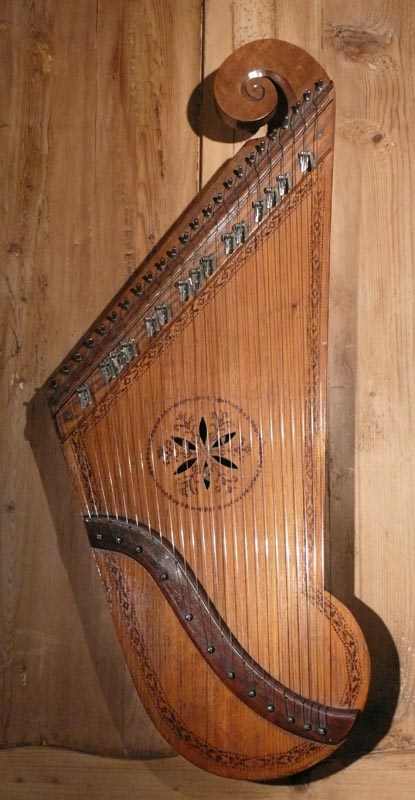
The kanklės is a Lithuanian plucked string instrument (chordophone) belonging to the Baltic box zither family known as the Baltic psaltery, along with the Latvian kokles, Estonian kannel, Finnish kantele, and Russian gusli.

Etymology

According to Finnish linguist Eino Nieminen, the name of the instrument, along with the names of most of its neighbouring counterparts (Latvian kokles, Finnish kantele, Estonian kannel and Livonian kāndla), possibly comes from the proto-Baltic form *kantlīs/*kantlēs, which originally meant ‘the singing tree’, most likely deriving from the Proto-Indo-European root *qan- (‘to sing, to sound’; cf. Latin “canto, cantus, canticum”, Italian “cantare”, French “chanter”, English “chant, cantor”).

A Lithuanian ethnologist Romualdas Apanavičius believes Kanklės could be derived from the Proto-European root *gan(dh)-, meaning ‘a vessel; a haft (of a sword)’, suggesting that it may be related to the Russian word gusli.

Construction

Although kanklės vary both regionally and individually, there are some common characteristics in their construction.

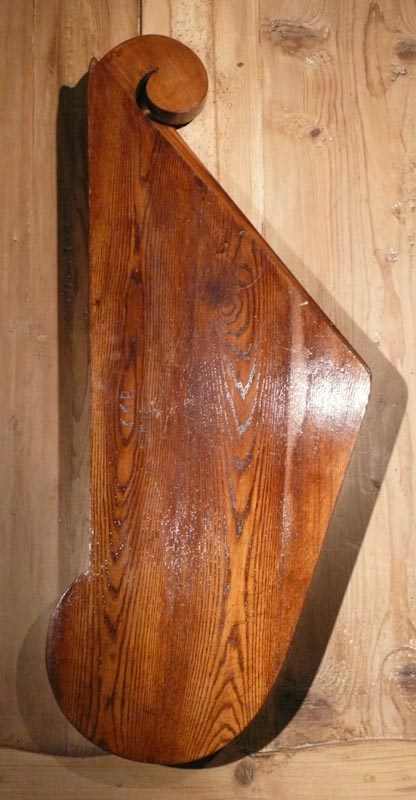
Kanklės belong to the zither family, which means that their strings are parallel to the soundboard (not perpendicular, like in a harp) and do not extend beyond it (not like in e.g. a guitar, where they extend to the neck). The body of the kanklės is made from one trapezoidal piece of linden tree, ash tree, oak, maple or black alder, which is hollowed out to create a cavity. A thin sheet of softwood (usually spruce) is used to make a soundboard, which covers the body. Soundholes, which traditionally take the shape of a stylized flower or star, are cut into the soundboard, allowing sound to project outward. At the narrowest side of the body, a metal bar is attached to which the strings made of wire or gut are anchored. The opposite ends of the strings are attached to a row of tuning pegs inserted into holes at the opposite side of the body.

Kanklės is usually rested on the player’s lap and played with the fingers or a pick made of bone or quill.

History

According to Birutė Žalalienė, psaltery, coming from Western Europe, could have been used in Lithuania to accompany church singing since the 15th century, and later in folk music in Lithuania Minor and Samogitia.

The word “kanklės” is first used in writing in 1580 by Jonas Bretkūnas in his Bible translation. Vincas Kudirka published two collections of folk songs adapted for choirs, titled Kanklės, in 1895 and 1898. In 1906, Pranas Puskunigis established an ensemble of kanklės players, mostly from the students at the Veiveriai Teachers’ Seminary, in Skriaudžiai. This ensemble, known simply as “Kanklės” since 1984, continues to this day. A school for kanklės players was opened in 1930 in Kaunas. Kanklės are taught at the Lithuanian Academy of Music and Theatre since 1945. Concert kanklės were first constructed in 1964.

Types

Apanavičius classifies the kanklės into three basic traditional types, although there are variations within each type and some overlap of areas. Each type has its own playing technique.

Kanklės of Northeastern Aukštaitians: the simplest and most ancient form. Carved out of a single piece of wood into a boat or coffin shape.

Kanklės of Western Aukštaitians and Samogitians: somewhat larger than those of Northeastern Aukštaitija, usually having between eight and twelve strings. They have a flat bottom, and in some cases, the shortest end is carved with the stylized figure of a bird’s or fish’s tail.

Kanklės of Northwestern Samogitians and Suvalkians: usually the most decorated type, and kanklės used in concert performance are most often based on this variety. The most prominent identifying feature is the addition of a carved spiral figure to the point of the instrument’s body and sometimes, the rounding of the narrow end of the body. Typically, these instruments have between nine and thirteen strings.

Concert kanklės, with an expanded range of more than four octaves (29 strings, C3-C7) and added chromaticism, provided by means of metal levers at the side of the instrument, similar to the ones used in a Celtic or lever harp, were constructed in 1964 by P. Kupčikas following the design of P. Stepulis and D. Mataitienė. In the 1960s they followed the lead of Latvian concert kokles which had first been constructed in 1951.

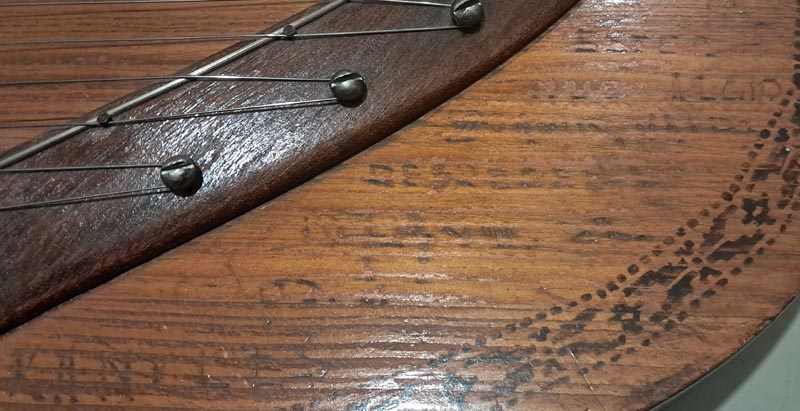
Probably Lithuanian inscription on the top. What is visible: Eszter, 22 August 1971, Debrecen

no data

Privacy Preferences
When you visit our website, it may store information through your browser from specific services, usually in form of cookies. Here you can change your privacy preferences. Please note that blocking some types of cookies may impact your experience on our website and the services we offer.