Skip to main content Scroll Top
Instruments from all over the world!

Tanbour

Add to favorites
Added to Cart View Cart Checkout
Added to Wishlist View Wishlist
Removed from Wishlist
Information
Dimensions 1186 × 145 × 155 mm
Name of musical instrument

Type of musical instrument

Typical place of occurrence

Date of manufature of instrument

Place of manufacture

Made by

Restored by

Scale

Number of strings

How to play musical instrument

Continent

Country

Sharing:
Categories:
Labels:

Tanbour

Information
Dimensions 1186 × 145 × 155 mm
Name of musical instrument

Type of musical instrument

Typical place of occurrence

Date of manufature of instrument

Place of manufacture

Made by

Restored by

Scale

Number of strings

How to play musical instrument

Continent

Country

Sharing:
Categories:
Labels:

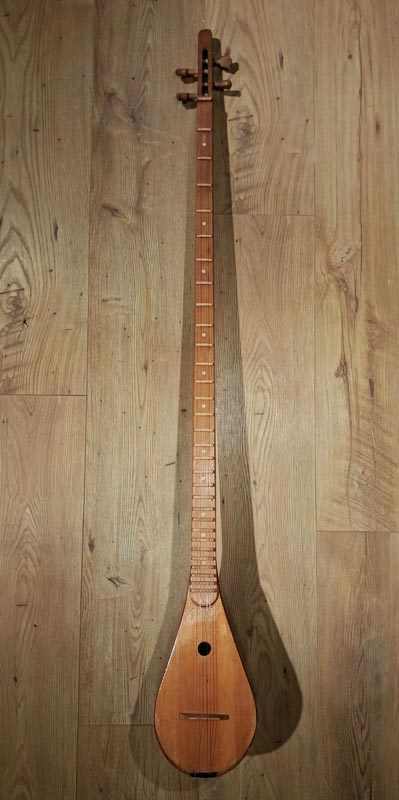
The tanbur (or tambor or tambir) is another long-neck lute from Central Asia that exist in different shapes, and is the wire-strung companion of the dutar.

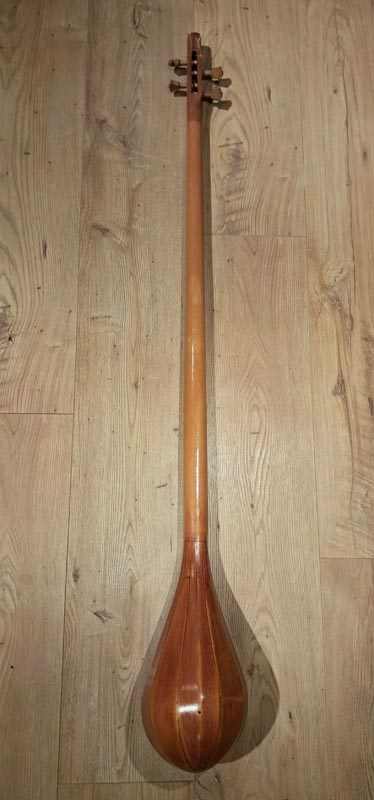
The body of the Uzbek tanbur is made from a hollowed out piece of mulberry wood, and often smaller than the dutar. The front is made from mulberry.

The long neck (mulberry or apricot) is also the pegbox. The frets are made of thick gut string, tied-on (3 windings) in some diatonic scale. At the left side of the neck is a groove to ease making the knots in the frets. There are 4 flat T-shaped friction pegs, two on the front, and two on the left. The 4 metal strings run over a small loose bridge to a bit of wood at the edge of the body. The first two strings are tuned the same, but they are so far apart that only the first one is fingered.

The neck is often highly decorated with inlay bone (or white plastic nowadays) in squares, triangles, lines. The top of the back has triangle inlays, together forming a kind of windrose. The soundholes are a few drilled holes in a geometrical design. The entire instrument is varnished.

The tanbur is always played with a wire plectrum on the index-finger, similar to the Indian sitar plectrum (mizrab), so you can pick forwards and backwards. The left hand plays mainly on the first course – the others are used as drones.

The music is usually instrumental, but the tanbur is also used to accompany singing.

https://www.atlasofpluckedinstruments.com/central_asia.htm

no data

Reviews

There are no reviews yet.

Add a review

For security, use of CloudFlare's Turnstile service is required which is subject to the CloudFlare Privacy Policy and Terms of Use.

You might also be interested in this

Privacy Preferences
When you visit our website, it may store information through your browser from specific services, usually in form of cookies. Here you can change your privacy preferences. Please note that blocking some types of cookies may impact your experience on our website and the services we offer.