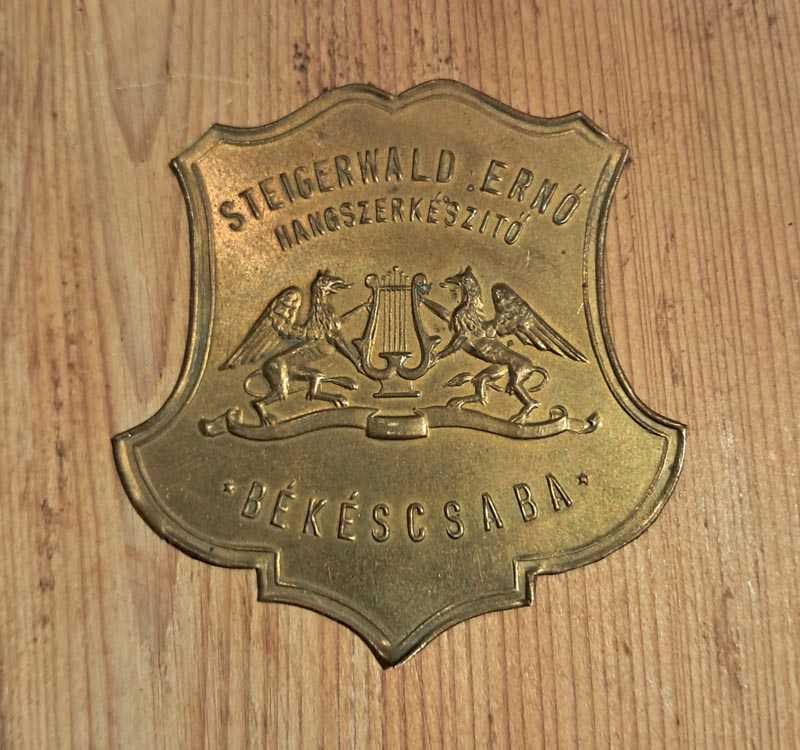
Musical instrument plate - Ernő Steigerwald - Békéscsaba
| Dimensions | 54 × 50 × 1 mm |
|---|---|
| Name of musical instrument | |
| Within other caregory | Musical instrument plate |
| Typical place of occurrence | |
| Date of manufature of instrument | |
| Place of manufacture | |
| Made by | |
| Restored by | |
| Scale | |
| Number of strings | |
| How to play musical instrument | |
| Continent | |
| Country |
no data
ERNŐ STEIGERWALD (1904-?)
Studied with Márton Hein in Székesfehérvár until 1918-21, then with Róbert Laumann, from 1924 she worked in Dezső Bárány’s “English workshop”. She also worked in the workshops of István Havas, József Schneider and Sternberg. In 1932 he became self-employed.
He also made bows.
https://vonokeszites.hu/vono-szenakazalban/steigerwald-erno
STEIGERWALD ERNŐ (* 1904.XI.30., Szolnok) is undoubtedly one of the “grand old men” of the profession, who despite his old age is still working in Békéscsaba.
His father was a carpenter at the railway in Székesfehérvár. He was a good friend of Márton Hein and in the autumn of 1918, he sent his son to study with him.
Ernő Steigerwald was released in 1921 and, on the recommendation of Károly Jerzsabek, was employed by Róbert Laumann, who at the time – during the second coup d’état – had a workshop on the ground floor at 24 Semmelweis u. Here he worked with Sándor Laczkó, Károly Horváth and László Benedek.
At the beginning of 1924 – at the same time as Sándor Laczkó – he moved to Dezső Bárány’s “English workshop”, where he worked with Miksa Frirsz sr. and József Mirth.
At the beginning of 1925 he returned to Székesfehérvár, to Márton Hein’s workshop on Simor Street. In the autumn of the same year, however, he went back to Pest, this time to István Havas at 16B Üllői út.
In 1926, he was already working at Mogyoróssy at Rákóczi út 71, in the company of JÓZSEF SCHNEIDER, László Benedek and László Bóza. At that time Mihály Vasetz and János Gruber were still there as apprentices.
In 1927 he moved to Sternberg. Until the beginning of 1929 he worked at 60 Rákóczi út, then he found a job at the Budapest depot of the company “Meinel et Herold” in Klingenthal (IX, Üllői út 19) until June 1931. At that time, the company closed the depot due to banking restrictions imposed by the economic crisis.
In August 1932, it became independent in Gyula, at 9 baron Wenkheim Béla utca. In February 1934, he opened a workshop at Luther utca 8, Békéscsaba, but he also maintained his Gyula premises until 1939, where he employed an assistant.
In 1939, he opened a shop at 4 Andrássy utca in Békéscsaba, but closed his Gyula workshop in the autumn of the same year.
His shop closed in 1950. In March 1953 he had to move his workshop from Luther utca to 16 Tanácsköztársaság utca (then it was Stalin utca).
H has been operating at its present location – 19 Jókai utca – since 23rd January, 1968.
He has repaired a wide variety of instruments: strings, mallets, brass and woodwinds, accordions, drums and even – with minor repairs – pianos. He also made bowed instruments (violin, viola, cello, double bass), plucked instruments (mandolin, guitar, balalaika, banjo) and bows. He also made children’s instruments (1/4, 1/2, 3/4 violins, 1/2 cello) and bows (1/4 violin and cello bows from beech wood). He worked mainly on the Joseph Guarneri form, but also made violins after the Stradivari pattern. The violas followed the J. Guarneri mould, the cellos the Stradivari mould. The double basses are in individual shapes. He used a brownish-red and orange-coloured sesquioxide varnish, which he made himself according to a recipe from Jerzhabek. Always satin finished.
As an assistant, he wrote his name and the year of manufacture in ink under the lacquer under the fingerboard. Since 1932 he has used a printed label on which he has written the year, month and day by hand. He taught his son László Steigerwald the trade.
András Tímár, Dr. From the book “History of Hungarian violin making” – 1987

Reviews
There are no reviews yet.