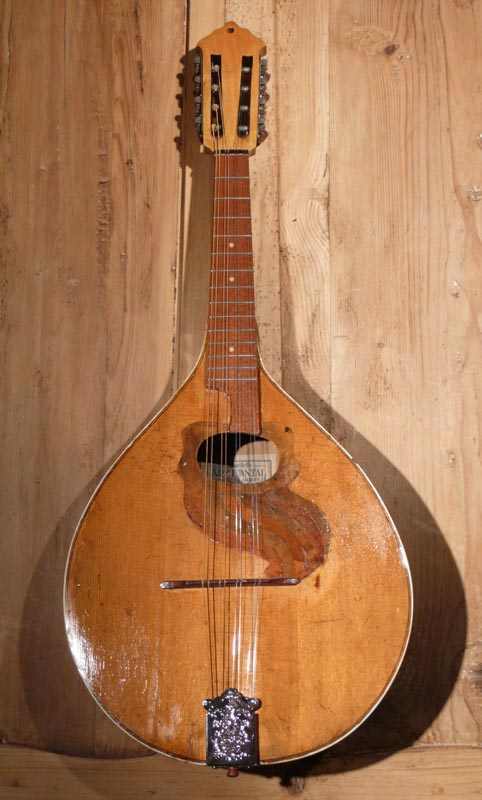
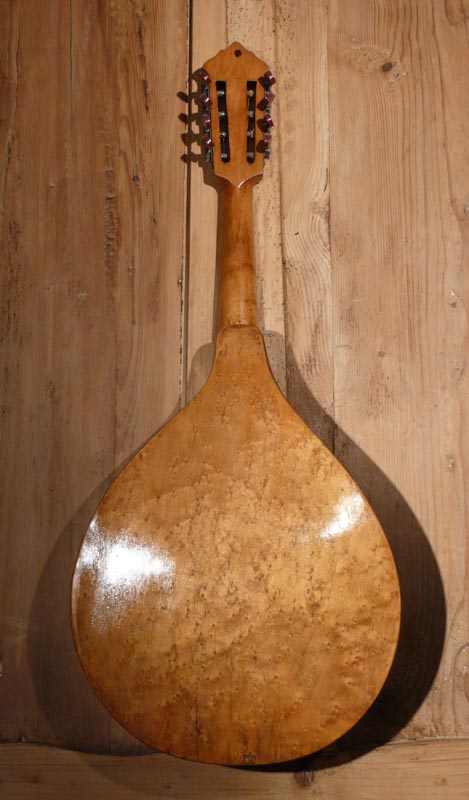
Mandola - Antal Arzt - Belváros-Lipótváros – Budapest 2.
| Dimensions | 735 × 315 × 83 mm |
|---|---|
| Name of musical instrument | |
| Type of musical instrument | |
| Typical place of occurrence | |
| Date of manufature of instrument | |
| Place of manufacture | |
| Made by | |
| Restored by | |
| Scale | |
| Number of strings | |
| How to play musical instrument | |
| Continent | |
| Country |
Mandola
The mandola (US and Canada) or tenor mandola (Ireland and UK) is a fretted, stringed musical instrument. It is to the mandolin what the viola is to the violin: the four double courses of strings tuned in fifths to the same pitches as the viola (C3-G3-D4-A4), a fifth lower than a mandolin. The mandola, though now rarer, is an ancestor of the mandolin. (The word mandolin means little mandola.)
The name mandola may originate with the ancient pandura, and is also rendered as mandora, the change perhaps having been due to approximation to the Italian word for “almond”. The instrument developed from the lute at an early date, being more compact and cheaper to build, but the sequence of development and nomenclature in different regions is now hard to discover. Historically related instruments include the mandore, mandole, vandola (Joan Carles Amat, 1596), bandola, bandora, bandurina, pandurina and – in 16th-century Germany – the quinterne or chiterna.
However, significantly different instruments have at times and places taken on the same or similar names, and the “true” mandola has been strung in several different ways.
The mandola has four double courses of metal strings, tuned in unison. The scale length is typically around 42 cm. The mandola is typically played with a plectrum (pick). The double strings accommodate a sustaining technique called tremolando, a rapid alternation of the plectrum on a single course of strings.
The mandola is commonly used in folk music—particularly Italian folk music. It is sometimes played in Irish traditional music, but the instruments octave mandolin, Irish bouzouki and modern cittern are more commonly used. Some Irish traditional musicians, following the example of Andy Irvine, restring the tenor mandola with lighter, mandolin strings and tune it F-C-G-C (two semi-tones lower than G-D-A-D, since the mandola’s fretboard is two frets longer than the mandolin’s), while others (Brian McDonagh of Dervish being the best known) use alternate tunings such as D-A-E-A. Like the guitar, the mandola can be acoustic or electric. Attila the Stockbroker, punk poet and frontman of Barnstormer, uses an electric mandola as his main instrument. Alex Lifeson, guitarist of Rush, has also featured the mandola in his work.
Mandolas are sometimes played in mandolin orchestras, along with other members of the mandolin family: mandolin, mandocello and mandobass. Sometimes the octave mandolin (also referred to as an octave mandola) is included as well.
Antal Arzt
Place of birth: Budapest (Újpest)
Date of birth: 6th March, 1905
Mother’s name: Lukovics Ida
Father’s name: Arzt József
Father’s occupation: Master independent underwear maker
Brothers and sisters name: József, Ferenc, Katalin
Brothers and sisters year of birth: 1901,1909,1915
Occupation of brothers and sisters: Merchant’s assistant, factory worker, factory worker
Marital status: married
Spouse’s name: Etelka Karton
Spouse’s occupation: household
Date of marriage: May, 1936
Place of marriage: Budapest
Name of child: Antal
Year of birth of child: 1942
Place of birth of his children: Budapest
Occupation of children: Film director
Address: Budapest, 1065 VI Révay u. 6.1/3 Previous addresses Budapest, VI Révay u. 8.1936-37 Budapest, II Széher u. 46.1930-36 Pécs Puturluk u. 8.1924-30
Education: 4 civil schools
Qualifications: Master instrument maker
Studies of musical instruments: cello (4 years)
Instrumental teachers: János Csala
With whom he studied instrument making: István Havas
When: 1920-23
Where: Budapest
Who else was working in this workshop at that time: Gabler
With whom was he released: István Havas
When: 1st April, 1923
Who he worked for as an assistant (when, with whom): István Havas 1923 Dezső Bárány 1923-24 János Lenhardt Pécs 1924-30
When became independent: 1st May, 1931
Where: Budapest
Who else were independent masters at the same time in the same place: János Spiegel, Mihály Reményi, András Bergmann, Lajos Kovács, Pál Pilát, Róbert Laumann, Jeromos Cigi
Current address of workshop: Budapest, V. Kálmán u. 24.
Professional, social activities: (Industrial Association, KIOSZ, etc.) Member of KIOSZ examination committee. Vice-President of the Master Examination Committee since 1959.
Exhibitions (participation): Berlin 1938, International Crafts Exhibition Competitions (participation) Poznan 1960 Liège 1963
Other awards: 1962 ‘Good Quality’ badge 1970 ‘Excellent Master of Industry’
How many instruments has he made: 250-460
Violin: 47
Viola: 6
Cello: 15
Guitar: 123
Other: Mandolin 250-260
Characteristics of his instruments Type Stradivari – Guarneri (2/3:1/3 ratio) Lacquer (material, colour) Liquor, golden yellow-brown
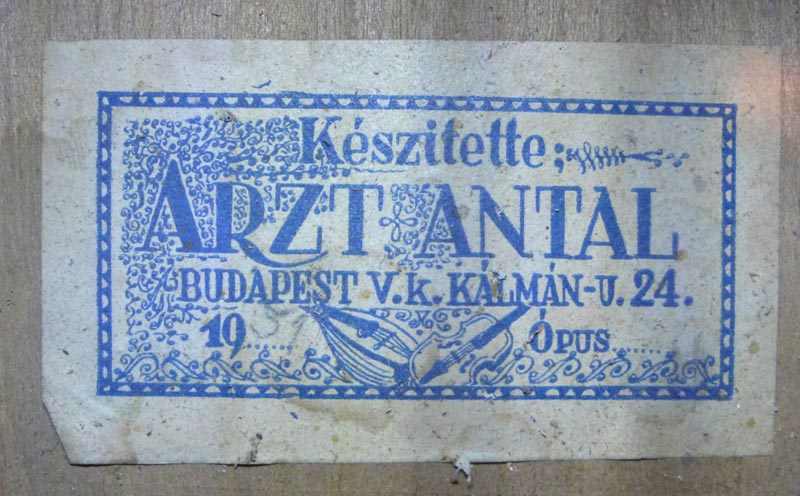
Master marks (printed only)
I/
ANTAL ARZT
Budapest V. Kálmán u. 24
Opus.. 19..
DISTINGUISHED AT THE WORLD EXHIBITION IN BERLIN
II/ [probably after the war]
Made by:
ANTAL ARZT
BUDAPEST. V. KÁLMÁN U. 24.
19.. Opus –
Dr Sándor Erdélyi: Hungarian Treasures Of Violinists – 1996