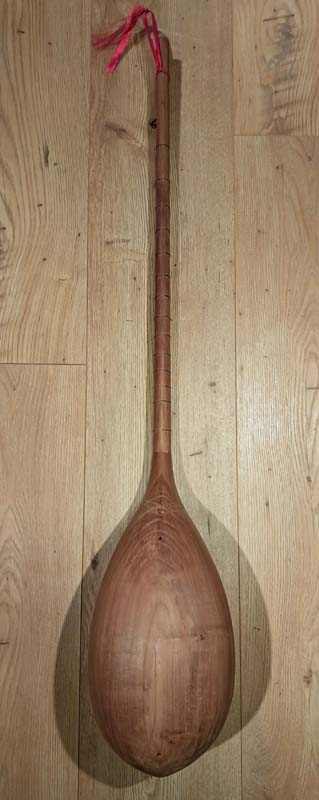
Dutar - Turkmen
| Dimensions | 887 × 157 × 145 mm |
|---|---|
| Name of musical instrument | |
| Type of musical instrument | |
| Typical place of occurrence | |
| Date of manufature of instrument | |
| Place of manufacture | |
| Made by | |
| Restored by | |
| Scale | |
| Number of strings | |
| How to play musical instrument | |
| Continent | |
| Country |
The Turkmen dutar looks in shape very much like the Iranian tanboor, but it has only 2 strings.
The body of the Turkmen dutar is carved from one piece of mulberry wood. The thin top is also made of mulberry wood, and slightly rounded. There are several small sound holes drilled in the front in some pattern, and one small hole on the back. The entire instrument is left unvarnished.
The neck is quite short (for a dutar) and oval round. It includes the pegbox, which is in a slight angle to the back.
The frets are made from round metal hoops, welded together – in a chromatic scale. There is a groove on the left side of the neck.
The two thin metal strings go over a small metal nut, under a fret-like hoop to two Y-shaped brass (!) tuning pegs on the front of the pegbox.
The strings run over an extremely tiny bridge (half a matchstick thick !) to some plastic device on the edge of the body.
Playing is mainly strumming with the index finger; the left hand fingers both strings. Music can be instrumental, or to accompany singing.
https://www.atlasofpluckedinstruments.com/central_asia.htm#turkmenistan
no data

Reviews
There are no reviews yet.