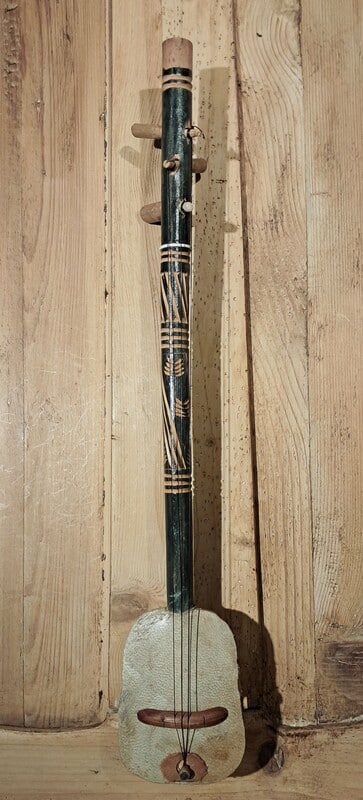
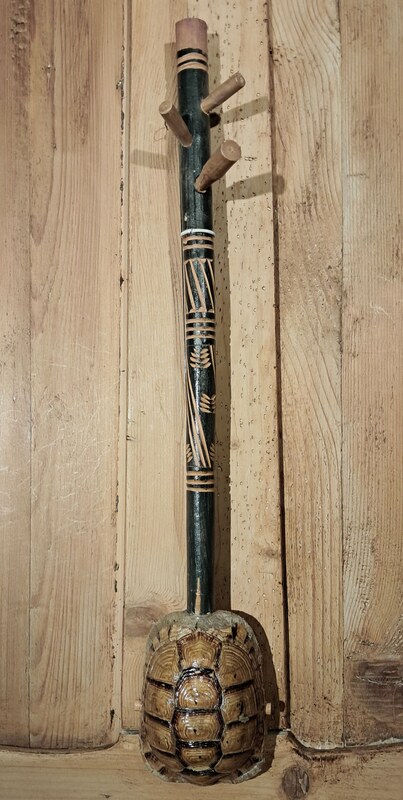
Gunibri
| Dimensions | 525 × 90 × 48 mm |
|---|---|
| Name of musical instrument | |
| Type of musical instrument | |
| Typical place of occurrence | |
| Date of manufature of instrument | |
| Place of manufacture | |
| Made by | |
| Restored by | |
| Scale | |
| Number of strings | |
| How to play musical instrument | |
| Continent | |
| Country |
The gunbri is a popular lute North of the Sahara, played mainly by the Berbers and Rwais tribes in Morocco. Other names are guimbri, guembri, gembri, gimbri, gambre, gombri – and in some regions loutar.
The body is a rounded piece of wood hollowed out, with a (goat) skin glued over the front. A thick round neck goes all the way through the body. The neck and the tuning pegs are turned on a lathe. The wood is usually left plain.
The 4 silk or nylon strings run over a loose wooden bridge and are fastened to the end of the round neck stick, through a small hole in the skin.
The gunbri is usually played with the fingers. An extra hoop is tied around the neck to serve as “nut”, giving all the strings the same scale length. However like on the ngoni, usually only the 2 middle strings are fingered.
A smaller version of the gunbri is called swisdi or suissen and used in popular urban style of singing. A larger version, which is called loutar (or lotar), is used in the Middle Atlas region by the Amazigh imdyazn (bards).
The gunibri is a small gunbri, with 3 nylon strings. There are several qualities.
The body could be made like the gunbri, from hollowed out wood.
Some of them has the back of the body made with a tortoise shell, and has quite a thick skin. This gunibri would be called fakroun or fakrun (= “tortoise”).
The round neck is usually decorated. It is usually painted black, with scratches to reveal the blanc wood underneath as decoration. It could also be just painted, without scratches. Most of these small instruments are for the tourist trade.
The better quality ones – resembling more the proper gunbri – are sometimes called suissen and used in a certain type of Moroccan classical music
https://www.atlasofpluckedinstruments.com/africa.htm#north
no data

Reviews
There are no reviews yet.