Skip to main content Scroll Top
Instruments from all over the world!

Claves

Add to favorites
Added to Cart View Cart Checkout
Added to Wishlist View Wishlist
Removed from Wishlist
Information
Dimensions 225 × 30 × 30 mm
Name of musical instrument

Type of musical instrument

Typical place of occurrence

Date of manufature of instrument

Place of manufacture

Made by

Restored by

Scale

How to play musical instrument
Continent

Country

Sharing:
Categories:
Labels:

Claves

Information
Dimensions 225 × 30 × 30 mm
Name of musical instrument

Type of musical instrument

Typical place of occurrence

Date of manufature of instrument

Place of manufacture

Made by

Restored by

Scale

How to play musical instrument
Continent

Country

Sharing:
Categories:
Labels:

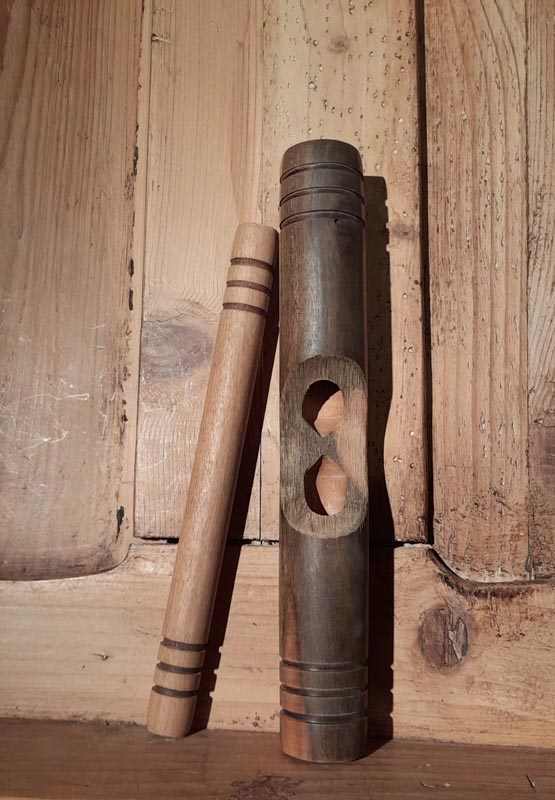
The claves are idiophonic percussion instruments consisting of a pair of 20-30 mm thick, 20-30 cm long rods which, when struck together, produce a sharp, clicking sound. They are traditionally made of wood, typically rosewood, ebony or grenadilla. Nowadays they can also be made of fibreglass or plastic. Claves are sometimes hollowed to amplify the sound.

When struck, claves produce a bright, penetrating clicking noise. This makes them useful when playing in large dance bands. Claves are sometimes hollow and carved in the middle to amplify the sound.

History

Claves have been very important in the development of Afro-Cuban music, such as the son and guaguancó. They are often used to play an ostinato, or repeating rhythmic figure, throughout a piece known as the clave.

Many examples of clave-like instruments can be found around the world.

Technique

The basic principle when playing claves is to allow at least one of them to resonate. The usual technique is to hold one lightly with the thumb and fingertips of the non-dominant hand, with the palm up. This forms the hand into a resonating chamber for the clave. Holding the clave on top of fingernails makes the sound clearer. The other is held by the dominant hand at one end with a firmer grip, much like how one normally holds a drumstick. With the end of this clave, the player strikes the resting clave in the center.

Traditionally, the striking clave is called el macho (“the male”) and the resting clave is called la hembra (“the female”). This terminology is used even when the claves are identical.

A roll can be achieved on the claves by holding one clave between the thumb and first two fingers, and then alternating pressure between the two fingers to move the clave back and forth. This clave is placed against the resonating clave to produce a roll.

Use in popular music

Some salsa singers play this percussion while singing.

Among the bands to have used claves are the Beatles in their recordings “Don’t Bother Me”, “And I Love Her” and The Who in their song “Magic Bus”.

Claves are also utilized in the interstitial spaces of the Night Court theme.

Use in classical music

Many composers looking to emulate Afro-Cuban music will often use claves such as Arturo Márquez with Danzón No. 2 or George Gershwin with his Cuban Overture.

Steve Reich’s Music for Pieces of Wood is written for five pairs of claves.

https://en.wikipedia.org/wiki/Claves

no data

Reviews

There are no reviews yet.

Add a review

For security, use of CloudFlare's Turnstile service is required which is subject to the CloudFlare Privacy Policy and Terms of Use.

You might also be interested in this

Privacy Preferences
When you visit our website, it may store information through your browser from specific services, usually in form of cookies. Here you can change your privacy preferences. Please note that blocking some types of cookies may impact your experience on our website and the services we offer.