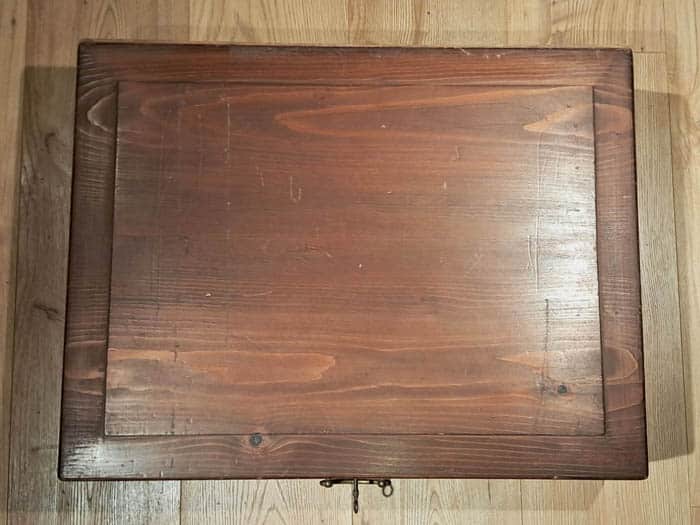
Zither - Guitar zither - Triola - Mechanical zither
| Dimensions | 547 × 405 × 115 mm |
|---|---|
| Name of musical instrument | |
| Type of musical instrument | |
| Typical place of occurrence | |
| Date of manufature of instrument | |
| Place of manufacture | |
| Made by | |
| Restored by | |
| Scale | |
| Number of strings | |
| How to play musical instrument | |
| Continent | |
| Country |
The guitar zither (also chord zither, fretless zither, mandolin zither or harp zither) is a musical instrument consisting of a sound-box with two sets of unstopped strings. One set of strings is tuned to the diatonic, chromatic, or partially chromatic scale and the other set is tuned to make the various chords in the principal key of the melody strings.
First patented May 29, 1894 by Friederich Menzenhauer (1858-1937), the guitar zither came into use in the late 19th century and was widely mass-produced in the United States and in Germany by Menzenhauer and later by Oscar Schmidt Inc., the Phonoharp Company, and others’.
The 1902 Sears catalogue touted the Deweylin Harp – a type of fretless zither -as “…the wonder of the age,” and “…the greatest musical instrument that has ever been placed before the public.” These mandolin-guitar-zithers purported to combine three instruments for the price of one.
A form of psaltery and member of the family of chordophones, the guitar zither is closely related to the Autoharp, first patented over 20 years earlier. It differs from it in not having damping bars for producing chords, and from the concert zither by the absence of a fretboard for melodic use.
The name guitar zither is apparently derived from its sound. The mandolin zither (or mandolin harp) has doubled strings in unison courses producing a more mandolin-like sound.
https://en.wikipedia.org/wiki/Guitar_zither
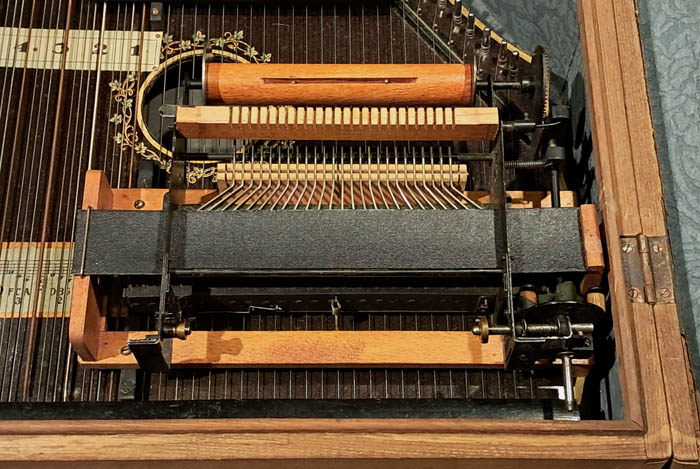
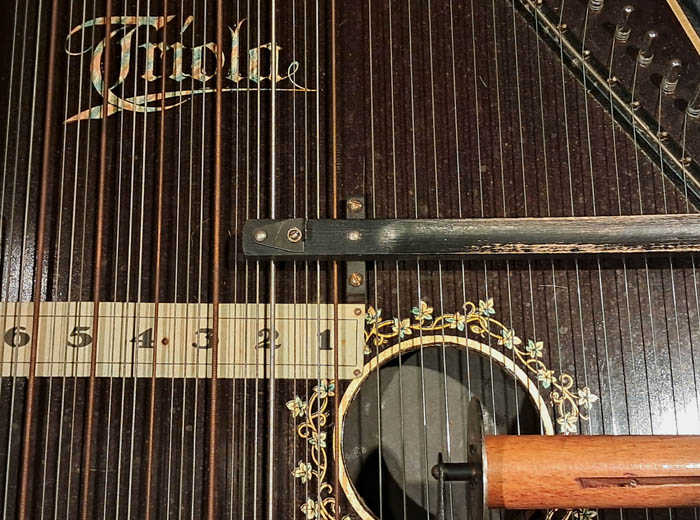
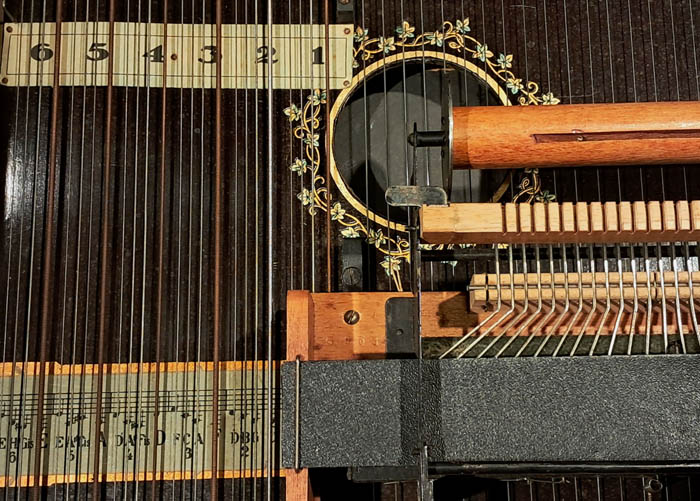
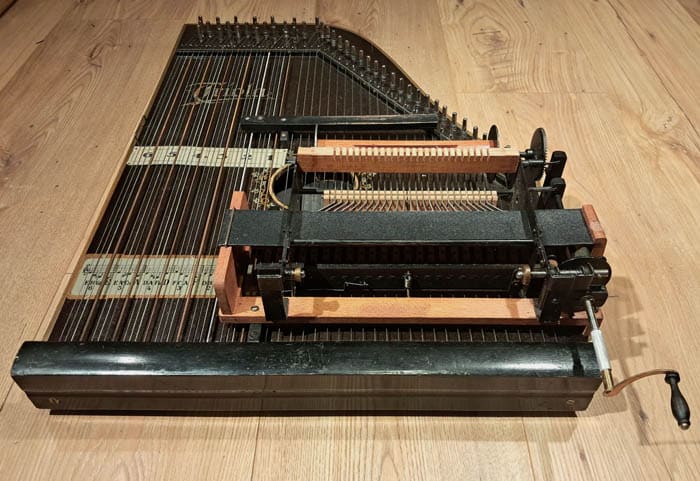
The Triola, or mechanical zither was popular in the late teens to 1920’s. Using a 25 note paper roll to activate keys, it is played by turning a crank at the lower right of the instrument. Only the treble notes are played automatically by the roll, the bass notes are played by hand by following the numbers printed on the rolls and strumming the appropriate group of bass strings marked on the zither.
The restorer Miklós Mednyánszky plays the instrument:

Reviews
There are no reviews yet.