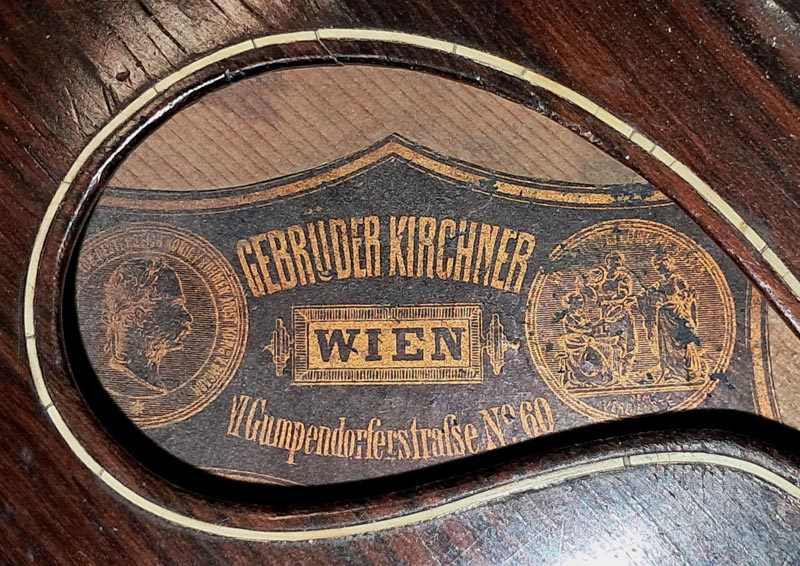
Zither – Bowed zither – Gebrüder Kirchner – Vienna
| Dimensions | 498 × 270 × 62 mm |
|---|---|
| Name of musical instrument | |
| Type of musical instrument | |
| Typical place of occurrence | |
| Date of manufature of instrument | |
| Place of manufacture | |
| Made by | |
| Restored by | |
| Scale | |
| Number of strings | |
| How to play musical instrument | |
| Continent | |
| Country |
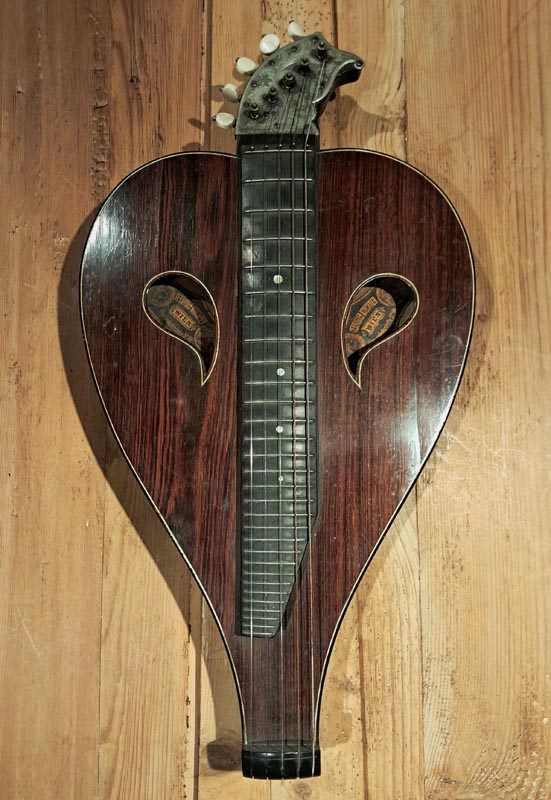
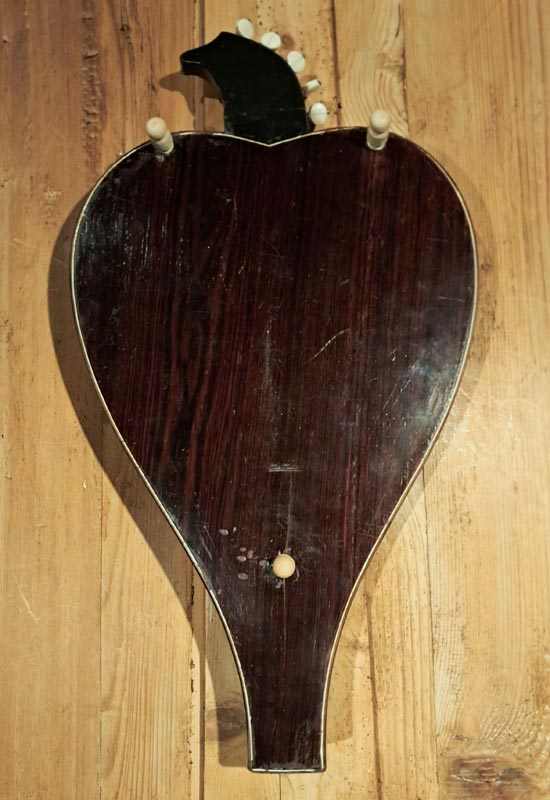
The first invention appeared in 1823 courtesy of zither virtuoso Johann Petzmayer of Munich. It was a roughly heart-shaped instrument of simple flat construction and three strings. He soon increased it to four strings, which became standard on nearly all forms of bowed zither. Like all such instruments, they were fretted like zithers, and would be tuned nominally like a violin, but backwards – e’’ a’ d’ g – which is the traditional tuning of the common Alpine zither fretboard’s melody strings. (Viola tuning in C was another option.) Bowing them is awkward for many of us. The instrument lays flat on a table, fingered from above as in the Alpine zither which puts the right hand’s bow at an improbable angle.
Thus, you’ve got to figure out a decent bowing position (tip of bow away from you or towards you to the left; the latter seems to be traditional), then put the left hand at an awkward angle.
no data

Reviews
There are no reviews yet.