Rubab - Kashgar rubab (primo)
| Dimensions | 580 × 170 × 105 mm |
|---|---|
| Name of musical instrument | |
| Type of musical instrument | |
| Typical place of occurrence | |
| Date of manufature of instrument | |
| Place of manufacture | |
| Made by | |
| Restored by | |
| Scale | |
| Number of strings | |
| How to play musical instrument | |
| Continent | |
| Country |
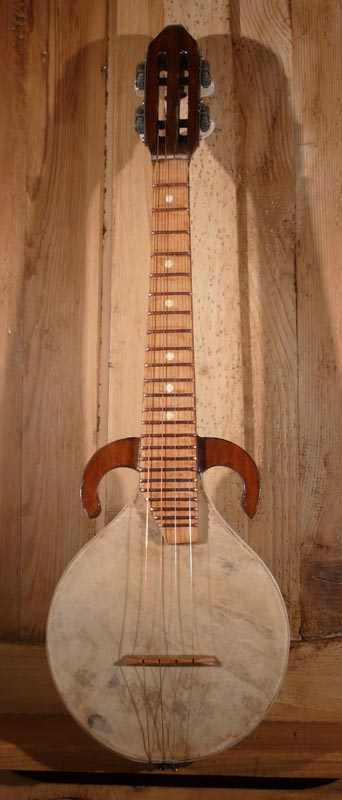
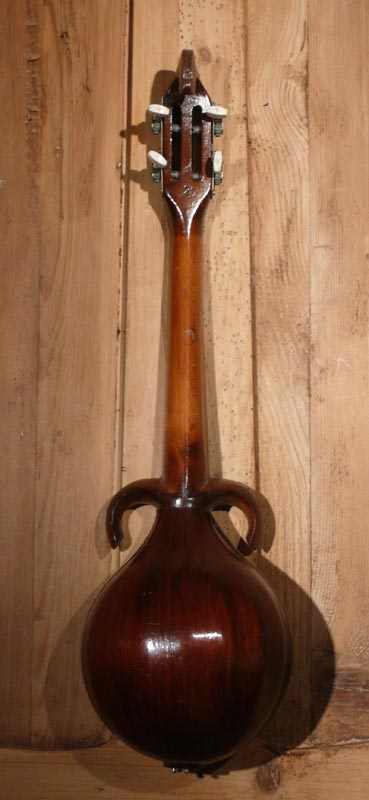
The Kashgar rubab which is mainly used in West China (by the Uyghurs) has a factory-made relation in Uzbekistan. During the Soviet period many folk instruments were changed to a more Western style instrument (so they could be used to play “proper”, written music), by adding fixed frets, and machine tuners. The instruments usually were made in different sizes, like primo, soprano, alto, tenor, etc.
The body of an Uzbek kashgar rubab is made from (8-10) separate strips glued together, with on the front a thick hide (probably fish skin), glued around the edge with a strip of black leather. The neck and peghead are carved from one piece of wood, with two “wings” carved on the lower end, and a small backward curve under the tuning head.
The neck has a raised fretboard, with metal (copper) strips as frets. The peghead is slotted with guitar-style tuners, on both sides. The 4 or 5 metal strings run over a large loose wooden bridge on the skin front, to separate pins on the edge of the body.
The instrument is not as much decorated as the kashgar rubab of the Uyghurs. It is varnished, with the neck in a lighter colour (typical for Uzbek instruments).
https://www.atlasofpluckedinstruments.com/central_asia.htm#uzbekistan