Skip to main content Scroll Top
Instruments from all over the world!

Pipa

Add to favorites
Added to Cart View Cart Checkout
Added to Wishlist View Wishlist
Removed from Wishlist
Information
Dimensions 1020 × 315 × 117 mm
Name of musical instrument

Type of musical instrument

Typical place of occurrence

Date of manufature of instrument

Place of manufacture

Made by

Restored by

Scale

Number of strings

How to play musical instrument

Continent

Country

Sharing:
Categories:
Labels:

Pipa

Information
Dimensions 1020 × 315 × 117 mm
Name of musical instrument

Type of musical instrument

Typical place of occurrence

Date of manufature of instrument

Place of manufacture

Made by

Restored by

Scale

Number of strings

How to play musical instrument

Continent

Country

Sharing:
Categories:
Labels:

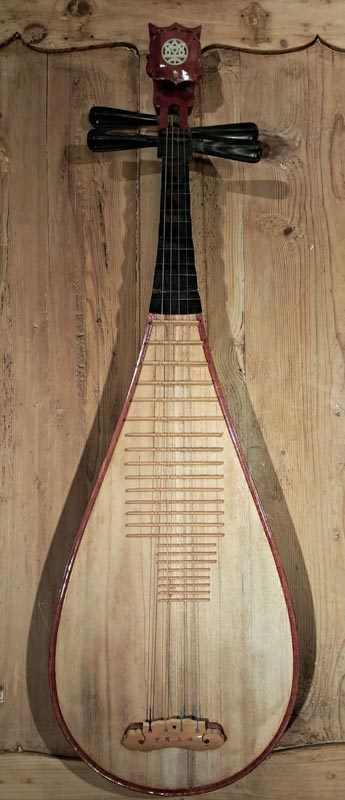
The pipa, pípá, or p’i-p’a (Chinese: 琵琶) is a traditional Chinese musical instrument belonging to the plucked category of instruments. Sometimes called the “Chinese lute”, the instrument has a pear-shaped wooden body with a varying number of frets ranging from 12 to 31. Another Chinese four-string plucked lute is the liuqin, which looks like a smaller version of the pipa. The pear-shaped instrument may have existed in China as early as the Han dynasty, and although historically the term pipa was once used to refer to a variety of plucked chordophones, its usage since the Song dynasty refers exclusively to the pear-shaped instrument.

The pipa is one of the most popular Chinese instruments and has been played for almost two thousand years in China. Several related instruments are derived from the pipa, including the Japanese biwa and Korean bipa in East Asia, and the Vietnamese đàn tỳ bà in Southeast Asia. The Korean instrument is the only one of the three that is no longer widely used.

History

There are some confusions and disagreements about the origin of pipa. This may be due to the fact that the word pipa was used in ancient texts to describe a variety of plucked chordophones of the period from the Qin to the Tang dynasty, including the long-necked spiked lute and the short-necked lute, as well as the differing accounts given in these ancient texts. Traditional Chinese narrative prefers the story of the Han Chinese Princess Liu Xijun sent to marry a barbarian Wusun king during the Han dynasty, with the pipa being invented so she could play music on horseback to soothe her longings. Modern researchers such as Laurence Picken, Shigeo Kishibe, and John Myers suggested a non-Chinese origin.

The earliest mention of pipa in Chinese texts appeared late in the Han dynasty around the 2nd century AD. According to Liu Xi’s Eastern Han dynasty Dictionary of Names, the word pipa may have an onomatopoeic origin (the word being similar to the sounds the instrument makes), although modern scholarship suggests a possible derivation from the Persian word “barbat”, the two theories however are not necessarily mutually exclusive. Liu Xi also stated that the instrument called pipa, though written differently (枇杷; pípá or 批把; pībǎ) in the earliest texts, originated from amongst the Hu people (a general term for non-Han people living to the north and west of ancient China). Another Han dynasty text, Fengsu Tongyi, also indicates that, at that time, pipa was a recent arrival, although later 3rd-century texts from the Jin dynasty suggest that pipa existed in China as early as the Qin dynasty (221–206 BC). An instrument called xiantao (弦鼗), made by stretching strings over a small drum with handle, was said to have been played by labourers who constructed the Great Wall of China during the late Qin dynasty. This may have given rise to the Qin pipa, an instrument with a straight neck and a round sound box, and evolved into ruan, an instrument named after Ruan Xian, one of the Seven Sages of the Bamboo Grove and known for playing similar instrument. Yet another term used in ancient text was Qinhanzi (秦漢子), perhaps similar to Qin pipa with a straight neck and a round body, but modern opinions differ on its precise form.

The pear-shaped pipa is likely to have been introduced to China from Central Asia, Gandhara, and/or India. As people traveled along the Silk Road, the “oval” or oval-shaped pipa traveled through Central Asia and was introduced to China, where it became known as the “pipa.” Pear-shaped lutes have been depicted in Kusana sculptures from the 1st century AD. The pear-shaped pipa may have been introduced during the Han dynasty and was referred to as Han pipa. However, depictions of the pear-shaped pipas in China only appeared after the Han dynasty during the Jin dynasty in the late 4th to early 5th century. Pipa acquired a number of Chinese symbolisms during the Han dynasty – the instrument length of three feet five inches represents the three realms (heaven, earth, and man) and the five elements, while the four strings represent the four seasons.

Depictions of the pear-shaped pipas appeared in abundance from the Southern and Northern dynasties onwards, and pipas from this time to the Tang dynasty were given various names, such as Hu pipa (胡琵琶), bent-neck pipa (曲項琵琶, quxiang pipa), some of these terms however may refer to the same pipa. Apart from the four-stringed pipa, other pear-shaped instruments introduced include the five-stringed, straight-necked, wuxian pipa (五弦琵琶, also known as Kuchean pipa (龜茲琵琶)), a six-stringed version, as well as the two-stringed hulei (忽雷). From the 3rd century onwards, through the Sui and Tang dynasty, the pear-shaped pipas became increasingly popular in China. By the Song dynasty, the word pipa was used to refer exclusively to the four-stringed pear-shaped instrument.

The pipa reached a height of popularity during the Tang dynasty, and was a principal musical instrument in the imperial court. It may be played as a solo instrument or as part of the imperial orchestra for use in productions such as daqu (大曲, grand suites), an elaborate music and dance performance. During this time, Persian and Kuchan performers and teachers were in demand in the capital, Chang’an (which had a large Persian community). Some delicately carved pipas with beautiful inlaid patterns date from this period, with particularly fine examples preserved in the Shosoin Museum in Japan. It had close association with Buddhism and often appeared in mural and sculptural representations of musicians in Buddhist contexts. One of the Buddhist Four Heavenly Kings, the Eastern Dhṛtarāṣṭra, is often depicted with a pipa. Additionally, masses of pipa-playing Buddhist semi-deities are depicted in the wall paintings of the Mogao Caves near Dunhuang. The four and five-stringed pipas were especially popular during the Tang dynasty, and these instruments were introduced into Japan during the Tang dynasty as well as into other regions such as Korea and Vietnam. The five-stringed pipa however had fallen from use by the Song dynasty, although attempts have been made to revive this instrument in the early 21st century with a modernized five-string pipa modeled on the Tang dynasty instrument.

During the Song dynasty, pipa fell from favour at the imperial court, perhaps a result of the influence of neo-Confucian nativism as pipa had foreign associations. However, it continued to be played as a folk instrument that also gained the interest of the literati. The pipa underwent a number of changes over the centuries.

By the Ming dynasty, fingers replaced plectrum as the popular technique for playing pipa, although finger-playing techniques existed as early as Tang. Extra frets were added; the early instrument had 4 frets (相, xiāng) on the neck, but during the early Ming dynasty extra bamboo frets (品, pǐn) were affixed onto the soundboard, increasing the number of frets to around 10 and therefore the range of the instrument. The short neck of the Tang pipa also became more elongated.

In the subsequent periods, the number of frets gradually increased, from around 10 to 14 or 16 during the Qing dynasty, then to 19, 24, 29, and 30 in the 20th century. The 4 wedge-shaped frets on the neck became 6 during the 20th century. The 14- or 16-fret pipa had frets arranged in approximately equivalent to the western tone and semitone, starting at the nut, the intervals were T-S-S-S-T-S-S-S-T-T-3/4-3/4-T-T-3/4-3/4. (T=whlole tone; S=half tone) Some frets produced a 3/4 tone or “neutral tone”. In the 1920s and 1930s, the number of frets was increased to 24, based on the 12 tone equal temperament scale, with all the intervals being semitones. The traditional 16-fret pipa became less common, although it is still used in some regional styles such as the pipa in the southern genre of nanguan/nanyin. The horizontal playing position became the vertical (or near-vertical) position by the Qing dynasty, although in some regional genres such as nanguan the pipa is still held guitar fashion.

During the 1950s, the use of metal strings in place of the traditional silk ones also resulted in a change in the sound of the pipa which became brighter and stronger.

Playing and performance

The name “pipa” is made up of two Chinese syllables, “pí” (琵) and “pá” (琶). These, according to the Han dynasty text by Liu Xi, refer to the way the instrument is played – “pí” is to strike outward with the right hand, and “pá” is to pluck inward towards the palm of the hand.[6] The strings were played using a large plectrum in the Tang dynasty, a technique still used now for the Japanese biwa. It has however been suggested that the long plectrum depicted in ancient paintings may have been used as a friction stick like a bow. The plectrum has now been largely replaced by the fingernails of the right hand. The most basic technique, tantiao (彈挑), involves just the index finger and thumb (tan is striking with the index finger, tiao with the thumb). The fingers normally strike the strings of pipa in the opposite direction to the way a guitar is usually played, i.e. the fingers and thumb flick outward, unlike the guitar where the fingers and thumb normally pluck inward towards the palm of the hand. Plucking in the opposite direction to tan and tiao are called mo (抹) and gou (勾) respectively. When two strings are plucked at the same time with the index finger and thumb (i.e. the finger and thumb separate in one action), it is called fen (分), the reverse motion is called zhi (摭). A rapid strum is called sao (掃), and strumming in the reverse direction is called fu (拂). A distinctive sound of pipa is the tremolo produced by the lunzhi (輪指) technique which involves all the fingers and thumb of the right hand. It is however possible to produce the tremolo with just one or more fingers.

The left hand techniques are important for the expressiveness of pipa music. Techniques that produce vibrato, portamento, glissando, pizzicato, harmonics or artificial harmonics found in violin or guitar are also found in pipa. String-bending for example may be used to produce a glissando or portamento. Note however that the frets on all Chinese lutes are high so that the fingers and strings never touch the fingerboard in between the frets, this is different from many Western fretted instruments and allows for dramatic vibrato and other pitch changing effects.

In addition, there are a number of techniques that produce sound effects rather than musical notes, for example, striking the board of the pipa for a percussive sound, or strings-twisting while playing that produces a cymbal-like effect.

The strings are usually tuned to A2 D3 E3 A3 , although there are various other ways of tuning. Since the revolutions in Chinese instrument-making during the 20th century, the softer twisted silk strings of earlier times have been exchanged for nylon-wound steel strings, which are far too strong for human fingernails, so false nails are now used, constructed of plastic or tortoise-shell, and affixed to the fingertips with the player’s choice of elastic tape. However, false nails made of horn existed as early as the Ming period when finger-picking became the popular technique for playing pipa.

The pipa is held in a vertical or near-vertical position during performance, although in the early periods the instrument was held in the horizontal position or near-horizontal with the neck pointing slightly downwards, or upside down. Starting about the 10th century, players began to hold the instrument “more upright”, as the fingernail style became more important. Through time, the neck was raised and by the Qing dynasty the instrument was mostly played upright.

https://en.wikipedia.org/wiki/Pipa

no data

Reviews

There are no reviews yet.

Add a review

For security, use of CloudFlare's Turnstile service is required which is subject to the CloudFlare Privacy Policy and Terms of Use.

You might also be interested in this

Privacy Preferences
When you visit our website, it may store information through your browser from specific services, usually in form of cookies. Here you can change your privacy preferences. Please note that blocking some types of cookies may impact your experience on our website and the services we offer.