Kalimba
| Dimensions | 192 × 128 × 55 mm |
|---|---|
| Name of musical instrument | |
| Type of musical instrument | |
| Typical place of occurrence | |
| Date of manufature of instrument | |
| Place of manufacture | |
| Made by | |
| Restored by | |
| Scale (length of lamellae) | 34-63 |
| Number of strings (number of slats) | 17 |
| How to play musical instrument | |
| Continent | |
| Country |
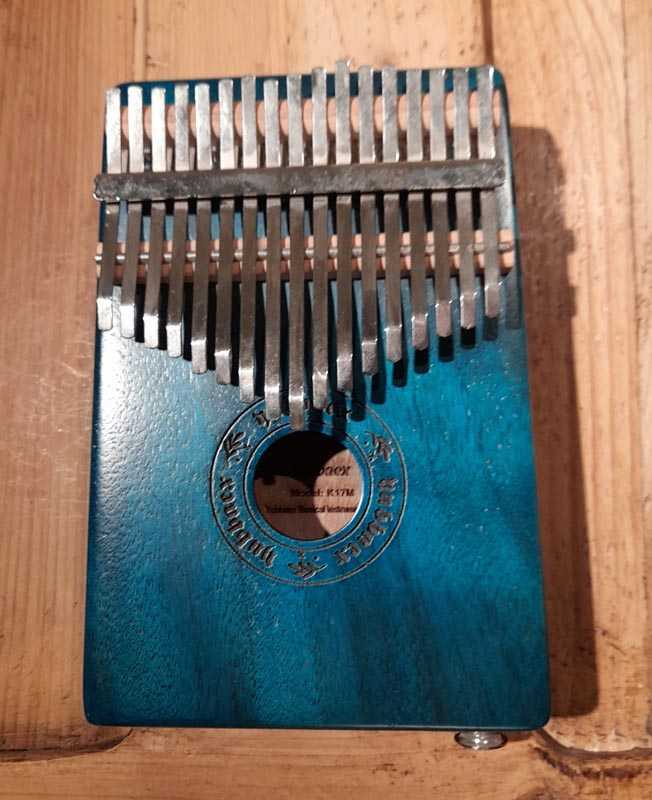
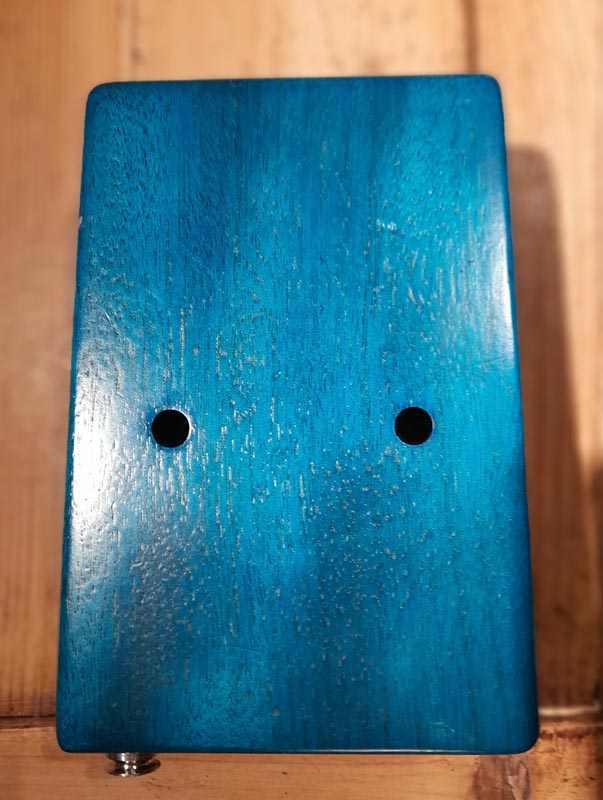
The kalimba or mbira, is an idiophone of African origin, including the lamellophone. It is played by holding it in the hand (often with the thumb). The body or resonator is usually made of wood. It is usually hollow, but can also be solid, sometimes carved into the shape of a man or other figure for cultic reasons. Metal or wooden reeds (lamellae) of different lengths are fitted in rows on the upper flat. The height of the sound is determined by the length of the tongues. Longer ones (deeper pitched) are placed in the middle, and as you move towards the edge, shorter ones (higher pitched) are placed alternately to the right and left. These are plucked, the vibration amplified by the sound box. In African varieties, seeds or pebbles are sometimes placed in the body. To increase the volume, they are usually fixed in a gourd cut in half. Standardisation began in the 1950s.
Other names: mbila, mbira, marimba, karimba, karimbao, likembe, okeme, nhare, matepe, njari, sansu, zanzu, ubo, limba. Larger versions are the African-American changüí or marimba.