



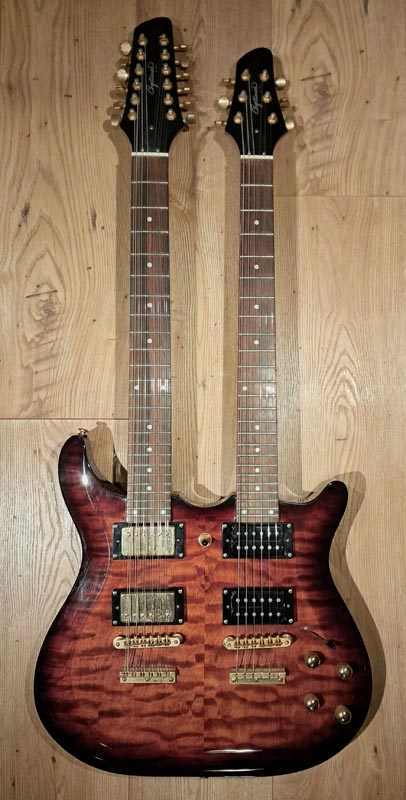
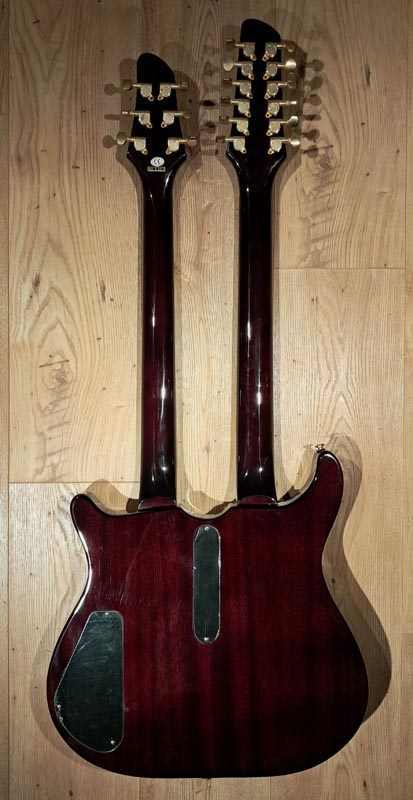
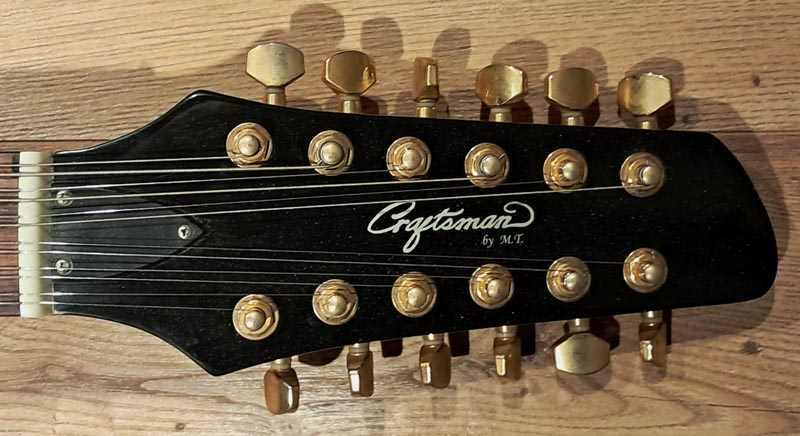
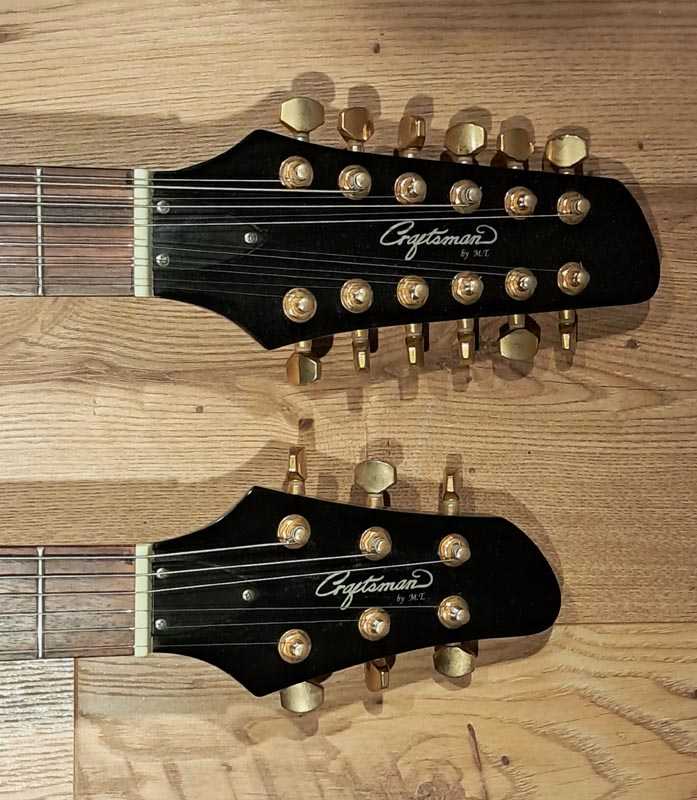


Guitar - Craftsman - Tibor Medgyesi – Józsefváros – Budapest
| Dimensions | 1030 × 441 × 55 mm |
|---|---|
| Name of musical instrument | Guitar – Craftsman – Tibor Medgyesi – Józsefváros – Budapest |
| Type of musical instrument | |
| Typical place of occurrence | |
| Date of manufature of instrument | |
| Place of manufacture | |
| Made by | |
| Restored by | |
| Scale | |
| Number of strings | |
| How to play musical instrument | |
| Continent | |
| Country |
The guitar is a stringed musical instrument that is usually fretted (with some exceptions) and typically has six or twelve strings. It is usually held flat against the player’s body and played by strumming or plucking the strings with the dominant hand, while simultaneously pressing selected strings against frets with the fingers of the opposite hand. A guitar pick may also be used to strike the strings. The sound of the guitar is projected either acoustically, by means of a resonant hollow chamber on the guitar, or amplified by an electronic pickup and an amplifier.
The guitar is classified as a chordophone, meaning the sound is produced by a vibrating string stretched between two fixed points. Historically, a guitar was constructed from wood, with its strings made of catgut. Steel guitar strings were introduced near the end of the nineteenth century in the United States, but nylon and steel strings became mainstream only following World War II. The guitar’s ancestors include the gittern, the vihuela, the four-course Renaissance guitar, and the five-course baroque guitar, all of which contributed to the development of the modern six-string instrument.
There are three main types of modern guitar: the classical guitar (Spanish guitar); the steel-string acoustic guitar or electric guitar; and the Hawaiian guitar (played across the player’s lap). Traditional acoustic guitars include the flat top guitar (typically with a large sound hole) or the archtop guitar, which is sometimes called a “jazz guitar”. The tone of an acoustic guitar is produced by the strings’ vibration, amplified by the hollow body of the guitar, which acts as a resonating chamber. The classical Spanish guitar is often played as a solo instrument using a comprehensive fingerstyle technique where each string is plucked individually by the player’s fingers, as opposed to being strummed. The term “finger-picking” can also refer to a specific tradition of folk, blues, bluegrass, and country guitar playing in the United States.
Electric guitars, first patented in 1937, use a pickup and amplifier that made the instrument loud enough to be heard, but also enabled manufacturing guitars with a solid block of wood needing a resonant chamber. A wide array of electronic effects units became possible including reverb and distortion (or “overdrive”). Solid-body guitars began to dominate the guitar market during the 1960s and 1970s; they are less prone to unwanted acoustic feedback. As with acoustic guitars, there are a number of types of electric guitars, including hollowbody guitars, archtop guitars (used in jazz guitar, blues and rockabilly) and solid-body guitars, which are widely used in rock music.
The loud, amplified sound and sonic power of the electric guitar played through a guitar amp have played a key role in the development of blues and rock music, both as an accompaniment instrument (playing riffs and chords) and performing guitar solos, and in many rock subgenres, notably heavy metal music and punk rock. The electric guitar has had a major influence on popular culture. The guitar is used in a wide variety of musical genres worldwide. It is recognized as a primary instrument in genres such as blues, bluegrass, country, flamenco, folk, jazz, jota, ska, mariachi, metal, punk, funk, reggae, rock, grunge, soul, acoustic music, disco, new wave, new age, contemporary music, and pop, occasionally used as a sample in hip-hop, dubstep, or trap music.
History
The modern word guitar and its antecedents have been applied to a wide variety of chordophones since classical times, sometimes causing confusion. The English word guitar, the German Gitarre, and the French guitare were all adopted from the Spanish guitarra, which comes from the Andalusian Arabic قيثارة (qīthārah) and the Latin cithara, which in turn came from the Ancient Greek κιθάρα which is of uncertain ultimate origin. Kithara appears in the Bible four times (1 Cor. 14:7, Rev. 5:8, 14:2, and 15:2), and is usually translated into English as harp.
The origins of the modern guitar are not known.[8] Before the development of the electric guitar and the use of synthetic materials, a guitar was defined as being an instrument having “a long, fretted neck, flat wooden soundboard, ribs, and a flat back, most often with incurved sides.” The term is used to refer to a number of chordophones that were developed and used across Europe, beginning in the 12th century and, later, in the Americas. A 3,300-year-old stone carving of a Hittite bard playing a stringed instrument is the oldest iconographic representation of a chordophone, and clay plaques from Babylonia show people playing a lute-like instrument which is similar to the guitar.
Several scholars cite varying influences as antecedents to the modern guitar. Although the development of the earliest “guitar” is lost to the history of medieval Spain, two instruments are commonly claimed as influential predecessors: the four-string oud and its precursor, the European lute; the former was brought to Iberia by the Moors in the 8th century. It has often been assumed that the guitar is a development of the lute, or of the ancient Greek kithara. However, many scholars consider the lute an offshoot or separate line of development which did not influence the evolution of the guitar in any significant way.
At least two instruments called “guitars” were in use in Spain by 1200: the guitarra latina (Latin guitar) and the so-called guitarra morisca (Moorish guitar). The guitarra morisca had a rounded back, a wide fingerboard, and several sound holes. The guitarra Latina had a single sound hole and a narrower neck. By the 14th century the qualifiers “moresca” or “morisca” and “latina” had been dropped, and these two chordophones were simply referred to as guitars.
The Spanish vihuela, called in Italian the viola da mano, a guitar-like instrument of the 15th and 16th centuries, is widely considered to have been the single most important influence in the development of the baroque guitar. It had six courses (usually), lute-like tuning in fourths and a guitar-like body, although early representations reveal an instrument with a sharply cut waist. It was also larger than the contemporary four-course guitars. By the 16th century, the vihuela’s construction had more in common with the modern guitar, with its curved one-piece ribs, than with the viols, and more like a larger version of the contemporary four-course guitars. The vihuela enjoyed only a relatively short period of popularity in Spain and Italy during an era dominated elsewhere in Europe by the lute; the last surviving published music for the instrument appeared in 1576.
Meanwhile, the five-course baroque guitar, which was documented in Spain from the middle of the 16th century, enjoyed popularity, especially in Spain, Italy and France from the late 16th century to the mid-18th century. In Portugal, the word viola referred to the guitar, as guitarra meant the “Portuguese guitar”, a variety of cittern.
There were many different plucked instruments that were being invented and used in Europe during the Middle Ages. By the 16th century, most of the forms of guitar had fallen off, to never be seen again. However, midway through the 16th century, the five-course guitar was established. It was not a straightforward process. There were two types of five-course guitars, differing in the location of the major third and in the interval pattern. The fifth course can be inferred because the instrument was known to play more than the sixteen notes possible with four. The guitar’s strings were tuned in unison, so, in other words, it was tuned by placing a finger on the second fret of the thinnest string and tuning the guitar bottom to top. The strings were a whole octave apart from one another, which is the reason for the different method of tuning. Because it was so different, there was major controversy as to who created the five course guitar. A literary source, Lope de Vega’s Dorotea, gives the credit to the poet and musician Vicente Espinel. This claim was also repeated by Nicolas Doizi de Velasco in 1640, however this claim has been contested by others who state that Espinel’s birth year (1550) make it impossible for him to be responsible for the tradition. He believed that the tuning was the reason the instrument became known as the Spanish guitar in Italy. Even later, in the same century, Gaspar Sanz wrote that other nations such as Italy or France added to the Spanish guitar. All of these nations even imitated the five-course guitar by “recreating” their own.
Finally, c. 1850, the form and structure of the modern guitar were developed by different Spanish makers such as Manuel de Soto y Solares and, perhaps the most important of all guitar makers, Antonio Torres Jurado, who increased the size of the guitar body, altered its proportions, and invented the breakthrough fan-braced pattern. Bracing, the internal pattern of wood reinforcements used to secure the guitar’s top and back and prevent the instrument from collapsing under tension, is an important factor in how the guitar sounds. Torres’ design greatly improved the volume, tone, and projection of the instrument, and it has remained essentially unchanged since.
Types
Guitars are often divided into two broad categories: acoustic and electric guitars. Within each category, there are further sub-categories that are nearly endless in quantity and are always evolving. For example, an electric guitar can be purchased in a six-string model (the most common model) or in seven- or twelve-string formats. An instruments overall design, internal construction and components, wood type or species, hardware and electronic appointments all add to the abundant nature of sub-categories and its unique tonal & functional property.
Acoustic
Acoustic guitars form several notable subcategories within the acoustic guitar group: classical and flamenco guitars; steel-string guitars, which include the flat-topped, or “folk”, guitar; twelve-string guitars; and the arched-top guitar. The acoustic guitar group also includes unamplified guitars designed to play in different registers, such as the acoustic bass guitar, which has a similar tuning to that of the electric bass guitar.
Renaissance and Baroque
Renaissance and Baroque guitars are the ancestors of the modern classical and flamenco guitar. They are substantially smaller, more delicate in construction, and generate less volume. The strings are paired in courses as in a modern 12-string guitar, but they only have four or five courses of strings rather than six single strings normally used now. They were more often used as rhythm instruments in ensembles than as solo instruments, and can often be seen in that role in early music performances. (Gaspar Sanz’s Instrucción de Música sobre la Guitarra Española of 1674 contains his whole output for the solo guitar.) Renaissance and Baroque guitars are easily distinguished, because the Renaissance guitar is very plain and the Baroque guitar is very ornate, with ivory or wood inlays all over the neck and body, and a paper-cutout inverted “wedding cake” inside the hole.
Classical
Classical guitars, also known as “Spanish” guitars, are typically strung with nylon strings, plucked with the fingers, played in a seated position and are used to play a diversity of musical styles including classical music. The classical guitar’s wide, flat neck allows the musician to play scales, arpeggios, and certain chord forms more easily and with less adjacent string interference than on other styles of guitar. Flamenco guitars are very similar in construction, but they are associated with a more percussive tone. In Portugal, the same instrument is often used with steel strings particularly in its role within fado music. The guitar is called viola, or violão in Brazil, where it is often used with an extra seventh string by choro musicians to provide extra bass support.
In Mexico, the popular mariachi band includes a range of guitars, from the small requinto to the guitarrón, a guitar larger than a cello, which is tuned in the bass register. In Colombia, the traditional quartet includes a range of instruments too, from the small bandola (sometimes known as the Deleuze-Guattari, for use when traveling or in confined rooms or spaces), to the slightly larger tiple, to the full-sized classical guitar. The requinto also appears in other Latin-American countries as a complementary member of the guitar family, with its smaller size and scale, permitting more projection for the playing of single-lined melodies. Modern dimensions of the classical instrument were established by the Spaniard Antonio de Torres Jurado (1817–1892).
Flat-top
Flat-top guitars with steel strings are similar to the classical guitar, however, the flat-top body size is usually significantly larger than a classical guitar, and has a narrower, reinforced neck and stronger structural design. The robust X-bracing typical of flat-top guitars was developed in the 1840s by German-American luthiers, of whom Christian Friedrich “C. F.” Martin is the best known. Originally used on gut-strung instruments, the strength of the system allowed the later guitars to withstand the additional tension of steel strings. Steel strings produce a brighter tone and a louder sound. The acoustic guitar is used in many kinds of music including folk, country, bluegrass, pop, jazz, and blues. Many variations are possible from the roughly classical-sized OO and Parlour to the large Dreadnought (the most commonly available type) and Jumbo. Ovation makes a modern variation, with a rounded back/side assembly molded from artificial materials.
Archtop
Archtop guitars are steel-string instruments in which the top (and often the back) of the instrument are carved from a solid billet, into a curved, rather than flat, shape. This violin-like construction is usually credited to the American Orville Gibson. Lloyd Loar of the Gibson Mandolin-Guitar Mfg. Co introduced the violin-inspired F-shaped hole design now usually associated with archtop guitars, after designing a style of mandolin of the same type. The typical archtop guitar has a large, deep, hollow body whose form is much like that of a mandolin or a violin-family instrument. Nowadays, most archtops are equipped with magnetic pickups, and they are therefore both acoustic and electric. F-hole archtop guitars were immediately adopted, upon their release, by both jazz and country musicians, and have remained particularly popular in jazz music, usually with flatwound strings.
Resonator, resophonic or Dobros
All three principal types of resonator guitars were invented by the Slovak-American John Dopyera (1893–1988) for the National and Dobro (Dopyera Brothers) companies. Similar to the flat top guitar in appearance, but with a body that may be made of brass, nickel-silver, or steel as well as wood, the sound of the resonator guitar is produced by one or more aluminum resonator cones mounted in the middle of the top. The physical principle of the guitar is therefore similar to the loudspeaker.
The original purpose of the resonator was to produce a very loud sound; this purpose has been largely superseded by electrical amplification, but the resonator guitar is still played because of its distinctive tone. Resonator guitars may have either one or three resonator cones. The method of transmitting sound resonance to the cone is either a “biscuit” bridge, made of a small piece of hardwood at the vertex of the cone (Nationals), or a “spider” bridge, made of metal and mounted around the rim of the (inverted) cone (Dobros). Three-cone resonators always use a specialized metal bridge. The type of resonator guitar with a neck with a square cross-section—called “square neck” or “Hawaiian”—is usually played face up, on the lap of the seated player, and often with a metal or glass slide. The round neck resonator guitars are normally played in the same fashion as other guitars, although slides are also often used, especially in blues.
Steel guitar
A steel guitar is any guitar played while moving a polished steel bar or similar hard object against plucked strings. The bar itself is called a “steel” and is the source of the name “steel guitar”. The instrument differs from a conventional guitar in that it does not use frets; conceptually, it is somewhat akin to playing a guitar with one finger (the bar). Known for its portamento capabilities, gliding smoothly over every pitch between notes, the instrument can produce a sinuous crying sound and deep vibrato emulating the human singing voice. Typically, the strings are plucked (not strummed) by the fingers of the dominant hand, while the steel tone bar is pressed lightly against the strings and moved by the opposite hand. The instrument is played while sitting, placed horizontally across the player’s knees or otherwise supported. The horizontal playing style is called “Hawaiian style”.
Twelve-string
The twelve-string guitar usually has steel strings, and it is widely used in folk music, blues, and rock and roll. Rather than having only six strings, the 12-string guitar has six courses made up of two strings each, like a mandolin or lute. The highest two courses are tuned in unison, while the others are tuned in octaves. The 12-string guitar is also made in electric forms. The chime-like sound of the 12-string electric guitar was the basis of jangle pop.
Acoustic bass
The acoustic bass guitar is a bass instrument with a hollow wooden body similar to, though usually somewhat larger than, that of a six-string acoustic guitar. Like the traditional electric bass guitar and the double bass, the acoustic bass guitar commonly has four strings, which are normally tuned E-A-D-G, an octave below the lowest four strings of the six-string guitar, which is the same tuning pitch as an electric bass guitar. It can, more rarely, be found with five or six strings, which provides a wider range of notes to be played with less movement up and down the neck.
Electric
Electric guitars can have solid, semi-hollow, or hollow bodies; solid bodies produce little sound without amplification. In contrast to a standard acoustic guitar, electric guitars instead rely on electromagnetic pickups, and sometimes piezoelectric pickups, that convert the vibration of the steel strings into signals, which are fed to an amplifier through a patch cable or radio transmitter. The sound is frequently modified by other electronic devices (effects units) or the natural distortion of valves (vacuum tubes) or the pre-amp in the amplifier. There are two main types of magnetic pickups, single- and double-coil (or humbucker), each of which can be passive or active. The electric guitar is used extensively in jazz, blues, R & B, and rock and roll. The first successful magnetic pickup for a guitar was invented by George Beauchamp, and incorporated into the 1931 Ro-Pat-In (later Rickenbacker) “Frying Pan” lap steel; other manufacturers, notably Gibson, soon began to install pickups in archtop models. After World War II the completely solid-body electric was popularized by Gibson in collaboration with Les Paul, and independently by Leo Fender of Fender Music. The lower fretboard action (the height of the strings from the fingerboard), lighter (thinner) strings, and its electrical amplification lend the electric guitar to techniques less frequently used on acoustic guitars. These include tapping, extensive use of legato through pull-offs and hammer-ons (also known as slurs), pinch harmonics, volume swells, and use of a tremolo arm or effects pedals.
Some electric guitar models feature piezoelectric pickups, which function as transducers to provide a sound closer to that of an acoustic guitar with the flip of a switch or knob, rather than switching guitars. Those that combine piezoelectric pickups and magnetic pickups are sometimes known as hybrid guitars.
Hybrids of acoustic and electric guitars are also common. There are also more exotic varieties, such as guitars with two, three, or rarely four necks, all manner of alternate string arrangements, fretless fingerboards (used almost exclusively on bass guitars, meant to emulate the sound of a stand-up bass), 5.1 surround guitar, and such.
Seven-string and eight-string
Solid-body seven-string guitars were popularized in the 1980s and 1990s. Other artists go a step further, by using an eight-string guitar with two extra low strings. Although the most common seven-string has a low B string, Roger McGuinn (of The Byrds and Rickenbacker) uses an octave G string paired with the regular G string as on a 12-string guitar, allowing him to incorporate chiming 12-string elements in standard six-string playing. In 1982 Uli Jon Roth developed the “Sky Guitar”, with a vastly extended number of frets, which was the first guitar to venture into the upper registers of the violin. Roth’s seven-string and “Mighty Wing” guitar features a wider octave range.
Electric bass
The bass guitar (also called an “electric bass”, or simply a “bass”) is similar in appearance and construction to an electric guitar, but with a longer neck and scale length, and four to six strings. The four-string bass, by far the most common, is usually tuned the same as the double bass, which corresponds to pitches one octave lower than the four lowest pitched strings of a guitar (E, A, D, and G). The bass guitar is a transposing instrument, as it is notated in bass clef an octave higher than it sounds (as is the double bass) to avoid excessive ledger lines being required below the staff. Like the electric guitar, the bass guitar has pickups and it is plugged into an amplifier and speaker for live performances.
Tuning
Standard
In standard tuning, the C-major chord has three shapes because of the irregular major-third between the G- and B-strings.
By the 16th century, the guitar tuning of ADGBE had already been adopted in Western culture; a lower E was later added on the bottom as a sixth string. The result, known as “standard tuning”, has the strings tuned from a low E to a high E, traversing a two-octave range: EADGBE. This tuning is a series of ascending fourths (and a single major third) from low to high. The reason for ascending fourths is to accommodate four fingers on four frets up a scale before moving to the next string. This is musically convenient and physically comfortable, and it eased the transition between fingering chords and playing scales. If the tuning contained all perfect fourths, the range would be two octaves plus one semitone; the high string would be an F, a dissonant half-step from the low E and much out of place.
Alternative
Standard tuning has evolved to provide a good compromise between simple fingering for many chords and the ability to play common scales with reasonable left-hand movement. There are also a variety of commonly used alternative tunings, for example, the classes of open, regular, and dropped tunings.
Open tuning refers to a guitar tuned so that strumming the open strings produces a chord, typically a major chord. The base chord consists of at least 3 notes and may include all the strings or a subset. The tuning is named for the open chord, Open D, open G, and open A are popular tunings. All similar chords in the chromatic scale can then be played by barring a single fret. Open tunings are common in blues music and folk music, and they are used in the playing of slide and bottleneck guitars. Many musicians use open tunings when playing slide guitar.
For the standard tuning, there is exactly one interval of a major third between the second and third strings, and all the other intervals are fourths. The irregularity has a price – chords cannot be shifted around the fretboard in the standard tuning E-A-D-G-B-E, which requires four chord-shapes for the major chords. There are separate chord-forms for chords having their root note on the third, fourth, fifth, and sixth strings.
In contrast, regular tunings have equal intervals between the strings, and so they have symmetrical scales all along the fretboard. This makes it simpler to translate chords. For the regular tunings, chords may be moved diagonally around the fretboard. The diagonal movement of chords is especially simple for the regular tunings that are repetitive, in which case chords can be moved vertically: Chords can be moved three strings up (or down) in major-thirds tuning and chords can be moved two strings up (or down) in augmented-fourths tuning. Regular tunings thus appeal to new guitarists and also to jazz-guitarists, whose improvisation is simplified by regular intervals.
On the other hand, some chords are more difficult to play in a regular tuning than in standard tuning. It can be difficult to play conventional chords, especially in augmented-fourths tuning and all-fifths tuning, in which the large spacings require hand stretching. Some chords, which are conventional in folk music, are difficult to play even in all-fourths and major-thirds tunings, which do not require more hand-stretching than standard tuning.
-In major-thirds tuning, the interval between open strings is always a major third. Consequently, four frets suffice to play the chromatic scale. Chord inversion is especially simple in major-thirds tuning. Chords are inverted simply by raising one or two notes by three strings. The raised notes are played with the same finger as the original notes. In contrast, in standard tuning, the shape of inversions depends on the involvement of the irregular major-third.
-All-fourths tuning replaces the major third between the third and second strings with a fourth, extending the conventional tuning of a bass guitar. With all-fourths tuning, playing the triads is more difficult, but improvisation is simplified because chord-patterns remain constant when moved around the fretboard. Jazz guitarist Stanley Jordan uses the all-fourths tuning EADGCF. Invariant chord-shapes are an advantage of other regular tunings, such as major-thirds and all-fifths tunings.
-Extending the tunings of violins and cellos, all-fifths tuning offers an expanded range CGDAEB, which however has been impossible to implement on a conventional guitar. All-fifths tuning is used for the lowest five strings of the new standard tuning of Robert Fripp and his former students in Guitar Craft courses; new standard tuning has a high G on its last string CGDAE-G.
Another class of alternative tunings is called drop tunings, because the tuning drops down the lowest string. Dropping down the lowest string a whole tone results in the “drop-D” (or “dropped D”) tuning. Its open-string notes DADGBE (from low to high) allow for a deep bass D note, which can be used in keys such as D major, d minor and G major. It simplifies the playing of simple fifths (powerchords). Many contemporary rock bands re-tune all strings down, making, for example, Drop-C or Drop-B tunings.
Scordatura
Many scordatura (alternate tunings) modify the standard tuning of the lute, especially when playing Renaissance music repertoire originally written for that instrument. Some scordatura drop the pitch of one or more strings, giving access to new lower notes. Some scordatura makes it easier to play in unusual keys.
TIBOR MEDGYESI
As the only one in Hungary, this is the only company that is not only run as a dealer, but also as a master guitar maker by Tibor Medgyesi. It is a great acknowledgement that the guitar and bass playing community of the Hungarian music scene is almost without exception a satisfied visitor of Medgyesi Hangszercenter:
István Alapi (EDDA), Tamás Szekeres, Peta Lukács (European Mantra, Bikini), Tamás Csejtei (Black To Black), Attila László (Charlie Band), Pál Vasvári, Tóth Tibi Tóth (Hooligans), György Szappanos (Tátrai Band), Girett Gábor (Rapülők), Lattman Béla, Menyhárt János (Demjén, V Moto-rock), Sipeki Zoltán PIPI (Zorán), Gerendás Péter, Galambos Ernő (MÉZ), Piri Béla (Szörényi Örs), Román Péter, Fáklya Endre (Carmen), Szűcs Antal Gábor (Tátrai latin, Skorpió), Kovács Andor, Jung Norbert (Pokolgép, Dirty Dance), Belányi István (Perfect Name), Töpi (Vénusz, Queen Memorial Orchestra), Zsolt Benkő (György Ferenczy and Herfli Davidson) Attila Mátyás (Sex Action), Richie Gabrieli (Zero G) Zoltán Töfi Cserfalvi (Iron Maidnem) and many others are happy users of their master instruments.


Reviews
There are no reviews yet.