Charango 1.
| Dimensions | 633 × 148 × 65 mm |
|---|---|
| Name of musical instrument | |
| Type of musical instrument | |
| Typical place of occurrence | |
| Date of manufature of instrument | |
| Place of manufacture | |
| Made by | |
| Restored by | |
| Scale | |
| Number of strings | |
| How to play musical instrument | |
| Continent | |
| Country |
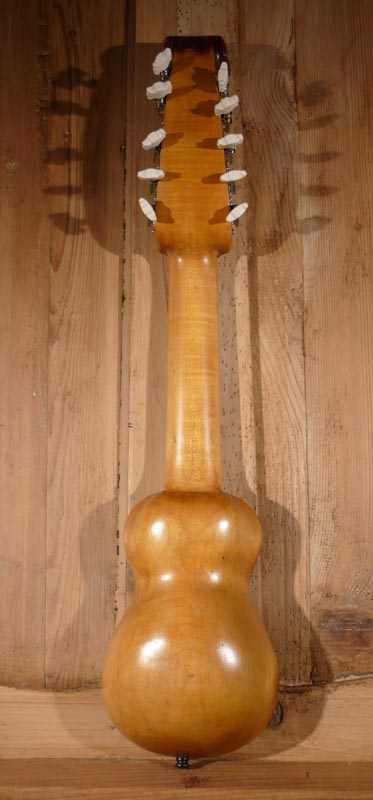
The charango is a folk instrument used mainly in the Andean regions of South America. There is a smaller, higher-pitched version, the walaycho, and a deeper, fuller version called the ronroco.
Traditionally it has a double curved, guitar-like outline, but more recently it can take many other shapes, including polygonal. The top has the thin, knotted string-fret, familiar from old guitars and lutes, with a round sound-hole above it. The rich inlaid decoration is characteristic.
The fingerboard is fretted and rises slightly above the top. Compared to the small body, the neck and the flat tuning head appear to be iron, with room for five double strings. Tuning was originally done with faders, more recently with mechanical string machines.
They can be made of many different materials and in many different shapes. In Peru, it is found with a flat back and a curved body similar to a guitar, while in Bolivia the most common type is the quirquincho, a mammal related to the tatoo, whose body is made of the bone carapace. There is also a monoxilithic body carved from a piece of wood, shaped like the curved body of the quirquincho, which is the best-sounding and most durable instrument. The most common material is a red hardwood called soto mara.
Stringing
Originally gut strings, nowadays nylon strings or fishing line are used. Metal strings are also rarely used.
Tuning: g’g’ – c “c” – e “e’ – a’a’ – e “e”
The pitch of the pairs of strings does not rise steadily from left to right, but drops at the middle string and then rises again. This gives the instrument a compact, clear sound when played rhythmically or chordally, and when playing melodies it allows a playing technique that is reminiscent of the harp, i.e. the successive notes can be floated into each other.